

When it comes to overseas traffic, the first thing to decide isn't "which platform to advertise on," but two things: whether your demand already exists in search boxes or needs to be stimulated through content; and whether your advertising environment is clean before opening accounts. The former determines which line to tilt your budget toward, the latter determines whether your account can survive the cold start.
Public domain customer acquisition generally has three lines: intent-driven active search (Google Search Ads, Performance Max, organic SEO), interest and algorithm recommendations (Meta, TikTok), and organic search content as a long-term foundation. The tool chains for these three lines share many components, but their scaling logic is completely different. Mixing them often leads to poor results on both sides.
First Determine Which Main Line You Fall Into
The criterion is simple: Will users actively search for your type of product?
- Yes: Tool-based SaaS, B2B industrial goods and accessories, standard consumables, functional products with clear category names. This demand already exists. Google Search Ads can directly capture high-intent bottom-funnel traffic, scale fastest, and provide the clearest attribution—it should be your first line.
- No: Novel small commodities, apparel and home goods, impulse consumer products that rely on visual impact and scenario-based seeding. Users don't know they need it, and there are no corresponding search terms. The main line should be on Meta and TikTok recommendation feeds, using creatives to create demand.
- In between: Products with category terms but fierce competition and low average order value. Typically, recommendation feeds handle acquisition and term creation, while search side captures brand terms and category long-tail.
During cold start, it's not advisable to run all three lines simultaneously. With diluted budget, each channel won't get enough conversion data to feed the algorithm, the model can't learn, and you'll conclude that "all three platforms don't work." A more stable approach is to run the main line until you have stable conversions, then use the second line to scale.
Google Line: Get Product Data Right Before Discussing Ad Structure
On the Google side, a common combination is Search Ads for precise intent, Performance Max (PMax) for cross-channel aggregated distribution, and Demand Gen for visual demand stimulation on YouTube, Gmail, and Display Network. The official approach is to let PMax automatically allocate impressions across channels, rather than manually splitting each placement.
For independent e-commerce sites, one prerequisite is more critical than ad structure: the standardization of Merchant Center product feeds. Whether fields like GTIN, price, product category, and availability are accurate and consistent directly determines whether products can be properly distributed to Shopping results and PMax. When feeds have widespread errors or price mismatches with landing pages, even the most refined ad structure is useless—fix the data first.
For B2B lead generation businesses, there's also a trade-off in match types on the search side. Broad match can capture long-tail but brings more noise; phrase match is more stable but lower volume. For a layered approach, refer to Should Foreign Trade Marketing Tools Use Broad Match or Phrase Match.
Meta Line: Loosen Targeting, Complete Data Feedback
Meta's direction in recent years is clear: Broad Targeting plus Advantage+ automation. Official best practices repeatedly emphasize that overly granular audience segmentation causes audience fragmentation, which actually weakens the system's learning efficiency—you think you're helping the algorithm narrow down, but you're actually limiting its ability to find people.
The real cost gap comes from the completeness of first-party data feedback: Meta Pixel handles the browser side, Conversions API (CAPI) handles the server side. Reporting from both ends simultaneously can recover conversion events lost due to browser restrictions. The more complete the data, the more accurately the system can judge "what kind of people will buy."
On this basis, using purchased customer lists and email lists to generate Lookalike audiences is a standard method to reduce acquisition costs. Note that this step depends on the quality of your real customer data. During cold start, when you don't have enough conversion samples, Lookalike has limited meaning—just run broad targeting honestly to accumulate data.
TikTok Line: Content Adaptation Matters More Than Bidding Techniques
TikTok suits products with strong visual impact, clear selling points in seconds, a touch of impulse buying, and content that can leverage community trends. If the product itself isn't camera-friendly, hard advertising won't perform well.
For placements, In-Feed Ads are the mainstay, TopReach for concentrated exposure, and e-commerce can use Smart+ Catalog automation.
One detail greatly impacts lead generation: using TikTok's native Instant Form to collect leads has a much lower drop-off rate than redirecting users to fill out a form on an independent site. Cross-border links inherently have loading speed and trust costs—try not to redirect off-platform for steps that can be completed on-platform.
Creative issues are often more fatal than ad settings. For example, repeatedly posting the same creative with a different title, or not noticing significantly lower engagement than peers. You can self-check against Is It Useful to Repost the Same Creative with a Different Title and What Engagement Rate Is Considered Low for Product Videos.
SEO: Slow to Take Effect, But It Determines Your Paid Ceiling
Organic search isn't just one channel; it's more like a foundation. Google's Search Essentials still covers the same things: clear and crawlable site architecture, accurate semantic titles and descriptions, and truly localized content for target markets rather than machine translation.
Its problem is the cycle—typically weeks to months before significant organic traffic. So the reasonable positioning is to use it to gradually dilute overall acquisition costs—ad landing pages and SEO content share the same creatives and structure. Ads handle immediate volume, content ensures you don't go to zero when you stop advertising. Teams with tight budgets should at least ensure basic standards for product pages and core category pages—this cost is very low.
Environment Sequence Before Launch: Get the Order Wrong and You Redo It
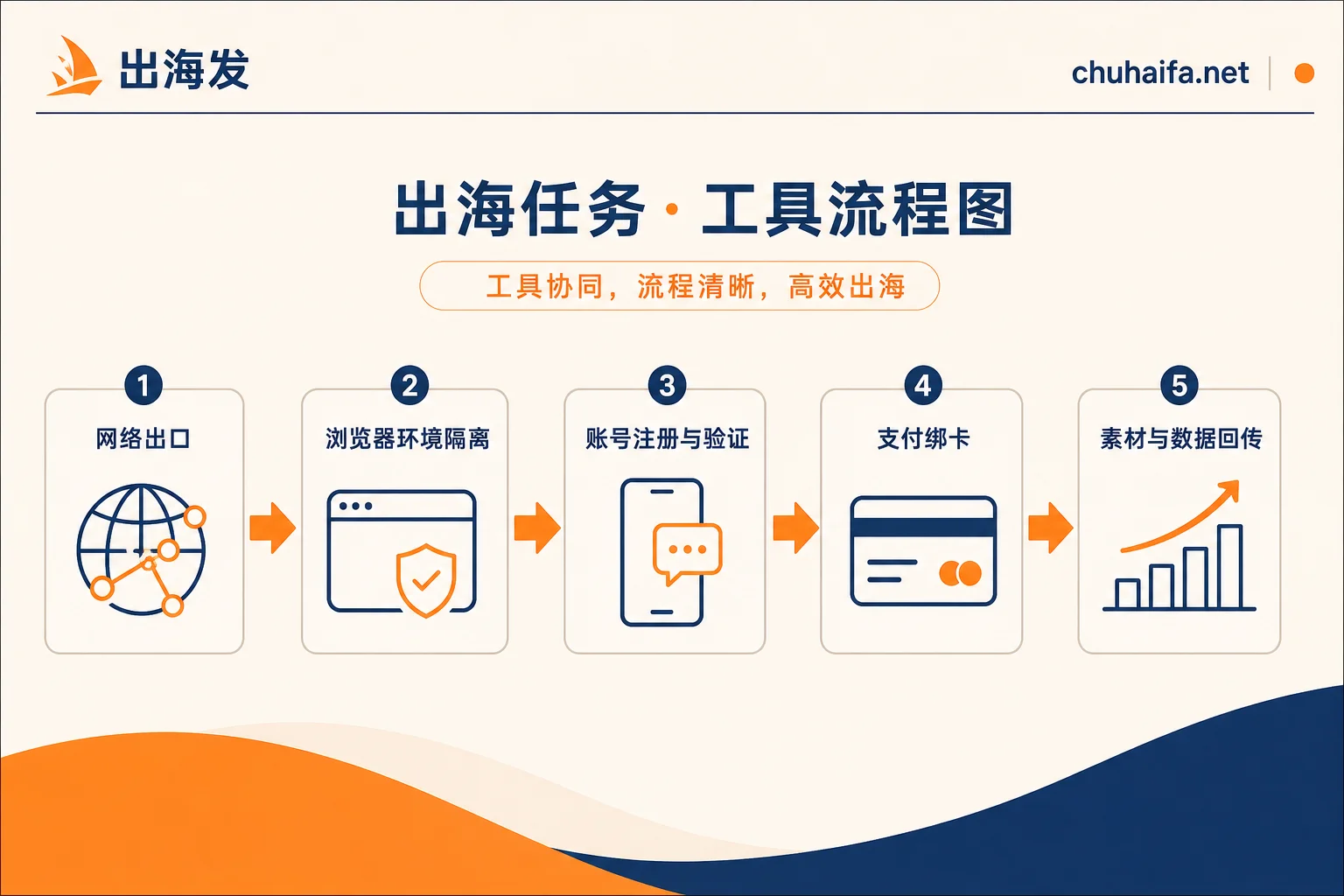
All the above is strategy. What actually stumps most teams is execution—accounts can't be opened, or get banned two days after opening, or payment cards can't be bound. This part has a clear sequence; wrong order usually means starting over:
Step 1: Define the network first. Before registering any account, decide your exit environment, including proxy type, region, and stability. A common mistake is registering accounts using whatever network is at hand, then changing IP later—the account's historical environment is already dirty. For how to match IP types to tasks, see How to Choose Overseas Proxy IPs.
Step 2: Do browser isolation. When running multiple ad accounts, stores, or social media profiles, an anti-detect browser separates each identity's browser environment, cookies, and fingerprint parameters to prevent platforms from linking them as the same group. Teams operating a single account can simplify this step, but as soon as you have a second account, you should set it up in advance.
Step 3: Register business accounts on each platform. Meta Business Manager, TikTok Ads Manager, and Google Ads all require phone number and email binding. Overseas numbers vary greatly in type and lifespan; disposable numbers cause problems during secondary verification. For number selection logic, see How to Choose Overseas SMS Verification Platforms.
Step 4: Solve payment. Ad accounts need a card that can reliably charge. Virtual cards differ significantly in issuance qualifications, channels, and decline rates. Before binding, it's advisable to go through the steps in How to Verify Compliance of Overseas Payment Tools—don't wait until launch day when a failed charge interrupts your campaign.
Step 5: Only then creatives and tracking. Multilingual copy and creative iteration can be accelerated with AI tools. On the advertising side, set up Pixel, CAPI, UTM, and attribution dashboards. This step is last because if the first four steps aren't stable, no amount of creatives will have a stable account to carry them.
Several High-Frequency Order Mistakes
- Register first, change environment later: The environment at registration is recorded; migrating later is riskier than setting it up correctly from the start.
- Multiple ad accounts sharing one exit: The most easily linked factor in bulk operations.
- Repeatedly changing conversion event settings: Frequent adjustments to feedback events or conversion definitions during cold start force the model to relearn each time.
- Machine-translating creatives directly for multilingual markets: Copy can be translated, but content formats and scenarios need to be redone per market, otherwise performance will be significantly lower than local creatives.
- Can't identify which stage volume dropped: When issues arise, first distinguish whether it's impressions, clicks, or conversions dropping. Don't just change budgets. For troubleshooting, refer to Using Social Media Data Analysis Tools to Identify Volume Drop Stages During Promo Periods.
Next, Pick Tools
After determining your main line and gaps, fill in what's missing:
- Exit network, proxies, and VPS → Overseas Network
- Multi-account environment isolation → Anti-Detect Browser
- Creative production, ad management, and attribution tracking → Ad Tools
For specific features and prices, refer to each provider's official website. Choose based on your current stage's actual tasks—you don't need to buy the entire chain at once.