

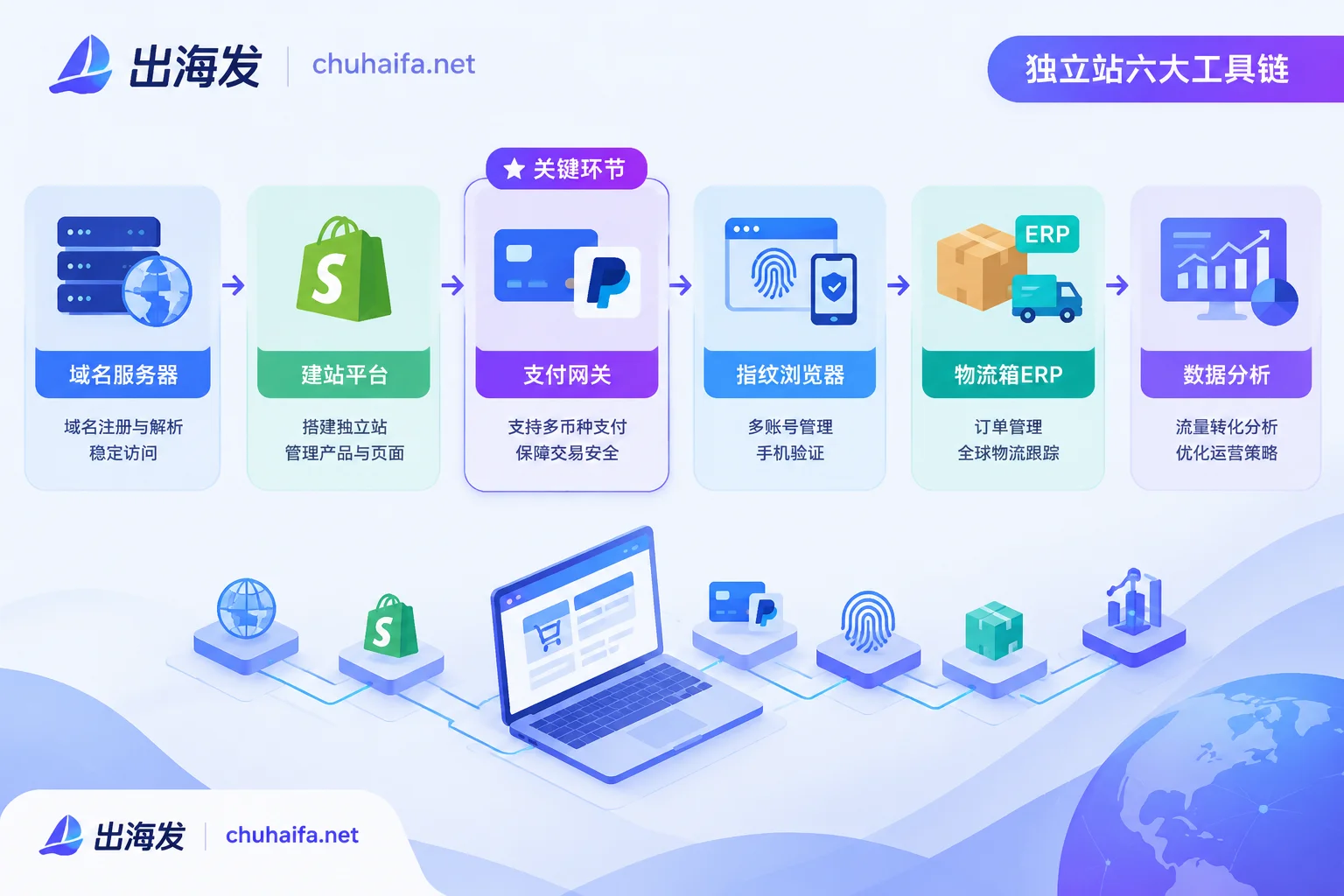
First, the overall logic: six types of tools configured by task flow
Taking a dropshipping site from zero to receiving the first overseas order involves six stages: basic environment setup, storefront launch, payment channel integration, account risk control isolation, order fulfillment management, and data tracking for conversion. Each stage corresponds to a type of tool, but it’s not a simple linear stack—the payment gateway is the key to success or failure, directly determining whether buyers can complete checkout; the entity registration location (domestic company or overseas entity) affects available payment channels and compliance thresholds; the team’s R&D capability determines whether to choose a SaaS-hosted solution or open-source self-built.
The usual configuration order is: first solve infrastructure like domain and server, then build the storefront, then connect the payment gateway (this step may require preparing an overseas entity and bank account in advance), simultaneously configure environment isolation tools to prevent account bans, then integrate the order fulfillment system, and finally embed data tracking code for later optimization.
Category 1: Network and domain infrastructure
This is the foundation of a dropshipping site, including three parts:
Top-level domain registration and DNS resolution: Need an independent overseas domain (e.g., .com, .shop), not a free subdomain or a domain requiring domestic ICP filing. Mainstream registrars include Namecheap, GoDaddy, or Cloudflare Registrar, the latter also offering free DNS resolution and CDN acceleration, suitable for sites with speed and protection requirements.
Overseas server or VPS: If choosing an open-source site builder (like WordPress + WooCommerce), you need an overseas cloud host to host the website program and database. If using a SaaS platform like Shopify, hosting is included, so this step can be skipped.
Stable overseas network environment: When later managing backends of overseas service providers like Stripe, PayPal, Shopify, frequent IP changes or using public proxies can trigger risk control. The team needs overseas network tools to stably access overseas services, including proxies, VPS, or dedicated line accelerators.
Category 2: E-commerce independent site building systems
Mainly divided into two routes:
Closed-loop hosted SaaS: Shopify, Shoplazza, BigCommerce, etc., with monthly subscriptions, the platform hosts servers, databases, security updates, and basic checkout processes. Startups usually prefer these platforms because they can go live quickly and come with app markets that directly integrate payment, logistics, email marketing plugins. Key selection criteria:
- Compatibility with mainstream payment gateways (Stripe, PayPal)
- Support for multi-language and multi-currency checkout
- Mobile adaptation and loading speed of theme templates
- Whether the app market has the logistics and ERP plugins you need
Self-hosted open-source systems: WordPress + WooCommerce, Magento, PrestaShop, etc., requiring you to rent servers, configure environments, maintain updates and security patches. Suitable for teams with R&D capabilities, needing deep customization, or concerned about platform policy changes. The cost structure shifts from monthly rent to development manpower + server costs, potentially lower long-term but with higher upfront investment.
For first-time site building, it’s recommended to start with a SaaS platform and consider migrating to a self-built system once the business stabilizes and customization needs become clear.
Category 3: Overseas payment gateways and settlement channels (core aspect)
This is crucial for whether a dropshipping site can close sales, typically requiring a combination of "credit card acquiring + e-wallets" to cover mainstream payment methods.
Credit card acquiring gateways
Shopify Payments: Shopify’s native gateway, supporting Visa/MasterCard/American Express, with the advantage of no additional transaction fees (using third-party gateways incurs an extra 0.5%-2%), and relatively lenient review. However, it’s only open to entities in specific countries; mainland China entities cannot apply.
Stripe: The most widely used third-party gateway globally, supporting 135+ currencies, with comprehensive technical documentation, suitable for teams with development capabilities. Key limitations: Requires a genuine overseas entity (US, UK, EU, Hong Kong, Singapore, etc.), local tax ID (e.g., US EIN), local bank account, and real business address. Logging in from a domestic IP or suddenly switching addresses can easily trigger account freezes and fund reviews.
Adyen, 2Checkout (now Verifone): Support applications from more country entities, but rates are usually higher than Stripe, and there are monthly transaction volume thresholds. Suitable for mid-to-large sellers with stable order volumes.
E-wallets
PayPal Express Checkout: The payment method with the highest trust among Western buyers; many prefer PayPal over directly entering credit card information. However, PayPal’s dispute and chargeback mechanism is not seller-friendly, and account freeze risk is high, requiring strict adherence to shipping timeliness and tracking upload requirements.
Localized wallets: If targeting Southeast Asia, you may need to integrate GrabPay, Touch'n Go, GCash, etc.; for Europe, Klarna, iDEAL, etc.
Settlement and fund repatriation
Foreign currencies like USD and EUR received by overseas gateways need to be settled back to domestic accounts through cross-border payment service providers. Mainstream options include:
- Airwallex: Provides virtual overseas bank accounts, can receive payments from Stripe, PayPal, etc., and supports settlement to domestic banks
- PingPong, LianLian Pay, WorldFirst: Commonly used settlement channels for cross-border e-commerce, with rates typically 0.5%-1%
Important reminder: Payment gateways are high-risk areas; when accounts are frozen, funds may be held for months. It’s advisable to integrate 2-3 gateways for redundancy, so you can quickly switch to a backup when the primary fails. If using Shopify without activating Shopify Payments, using third-party gateways incurs an additional 0.5%-2% transaction fee.
Category 4: Environment isolation and verification assistance tools
When applying for and logging into financial tools like Stripe and PayPal, the platform’s risk control system checks IP addresses, device fingerprints, browser environments, etc. If logging into a Stripe account registered in Los Angeles from an office in Beijing, or multiple accounts from the same computer, it can easily trigger account freezes.
Fingerprint browsers: Create independent browser environments for each account, isolating cookies, Canvas fingerprints, WebRTC, and other device information to prevent platforms from detecting multi-account associations. Essential when operating multiple stores or managing multiple payment gateway accounts simultaneously. You can find mainstream options in the fingerprint browser category.
Overseas SMS receiving platforms: When registering overseas payment accounts and receiving SMS verification codes and two-factor authentication (2FA), you need a real overseas phone number. Virtual number platforms allow pay-per-use code reception, but choose number types that support long-term use, as payment platforms may send security verification SMS irregularly. The overseas SMS receiving category lists mainstream platforms and number type descriptions.
Category 5: Product selection, fulfillment, and order ERP
After receiving orders on a dropshipping site, you need to connect the supply chain for procurement, order printing, and shipping.
Dropshipping plugins: If using a no-inventory model, plugins like DSers, CJ Dropshipping, Spocket can directly list products from supplier platforms (AliExpress, 1688) to your site with one click, and automatically sync orders to suppliers for fulfillment. Suitable for product testing or small-scale operations.
Cross-border e-commerce ERP: When order volumes increase, or when operating multiple platforms like dropshipping site + Amazon + Shopee, you need an ERP system to uniformly manage orders, inventory, procurement, order printing, and logistics tracking. Dianxiaomi, Mabang, Tongtool are common choices; check if they support your site-building platform and logistics channels.
Category 6: Data tracking and conversion recovery
After the site goes live, you need to track traffic sources, user behavior, and conversion funnels to optimize ad campaigns and page experience.
Google Analytics 4: A free traffic analysis tool to see visitor sources, page dwell time, bounce rate, conversion paths, etc. Need to embed tracking code in the site header; platforms like Shopify usually allow entering the GA4 ID directly in backend settings.
Meta Pixel (Facebook Pixel): If advertising on Facebook/Instagram, install Meta Pixel to track conversion events from ads (add to cart, initiate checkout, complete purchase) for ad optimization and building retargeting audiences.
Email/SMS marketing automation: On average, 70% of users who add to cart on a dropshipping site abandon at checkout. Tools like Klaviyo, Omnisend can automatically capture abandoned checkout user emails and send recovery emails (reminding of incomplete orders + limited-time discounts) to recover some lost orders.
Tool combinations by entity type
Actual configuration needs adjustment based on the company entity’s location:
Domestic entity: Cannot directly apply for Stripe and Shopify Payments; typically choose Shopify + PayPal + 2Checkout combination, or platforms friendly to domestic entities like Shoplazza. Settlement through cross-border payment providers like PingPong, LianLian.
Hong Kong/Singapore entity: Can apply for Stripe, but need to provide local bank account (e.g., HSBC Hong Kong or DBS Singapore) and proof of real office address. When managing accounts, use local IP environment to avoid direct login from mainland China.
US/UK entity: Can use Shopify Payments and Stripe, with optimal rates and relatively lenient review. But need to provide EIN (US Employer Identification Number) or UK company registration number, local bank account, and real business address.
Final reminder
The toolchain for a dropshipping site is not configured all at once but evolves with business stages:
Early stage: Domain + Shopify + PayPal + GA4, use minimal tools to run through the process, quickly test products and market feedback.
Growth stage: Add Stripe or other credit card gateways, integrate ERP for order management, configure Klaviyo for email recovery, use fingerprint browsers to isolate multi-account environments.
Mature stage: Consider migrating to self-built site to reduce platform dependency, integrate more localized payment methods, build your own data warehouse for deep analysis.
Payment gateways are the throat of the entire chain; it’s advisable to prepare multi-gateway redundancy and backup entities in advance. When selecting site-building, payment, or environment tools, you can find direct official websites under the cross-border e-commerce, overseas payment categories by channel.