

More people than you'd think get stuck at the verification code step when registering an overseas account. Some buy a number, enter it, and immediately get an "invalid number" error. Others successfully receive the code at first, but three months later, when they try to log in on a new device and need another verification, the number has long been released, and the account is unrecoverable. Neither problem is a matter of luck—it's about failing to clarify two important questions before placing an order.
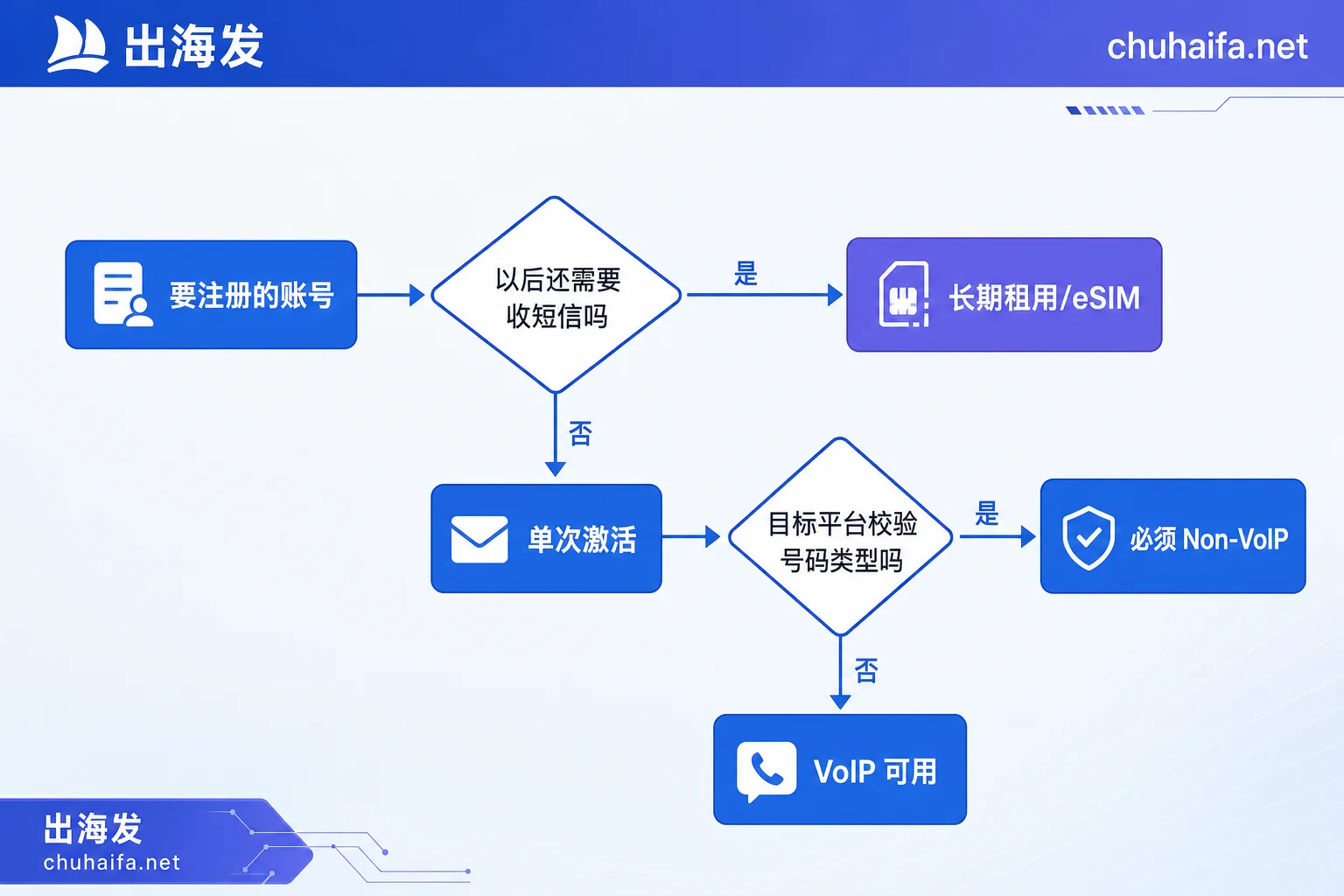
Question 1: Will this account need to receive SMS in the future? If yes, go for a long-term rental or a physical eSIM. If not, a one-time activation will do.
Question 2: Does the target platform verify the number's type? If it does, you must select numbers clearly marked as Non-VoIP / Real SIM. Buying regular virtual numbers would be a waste.
Settle these two points first, then compare prices and platforms. Reverse the order, and you might spend a little but lose big.
Number Type: The Real Difference Between VoIP and Non-VoIP
Numbers offered by SMS verification platforms fall into two broad categories: one is VoIP virtual numbers, assigned via internet-based phone lines; the other is number segments from real carrier SIM cards, often labeled Non-VoIP or Real SIM on platforms.
The difference isn't about whether they can receive SMS, but whether the other party is willing to send to them. Google, WhatsApp, Telegram, OpenAI, and many overseas financial institutions check the number's ownership during verification, often using CNAM or HLR databases to verify the characteristics of the number segment. Once identified as Fixed VoIP, the system usually returns an invalid number error or simply doesn't send the SMS—you wait on the SMS platform until it times out, receiving nothing.
So the selection rule depends on the target platform's risk control strength:
- High risk control (Google accounts, WhatsApp, payment and financial services requiring linked phones): Only consider number segments explicitly marked as Non-VoIP. Don't skimp here.
- Medium risk control (some social and content platforms): VoIP sometimes passes, but the success rate is unstable. The same number segment might work today and be blacklisted tomorrow.
- Low risk control (one-time forums, trial registrations): VoIP offers a clear price advantage and is sufficient.
It's important to note that there's no long-term valid list showing which numbers from which countries still work on which platforms. Target providers adjust their anti-fraud rules frequently. When a country's number segments are abused in bulk, they often become restricted as a whole. A feasible approach is to try a small order first. If it works, then buy in quantity. Don't prepay a large sum betting on the stability of a particular number segment.
Usage Duration: One-Time Activation vs. Long-Term Rental
This is a step many regret later.
One-time activation: The platform provides a number with a valid window typically from 15 to 30 minutes. Once you receive the verification code from the target platform, the order is complete, and the number is released back to the pool. The unit price is very low, suitable for one-time verifications where you don't need SMS afterward—like registering for a tool trial, claiming a discount, or running a test account you don't plan to maintain.
Long-term rental: Rent a number by day, week, or month. During the rental period, the number is exclusively yours, and you can receive codes repeatedly. You can renew when it expires. The price is an order of magnitude higher, but you gain the number's continuous availability.
The dividing line is clear: Will this account trigger a second SMS verification in the future? Changing devices, logging in from a different location, changing passwords, linking payment methods, or platform periodic security checks all require receiving a new code. If the number has been released and rotated to someone else, you won't receive it this time, and the account is essentially lost.
Compare against asset levels:
- Main operational WhatsApp, long-term Telegram accounts, security phones linked to store backends, and payment/collection-related accounts—these are "cannot be lost" types. Go with long-term rental or a physical eSIM you own. Don't use a one-time number.
- Secondary accounts in a matrix, or minor numbers for content distribution—consider the maintenance period. If you plan to use them for more than three months, rent. Short-term tests can use one-time.
- Pure one-time registrations—use one-time activation.
There's also a compromise: first use one-time activation to register the account, and after confirming you want to keep it long-term, quickly change the linked phone number in your account settings to a number you own long-term or an eSIM. Also set up security email and two-step verification backup codes. This way, even if the original number is released, the account still has other recovery paths. Many people procrastinate on this step and only realize it's too late when trouble arises.
Before Ordering, Set Up the Environment First
Receiving SMS is only the last link in the verification chain. If the environment isn't right, no matter how expensive the number, it won't pass.
The target platform's risk control looks at three things simultaneously: the IP location from which you operate, the browser fingerprint environment, and the country code of the phone number you fill in. If these don't match—like using a UK number with an IP exiting from a Southeast Asian data center—you'll likely get blocked the moment you fill in the number, with a message like "This number cannot be used for verification." At that point, you've already spent money, but the problem isn't with the number.
So the correct order of operations is:
- Decide on the country first. Choose a number based on the market where your business will land, not based on which country's numbers are cheaper.
- Then configure the IP. Use a clean residential exit from the same country, avoiding data center segments that are heavily shared and flagged. For proxies, VPS, etc., you can pick from the overseas network category based on route and region.
- Then set up the environment. For multi-account operations, use an anti-detect browser to give each account an independent environment, preventing cookies, local storage, and hardware fingerprints from mixing, so one account's issue doesn't drag down others.
- Finally, buy the number. The number's valid window is only ten to twenty minutes. Only after all preparatory work is done and the registration page is open at the step of filling in the phone number should you click to get a number, to avoid wasting the window.
Placing the number purchase last has another benefit: if you've been blocked in the first three steps (e.g., the registration page won't let you fill in the phone), you won't have lost anything extra.
What to Do If You Don't Receive the Code—Can You Get a Refund?
Overseas mainstream SMS platforms commonly have an "automatic refund for non-receipt" mechanism: if within the number's valid duration the target platform doesn't send an SMS, or if you proactively cancel the order, the deducted amount is automatically refunded to your account balance on that platform.
But remember two constraints:
- As long as one SMS is successfully received and displayed, the order is considered complete. Even if that SMS isn't the verification code you wanted (for instance, a welcome message from the carrier or other platform notification), it might count. So when you see a message, first confirm if it's the target verification code.
- Refunds go to your platform balance, not back to your original payment method. Most platforms don't support withdrawing balance back to your original payment channel. This directly influences your recharge strategy: start with a small amount for the current usage, then top up as needed. Don't deposit a large sum for "bonus" on an unverified platform.
Specific terms vary by platform. Refund window duration, whether a handling fee is deducted, and balance validity all depend on each platform's own rules. Take two minutes before ordering to check those, saving you hassle later.
If you don't receive the code, follow this order to troubleshoot faster:
- Confirm the number type is correct—does the target platform reject VoIP, and did you buy a Non-VoIP segment?
- Check if the IP and number country match, and whether your proxy exit is flagged.
- Try a different number, but switch to a different segment rather than repeatedly trying the same one. If the segment is restricted, it won't matter how many times you try.
- If consecutive attempts fail, switch platforms or countries. Don't keep burning money on one combination.
What to Look for When Choosing a Platform
Price is just one factor. What really affects the experience often includes:
- Clear labeling: Does it clearly distinguish VoIP and Non-VoIP? Are there usability hints by target service?
- Support for long-term rental and renewal: Platforms that only offer one-time activation are useless for important accounts.
- Country and service coverage: Are the numbers for your target market in stock, or often out of stock?
- Refund and balance rules: How are un-received codes refunded, to where, and can balance be used for other services?
- Recharge threshold and payment methods: What's the minimum recharge? What payment methods are supported? This varies and changes, so refer to the platform's official site.
- API and concurrency: Needed only for batch registration. Individuals and small teams don't need it and shouldn't pay a premium for it.
On this site, the overseas SMS verification category curates different types of service providers based on these dimensions, including NexSMS under "Recommended for Going Global," each linked directly to the official site. For specific number availability, rental prices, and payment methods, please refer to each official site's current info—this changes frequently, and any third-party transcription may be outdated.
One-Sentence Decision
Spend money in the right places: For one-time uses, use cheap one-time numbers; for long-term assets, use rental numbers or your own eSIM; for high-risk-control platforms, always use Non-VoIP; before buying a number, configure your IP and browser environment. These four lines cover most pitfalls. For the remaining differences, let small test orders verify.