

To determine whether Stripe or PayPal is better for your independent site, you don't need to dwell on brand reputation. Just focus on three criteria: account entity qualification, total withdrawal cost, and buyer checkout habits. These three criteria correspond to three different decision scenarios, and in most cases, the two are not mutually exclusive; they can be combined as primary and backup channels to maximize conversion rates for European and American orders.
Conclusion First: When to Use Stripe as Primary, and When You Must Keep PayPal
If your independent site is operated by a Hong Kong or overseas company and your target customers are concentrated in Europe and the US, accustomed to paying directly by credit card, Stripe is suitable as the primary acquiring channel; if your company entity is only domestic, or a significant portion of your buyers rely on PayPal's buyer protection, it's safer to start with PayPal. According to a February 2026 analysis by Cifnews on independent site payment practices, PayPal's standard fee is 4.4% + $0.30 per transaction, which can be reduced to 3.4% + $0.30 upon meeting monthly volume thresholds. Stripe's direct credit card fees in Europe and the US typically range from 2.9% to 3.4%, but requires a Hong Kong or overseas entity to open an account. Therefore, which of Stripe and PayPal suits your independent site depends first on where your company is registered.
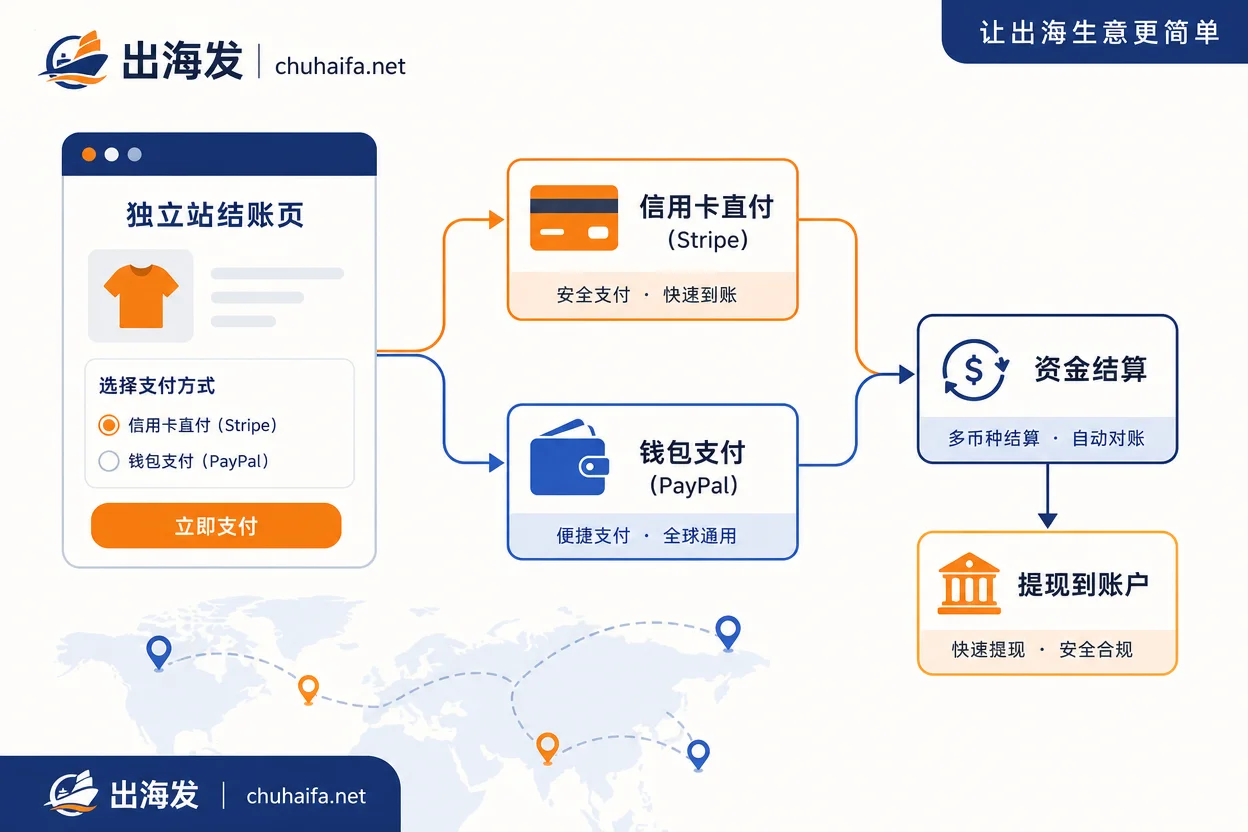
Criterion 1: Account Entity Qualification Determines Channel Order, Does Stripe Require a Hong Kong Company?
Stripe does require Hong Kong or overseas entity qualification to open an account; this is a hard requirement. Claims that "individuals in mainland China can stably open a permanent Stripe account without overseas documents" are either non-compliant packaging or false promises, with a high risk of fund freezing during secondary KYC. Avoid such attempts. If you only have a domestic entity, start with PayPal as your primary channel; if you've already registered a Hong Kong company, prioritize applying for Stripe. When your entity qualification doesn't meet the threshold, the order should be PayPal first, Stripe later.
Criterion 2: Fees and Withdrawal Chain, Calculate Per-Transaction Cost and Settlement in One Account
Many sellers only look at front-end fees and ignore withdrawal and settlement costs, resulting in lower actual received amounts than expected. According to industry standards compiled by Cifnews, PayPal withdrawals to domestic bank cards either go through third-party settlement or incur a $35 per transaction fee. Although Stripe has lower per-transaction fees, funds need to go through settlement when returned to China. So, when calculating, combine "per-transaction fee + withdrawal/settlement cost" into one net received amount. The table below compares the differences between the two channels:
| Comparison Dimension | Stripe | PayPal |
|---|---|---|
| Front-end Fee | Direct credit card payments in Europe/US typically 2.9%–3.4% | Standard 4.4% + $0.30/transaction, reduced to 3.4% + $0.30/transaction upon meeting monthly volume |
| Account Opening Entity | Requires Hong Kong or overseas entity qualification | Domestic entities can apply, relatively lower threshold |
| Withdrawal to Domestic Bank Cards | Requires third-party settlement, cost varies by institution | Requires third-party settlement or $35/transaction |
| Buyer Payment Habits | Direct credit card payment, no redirect | Wallet payment, high trust |
So, which of Stripe and PayPal suits your independent site? You can't just look at fee numbers; you must factor in the settlement chain.
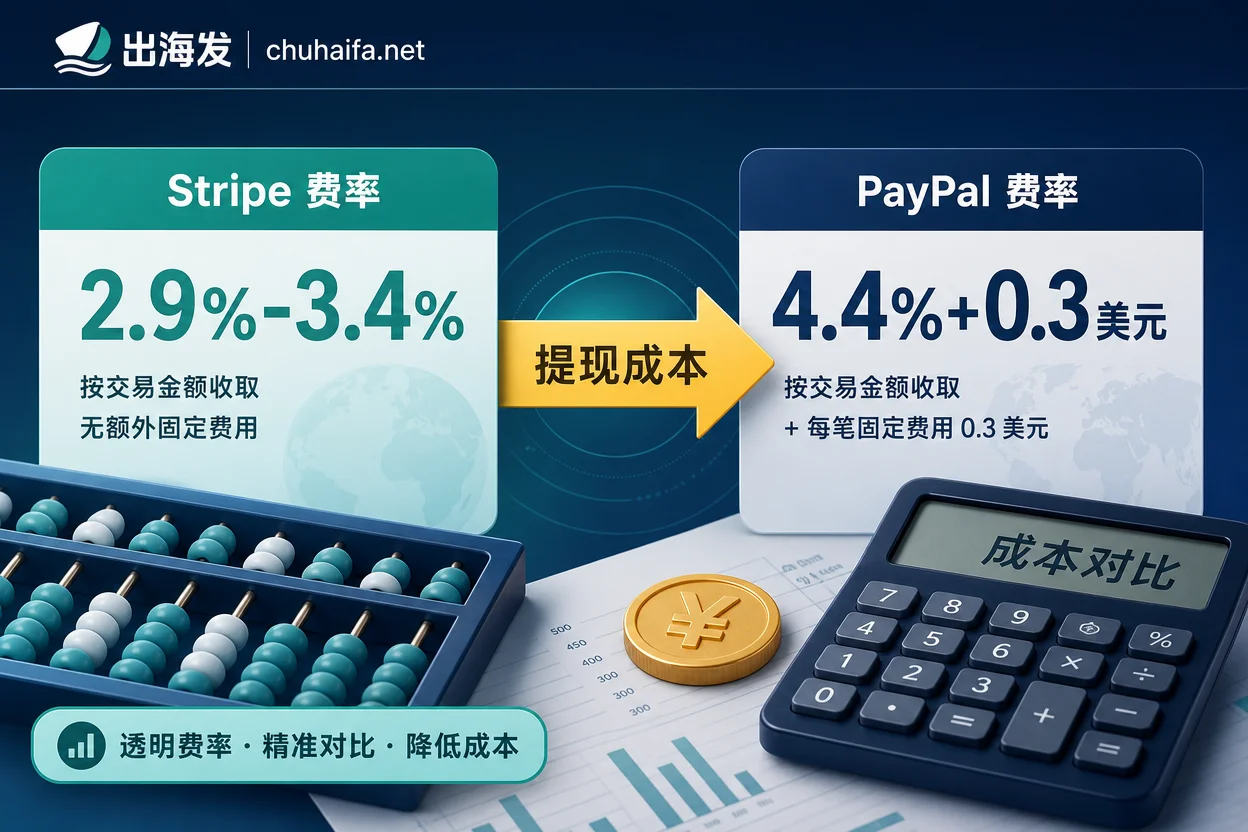
Criterion 3: Buyer Checkout Habits, Which Orders Do Direct Credit Card and Wallet Trust Cover?
Some European and American buyers prefer direct credit card payments, while others rely on PayPal's buyer protection. If your checkout page only offers credit cards, those relying on wallet trust may abandon the purchase. Will an independent site checkout page with only credit cards lose orders? Yes, it will. These lost orders often only show up as abandoned checkouts in the backend, making them hard to attribute and thus easily overlooked. It's recommended to arrange checkout page options based on your target market: for European and American customers, Stripe credit card as primary with PayPal as backup placed second; for Southeast Asian or trust-sensitive customers, place PayPal first.
"Stripe Replaces PayPal" Is a Common Misjudgment: Two Configurations of Primary and Backup Channels
The industry often says "Stripe can completely replace PayPal," but this doesn't hold true for most independent sites. The two are usually configured together on the checkout page rather than being mutually exclusive. Two common configurations are:
- Stripe Primary + PayPal Backup: Suitable for sites already with a Hong Kong company and a customer base mainly using credit cards in Europe/US, with PayPal covering wallet users.
- PayPal Primary + Stripe Later: Suitable for entities in China, starting with PayPal to get funds flowing, then adding Stripe when qualifications are complete to reduce overall costs.
When a single channel is blocked by risk control, orders are directly lost, which is why it's recommended to maintain at least two channels. If PayPal funds are frozen by risk control, the first step is to organize order logistics vouchers and buyer communication records and submit an appeal, rather than repeatedly creating new accounts, which only exacerbates risk flags.
Acquiring Is Not the Same as Payment Collection: How to Break Down the Process from Buyer Payment to Fund Settlement
Understanding the difference between acquiring and cross-border payment collection is key to avoiding pitfalls. A September 2025 payment service comparison analysis by AMZ123 distinguished between payment acquiring and cross-border payment collection: acquiring institutions like Airwallex support independent sites with API integration to collect payments directly from buyers, allowing same-currency settlement to reduce exchange losses; cross-border collection tools like WorldFirst focus on platform payouts, offering virtual accounts in 16 countries and low-fee payments to domestic supply chains.
Stripe and PayPal fall under the acquiring link in the chain. In simple terms, acquiring is "collecting the buyer's money," while settlement is "converting money into RMB and bringing it back." These are different stages. Connecting Stripe or PayPal only solves acquiring; the return path requires a separate settlement tool. This is a common confusion for sellers—they think once they connect the channel, money automatically returns to their domestic bank card.
Multi-Store, Multi-Platform Scenarios: Why Sub-Accounts for Payment Collection Should Be Isolated Per Store
If you operate on Amazon, TikTok Shop, and an independent site simultaneously, it's recommended to configure a separate multi-currency collection sub-account for each store. The benefits: when issues arise, risk doesn't spread, reconciliation is clear, and consistency of entity and login environment is easier to verify. Multi-platform correlation checks on store login environments, IP exits, and collection entity consistency are intensifying. Per-store isolation is both a fund management necessity and a compliance defense. For more tools on multi-platform login environment and collection entity consistency verification, see fingerprint browser recommendations. For specific tool choices, you can compare dimensions across cross-border payment platforms and use the evaluation approach for cross-border e-commerce tools to decide; we won't recommend specific products here.
After creating an evaluation dimension table covering entity qualification, overall fees, and checkout page ordering, you can compare candidate channels using the same dimensions in the overseas payment and cross-border settlement category on Chuhaifa.
Pre-Launch Checklist: Check Off Four Tables—Entity, Fees, Checkout Page, Reconciliation
Condense the three criteria into an actionable checklist to check off before launch:
| Check Item | Check Content | Pass Standard |
|---|---|---|
| Entity Qualification | Whether you have a Hong Kong or overseas company | If yes, prioritize Stripe; if no, start with PayPal |
| Fees and Withdrawal | Whether the total of per-transaction fee + settlement cost is lower than current solution | Net received amount improves or remains same |
| Checkout Page Order | Whether payment methods are arranged by customer preference | Both credit card and wallet have entry points |
| Reconciliation | Whether each store has an independent collection sub-account | Fund flow and orders can be mapped one-to-one |
Print this table and check item by item—it's more useful than repeatedly searching "Stripe vs PayPal for independent sites." You can also do the same dimension comparison with your candidate channels in the payment category on Chuhaifa to form your own selection sheet.
Frequently Asked Questions
Can Stripe and PayPal be connected to an independent site simultaneously?
Yes. The two are a typical complementary combination on the checkout page: Stripe covers direct credit card payments, PayPal covers wallet payments. Connecting both does not conflict; just display both methods side by side on the checkout page. Most site builders support this through native plugins.
Does Stripe account opening require a Hong Kong company?
Stripe requires Hong Kong or overseas entity qualification to open an account; this is a hard requirement. Domestic individual entities have no compliant path for stable opening. So-called "100% opening without overseas documents" is mostly non-compliant packaging, and funds risk freezing during secondary review. It's recommended to register a Hong Kong company first or use PayPal as a transitional option.
What are the fees for PayPal withdrawal to domestic bank cards?
PayPal withdrawal to domestic bank cards either goes through third-party settlement or incurs a $35 per transaction fee. The actual received amount is also affected by exchange rates. It's recommended to compare exchange rate differences among settlement tools and calculate the withdrawal cost into the per-transaction fee, not just look at front-end fees.
Can the PayPal fee of 4.4% be reduced?
Yes. PayPal's standard fee is 4.4% + $0.30 per transaction. Meeting monthly volume criteria allows for a tiered reduction to 3.4% + $0.30 per transaction. The specific application entry, criteria, and effective time depend on the current policy in the PayPal merchant dashboard or official support. Before signing up, estimate the reduced cost based on your recent monthly volumes.
What is the difference between acquiring and cross-border payment collection?
Acquiring is collecting payments from buyers, handled by tools like Stripe and PayPal, solving "where the money comes in;" settlement is converting foreign funds into local currency and transferring them back to China, handled by tools like WorldFirst, solving "how money returns to you." Both stages need to be configured separately.
How to handle PayPal risk control freezing funds?
If your PayPal account is frozen by risk control, first organize order and logistics vouchers and buyer communication records, then submit an appeal through official channels. Avoid re-registering new accounts repeatedly, which adds risk flags. Meanwhile, activate backup channels to keep orders flowing. The unfreezing outcome and timeline depend on official review; we make no promises here.