

How are cross-border collection fees calculated? The short answer: Amount received = (Order amount − Channel fee) − Intermediary bank deductions × Settlement rate (including exchange rate markup). Intermediary bank fees (Lifting Fees) in traditional wire transfers typically range from $15 to $50 per transaction, a common industry range; industry analysis also shows that banks and traditional institutions often add a 1%–3% markup to the mid-market exchange rate. With ISO 20022 driving fee transparency across the entire payment chain and the proliferation of local clearing networks, it's worth recalculating this cost. Below, we break it down into three layers.
Layer 1: Three Pricing Models for Channel Fees
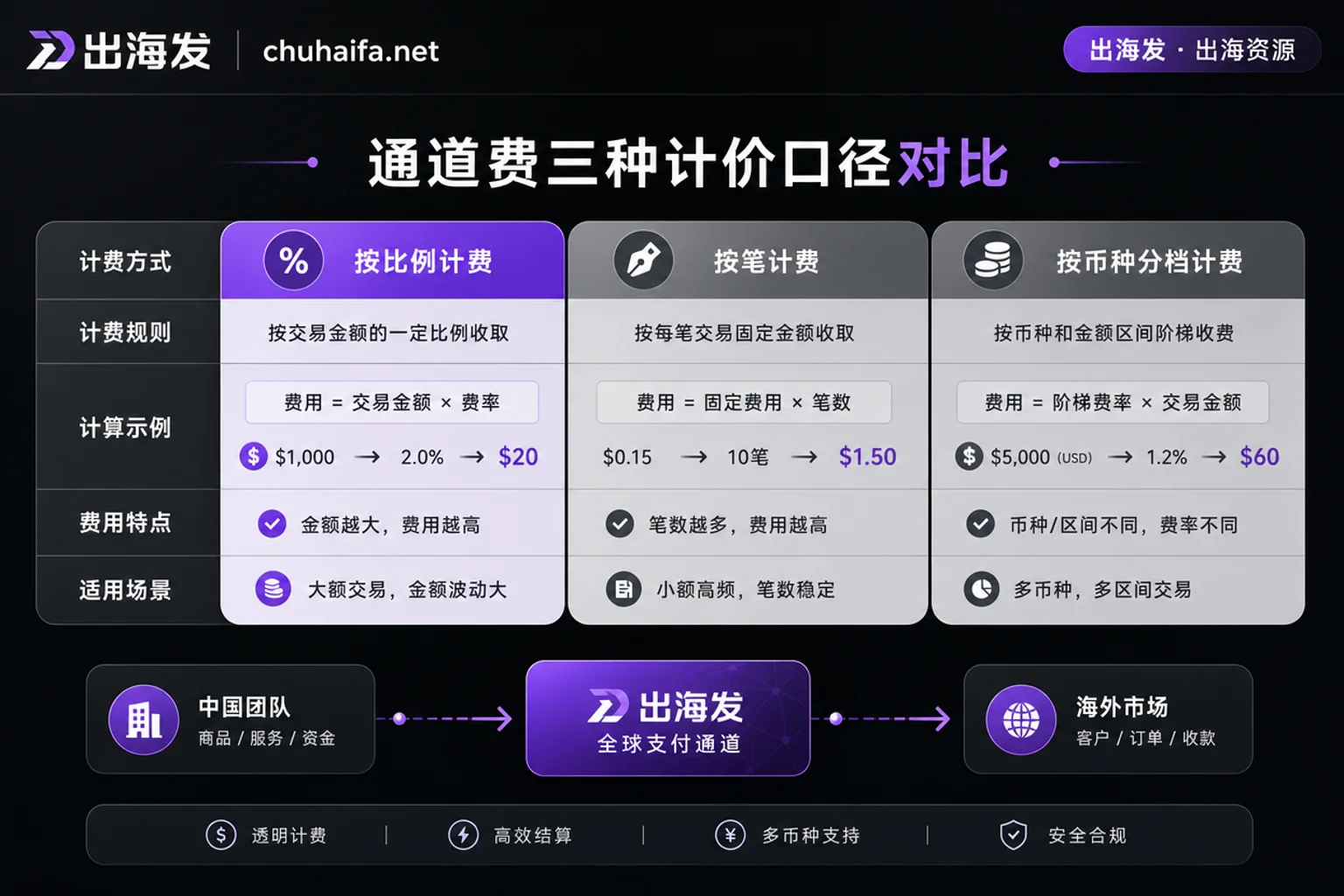
When calculating cross-border collection fees, the first thing to look at is the channel fee—it's the most visible upfront cost, but pricing models vary greatly among institutions, directly impacting your actual expense. When choosing a cross-border payment platform, don't just look at the nominal percentage; check three aspects:
| Pricing Model | Calculation | Best for | Risk Points |
|---|---|---|---|
| Percentage of transaction amount | Transaction amount × Fee rate% | Large amounts, few transactions | Fixed costs are high for small, frequent transactions |
| Fixed per transaction | Fixed amount per transaction | Small amounts, high frequency | Fee ratio is diluted for large collections |
| Tiered by currency | Different rates for different currencies | Multi-currency collections | Rates for less common currencies may be higher |
Key check: Include the fee model in your reconciliation sheet, confirming whether it's based on transaction amount, a per-transaction cap, or currency tier. For example, for a $5,000 collection, a 0.5% fee would be $25, but a fixed $15 per transaction would only be $15—the same amount, a $10 difference depending on the model.
SWIFT Correspondent Bank Fees: What's Typical in USD and How the Clearing Path Charges
When collecting via SWIFT wire transfer, funds typically pass through the payer's bank, multiple correspondent banks, and the receiving bank, and each correspondent bank may deduct Lifting Fees. This fee is independent of the amount and typically ranges from $15 to $50 per transaction, making it a fixed deduction. This answers the common question "SWIFT correspondent bank fees: how much in USD?"—$15–$50 is a common industry range; the actual fee depends on the specific charges.
Local clearing networks (such as ACH in the US, SEPA in Europe, and Faster Payments in the UK) settle directly into local accounts in the target country, eliminating the intermediary bank segment. For comparison:
| Comparison Dimension | Traditional SWIFT Wire | Local Clearing Network |
|---|---|---|
| Intermediary steps | Multiple correspondent banks | None (direct settlement) |
| Intermediary bank fees | $15–$50 per transaction | Typically $0 |
| Settlement time | 1–5 business days | Standard ACH: 1–3 business days |
| Fee transparency | Low | High |
Small, high-frequency collections are most impacted by intermediary bank fees—a fixed $15 per transaction on a $1,000 order represents a 1.5% cost.
Layer 3: Exchange Rate Markup—How to Reverse-Calculate the Difference Between Mid-Market and Settlement Rates
Exchange rate markup isn't shown in the fee breakdown, but it eats into your profits. The reverse calculation is simple:
Markup percentage = (Mid-market rate − Actual settlement rate) ÷ Mid-market rate × 100%
For example, if the USD/CNY mid-market rate is 7.20 and your actual settlement rate is 7.05, the markup is: (7.20 − 7.05) ÷ 7.20 ≈ 2.08%. Banks and traditional institutions commonly add a 1%–3% markup, and many platforms that advertise low fees hide costs this way.
Action tip: When withdrawing or converting, record the mid-market rate at that time and compare it with the actual settlement rate to calculate this hidden cost. Especially pay attention to the conversion step in multi-currency accounts, because many "zero fees" only apply to the deposit step; the exchange rate spread may be larger during conversion—this is the truth behind "Is there an additional fee when converting in multi-currency accounts?": it's not an explicit fee but a spread hidden in the exchange rate.
Putting the Three Layers into a Calculation Example: Cost Comparison for the Same Payment via Two Paths
Combining the three layers, we can answer how cross-border collection fees are calculated: a pure arithmetic example. Assume an order amount of $10,000, with settlement in USD:
| Deduction Item | Traditional SWIFT Path | Local Clearing Path |
|---|---|---|
| Channel fee (0.5%) | $50 | $50 |
| Intermediary bank fee | $25 | $0 |
| Exchange rate markup (2%) | $198.5 | $199 |
| Amount received | $9,726.5 | $9,751 |
The exchange rate markup is calculated on the balance after deducting the first two layers, so the markup amounts differ between the two paths. The two paths differ by $25, which is exactly the intermediary bank fee saved in the local clearing path. If the order amount drops to $2,000, the intermediary bank fee remains $25, representing 1.25% of the total, and the difference ratio between the two paths rises accordingly—the smaller the amount, the higher the proportion of the fixed intermediary bank fee.
Reverse Evaluation Dimensions: Fee Transparency, Clearing Path Visibility, and Reconciliation Granularity
Traditional cross-border settlement often lacks full-chain fee transparency. The Bank for International Settlements (BIS) CPMI, in its February 2026 update on ISO 20022 data standards, explicitly requires the full recording of the original transfer amount, intermediate conversion rates, and processing fees deducted at each node. This means the question "Why did the received amount decrease?" is changing from a guessing game to a verifiable bill.
To evaluate whether a collection channel is worth using, check three dimensions:
| Evaluation Dimension | Good Performance | Warning Signals |
|---|---|---|
| Fee transparency | Discloses original amount and per-node fees | Claims "low fees" but provides no breakdown |
| Clearing path | Clearly indicates local clearing or SWIFT | Cannot explain the path, only gives all-inclusive price |
| Reconciliation granularity | Per-transaction details + exchange rate snapshot | Only provides total, no layer-by-layer verification |
These three dimensions can also serve as selection criteria—the overseas payment resource category on chuhai.fa is continuously updated and categorized for easy comparison based on fee transparency and clearing path visibility. When comparing Stripe vs PayPal for independent site collections, these dimensions apply as well—don't just look at fee rates; look at how much information it provides for reconciliation.
Common Misconceptions: Zero Fees Doesn't Mean Zero Cost, Low Rates Doesn't Mean Higher Net Amount
Is it true when a collection platform says "0 fees"? The answer is clear: No. Zero fees usually only waive account opening fees or basic deposit channel fees; costs are often shifted to exchange rate markups during withdrawal/conversion or specific withdrawal network fees.
Also, local clearing is not a zero-cost panacea: standard ACH typically takes 1–3 business days, and each clearing system has per-transaction and daily limits. The conclusion for "Is local clearing or traditional wire transfer cheaper?" is: local clearing is clearly better for small, high-frequency transactions, but for large, non-urgent funds, SWIFT may not be worse—once the intermediary bank fixed fee is diluted, the difference narrows.
Self-Check Checklist for Reconciliation: What to Check Before Collection, After Receipt, and During Conversion
Calculating cross-border collection fees ultimately requires actionable reconciliation steps. Here's a three-phase checklist:
Before Collection
- Confirm clearing path: local clearing or SWIFT? Who bears the fees?
- Lock in the channel fee model: percentage, per transaction, or currency tier?
After Receipt
- Compare original transfer amount with actual credited amount to determine if the difference is a per-transaction or percentage deduction.
- If using SWIFT, record the actual intermediary bank fee (to compare with the common $15–$50 range).
During Conversion
- Record the mid-market rate at the time of conversion.
- Use the actual settlement rate to reverse-calculate the markup percentage, confirming it falls within the 1%–3% range.
When reconciling, you can copy the following fields into your internal sheet:
| Field | Description |
|---|---|
| Order amount | Original customer payment amount |
| Channel fee | Calculated per contract terms |
| Intermediary bank fee | Actual fee deducted in SWIFT path |
| Settlement rate | Actual rate applied |
| Mid-market rate | Reference rate on conversion day |
| Amount received | Actual amount credited |
The same layered approach can be applied to other cross-border expenses; refer to the breakdown in How to Calculate AI Export Tool Costs.
FAQ
Why is the received amount less than the order amount?
Typically due to the combined effect of three deductions: channel fee (percentage), intermediary bank fee (fixed per transaction), and exchange rate markup (percentage). First, compare the order amount with the credited amount, then check whether the difference is a fixed amount (intermediary bank fee) or a percentage amount (channel fee plus exchange rate markup) to quickly identify the specific layer.
How much is the SWIFT intermediary bank fee in USD?
Traditional SWIFT wire transfers have a mid-bank fee (Lifting Fees) commonly ranging from $15 to $50 per transaction, independent of the transfer amount and deducted as a fixed fee per transaction. The actual amount depends on the number of correspondent banks and their individual fees. For small collections, choosing a local clearing network can completely eliminate this fee.
How to detect the exchange rate markup?
On the day of conversion, subtract the actual settlement rate from the mid-market rate, then divide by the mid-market rate to get the markup percentage. For example, if the mid-market rate is 7.20 and the settlement rate is 7.05, the markup is 2.08%. This figure typically doesn't appear in the fee breakdown; you need to calculate it yourself.
Which is cheaper: local clearing or traditional wire transfer?
It depends on the amount and frequency. For small, high-frequency transactions, local clearing is significantly cheaper because it saves the fixed intermediary bank fee of $10–$50 per transaction; for large, infrequent transactions, the difference narrows as the intermediary bank fee is diluted. However, note that standard ACH typically takes 1–3 business days and has per-transaction and daily limits, so for urgent payments, wire transfer may be faster.
Is there an additional fee when converting in multi-currency accounts?
Not necessarily an explicit fee, but the exchange rate markup is hidden in the settlement rate. Multi-currency accounts may waive deposit channel fees, but if the actual settlement rate is lower than the mid-market rate during conversion, you're paying a hidden cost. Before conversion, compare the market rate with the platform's quote; be wary if the difference exceeds 1%.