

First, the conclusion: for free cross-border e-commerce ERPs that are not just trials and can be used long-term, there are mainly these options.
- Dianxiaomi, MangoManager: Permanently free basic versions, with version differentiation based on limits on the number of bound stores, sub-accounts, and data retention periods. These are currently the two most widely used.
- Saihu ERP: Targeted at Amazon and other sellers, offering a free monthly order quota (about 3,000 orders).
- Miaoshou ERP: Free basic functions for sourcing, listing, and order printing on platforms like TikTok Shop, Temu, Shopee, and Ozon.
- Odoo / ERPNext: Open-source self-hosted solutions. The software itself is free and does not limit the number of stores or accounts, but the cost shifts to servers and technical maintenance.
Most mainstream domestic ERPs follow a "free basic version + tiered paid VIP" structure. So the real question is not whether a free version exists, but where the free tier stops.
Free versions usually hit four limits
Regardless of the provider, the line between free and paid almost always falls on these four points. Before looking at pricing pages, calculate your own numbers:
- How many stores you can bind, and this is often calculated per platform. It's common that under the same account, Shopee allows 5 stores but Amazon only 1.
- How many sub-accounts you can create, which determines whether customer service, order printing, and purchasing can be handled by different people.
- How long order data is retained in the cloud. Historical documents beyond the period cannot be queried, affecting annual reviews and reconciliation.
- How many records can be migrated across platforms per day. When doing multi-platform listing, this is often the first limit you hit.
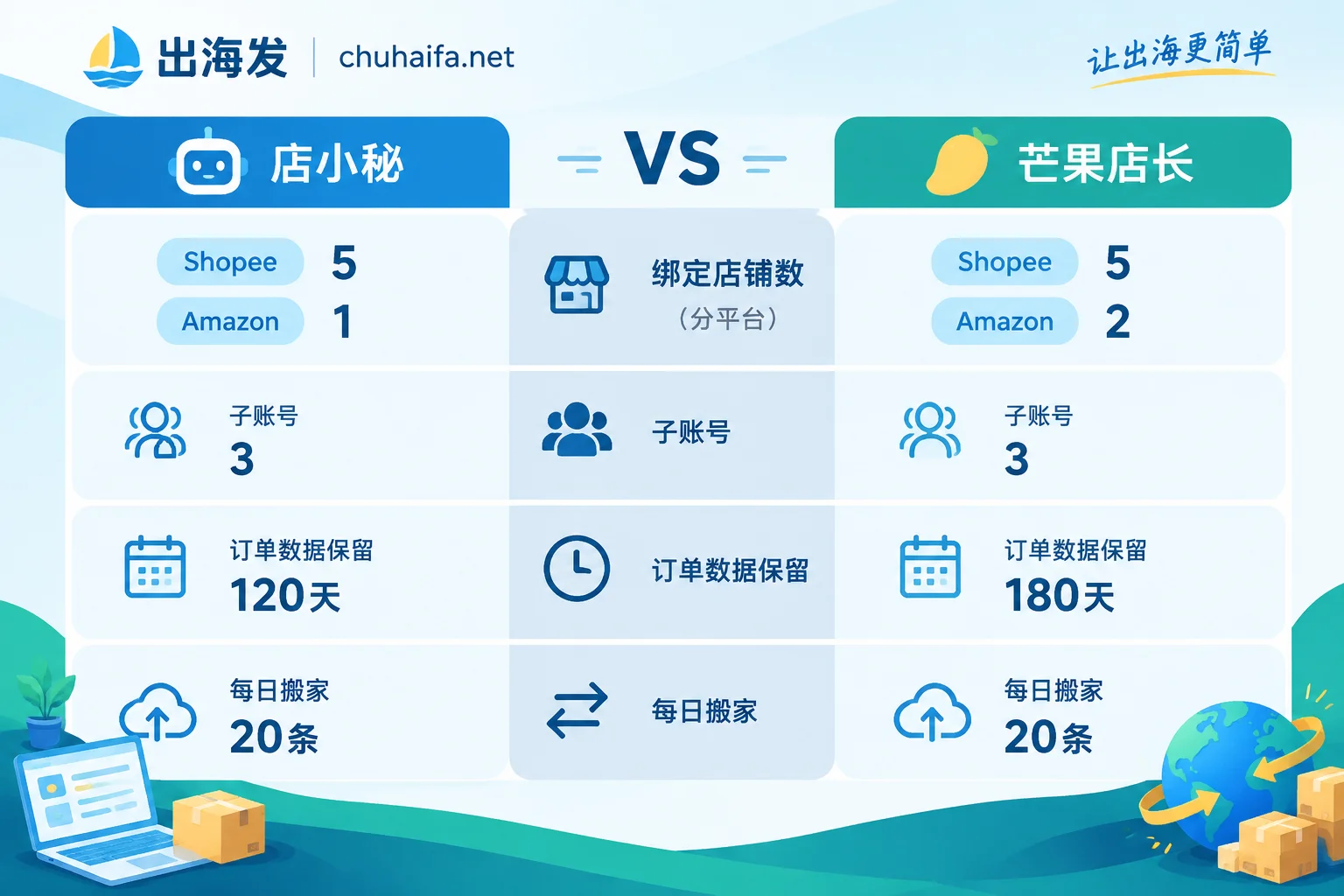
Dianxiaomi free version: widest platform coverage, store limits vary by platform
The free version of Dianxiaomi has no time limit and connects to over 70 mainstream global e-commerce platforms, including AliExpress, Shopee, Lazada, Amazon, eBay, TikTok Shop, Temu, etc. The free version does not limit order processing volume or basic product publishing volume, which is very friendly for sellers before they scale up.
Limitations are mainly on store binding: AliExpress self-operated and full-managed stores have no limit; Shopee and Lazada allow up to 5 free stores per platform; Amazon, TikTok, Temu, eBay, Shopify, etc., allow only 1 store each in the free version. Additionally, the free version allows up to 3 sub-accounts, 20 cross-platform data migrations per day, 120 days of order data retention in the cloud, and 30 days of operation logs.
In other words, if you are an AliExpress or Southeast Asia multi-store seller, the free version can last a long time. If your main battlefield is Amazon or you do multiple independent stores, you'll need to consider paying when you add a second store.
MangoManager free version: Southeast Asia focus, longer data retention
MangoManager also has a permanently free basic version, positioned more towards lightweight multi-platform management and Southeast Asian business. It supports Shopee, Lazada, Amazon, AliExpress, Temu, etc. In terms of free quotas, Shopee and Lazada each allow up to 5 stores, Wish 3, Amazon 2, and also 3 sub-accounts. Cross-platform migration is 20 records per day, and order data is stored for 180 days—two months longer than Dianxiaomi's 120 days. This difference will show when doing quarterly or longer reviews.
The free version can fully handle basic order printing and shipping, product sourcing, and simple inventory deduction—that is, the main chain of "listing—order—shipping". Features like in-depth profit calculation reports and batch automated marketing are reserved for VIP. So it suits scenarios where: goods are already selling, but you haven't reached the stage of needing precise gross profit calculation per SKU.
Quota-based free versions: Saihu, Miaoshou
Saihu ERP takes a different free approach—not cutting features but cutting usage. It offers sellers on Amazon and others a free processing quota of about 3,000 orders per month, suitable for sellers who want refined operations from the start. Miaoshou ERP, on the other hand, targets shelf and content e-commerce like TikTok Shop, Temu, Shopee, Ozon, and offers basic free functions for sourcing, listing, and order printing.
The quota tiers and gift rules for these two types are adjusted frequently. For specific order numbers and overage charges, always refer to the current instructions on each official pricing page. Don't budget based on someone else's screenshot from half a year ago.
Only consider if you have development capabilities: Odoo and ERPNext
The core modules of open-source solutions (inventory, basic order and financial flow) are free, and there is no limit on the number of stores and accounts. They support multiple languages and currencies, and you can integrate third-party platform APIs yourself—these are exactly the areas where SaaS free versions are most restrictive.
The trade-off is that you have to bear the costs of cloud server procurement, platform API debugging, and ongoing maintenance. When platform APIs change or store authorizations expire, SaaS vendors will follow up for you, but with self-hosting, you have to schedule it yourself. Without stable technical staff, don't treat it as a cost-saving solution.
How to choose based on your current situation
- Starting with 1-2 stores on a single platform: Both SaaS options are sufficient. The key is how many stores your platform counts as in their free tier. For Amazon, note that Dianxiaomi free version only allows 1 store, while Mango allows 2.
- Multiple stores on Shopee/Lazada in Southeast Asia (within 5): Both cover it. If you need longer historical order data, Mango's 180 days is more suitable.
- Starting on Amazon with monthly orders under 3,000: Saihu's free quota can be directly used for refined processes without paying for features first.
- Large-scale multi-platform listing: Calculate the migration quota first. 20 records per day means only 600 listings per month, which is usually the first thing that forces you to pay.
- Have development and operations: Odoo / ERPNext can bypass store and sub-account limits, but you must accept the long-term investment in API maintenance.
When to switch to paid
If any of the following occurs, the free version is no longer saving money but holding you back: the number of stores exceeds the free tier, you need more than 3 sub-accounts for division of labor, you need to retrieve historical orders beyond 120 or 180 days for annual reconciliation, or you start needing per-SKU profit calculation or batch automated marketing. These are natural results of business growth, not being ripped off.
Other tools to pair with ERP
ERP manages orders, inventory, and shipping "after the store is up". For multi-store operations, the real pitfalls often lie in the earlier stage:
- Multi-store login environment: Logging into multiple store accounts on the same computer—platforms look at browser fingerprints and IPs. ERP doesn't handle this. You can first read Are free fingerprint browsers enough for multi-account e-commerce? to decide whether to go for a paid solution, then choose from the fingerprint browser category.
- Registration and verification: New store registration and phone number binding require numbers from the corresponding country.
- Payment and advertising funds: For matching payment accounts and advertising cards, refer to How to pair virtual cards and cross-border payment accounts.
Once you determine which categories you need, ERPs and store operation tools are collected in the cross-border e-commerce category, each linking directly to the official website. Free quotas and prices are subject to the current instructions on each official website. If you are preparing to open a Southeast Asian store, What tools to prepare for a new TikTok Shop Southeast Asia store has a complete checklist in launch order.