

When choosing Lookalike seeds, first look at data quality and how deep the user intent is; audience size is a secondary consideration. The platform extracts common features from the seed and then finds similar people among all users. The cleaner the seed, the more concentrated the extracted features; if the seed is mixed, the people found will also be mixed.
You can prioritize like this:
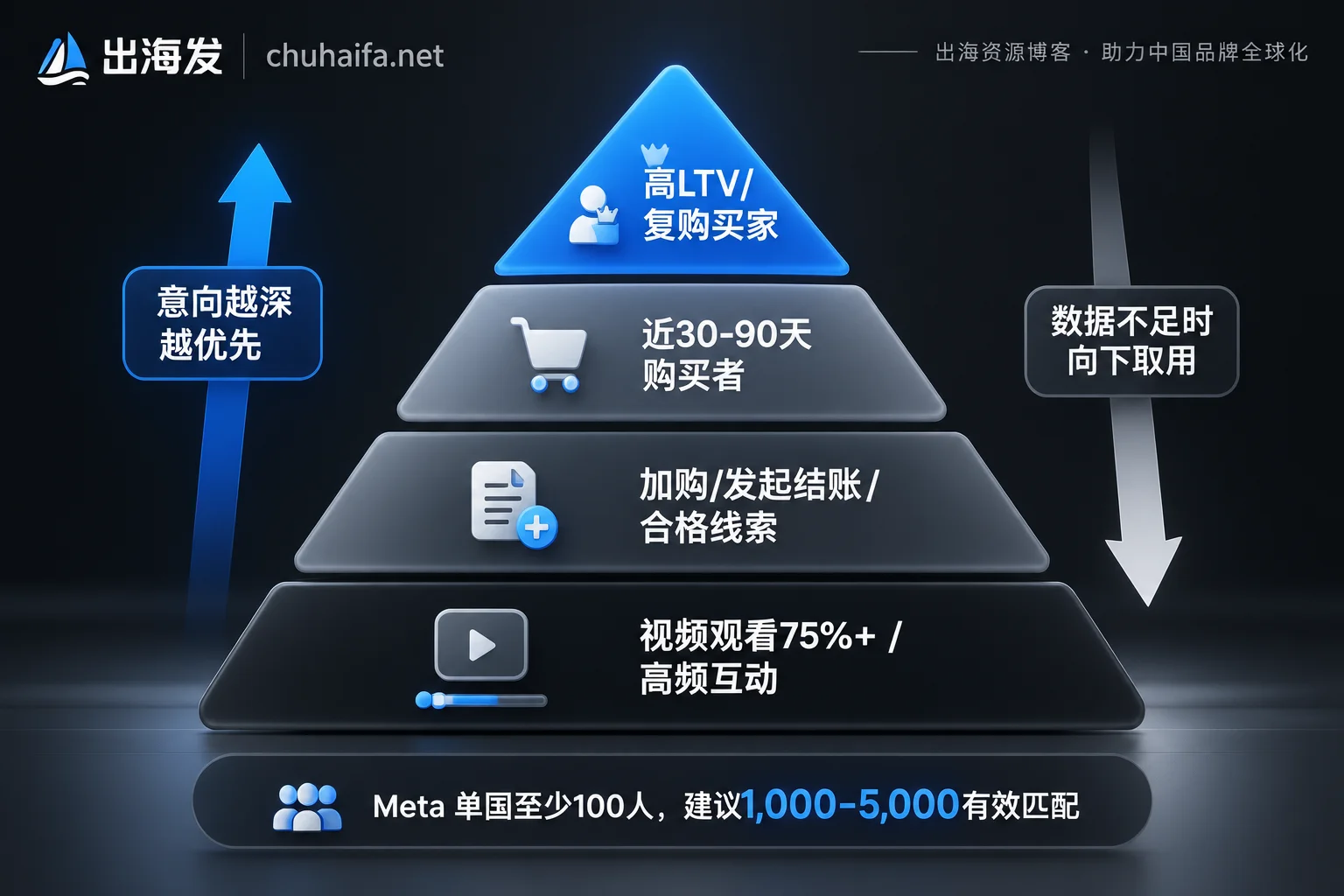
- High LTV, high average order value, or repeat buyers
- Buyers from the past 30–90 days
- Deep intent users: multiple add-to-carts, initiated checkouts, qualified leads
- Deep engagement users: video views over 75%, high-frequency page interactions
Use the upper tiers when possible. Tiers 3 and 4 are suitable for new accounts or when purchase volume is insufficient as a transitional option.
First confirm the audience threshold: 100 people can build, but it doesn't mean good performance
The minimum requirements for the two platforms are similar, but the criteria differ:
- Meta: The custom audience used as the source must have at least 100 people in a single country/region. Official best practices recommend an effective match size between 1,000–5,000.
- TikTok: When creating a Lookalike, the custom audience must have at least 100 successfully matched users.
There are two points to note here.
First, the threshold is based on matched people, not uploaded rows. You upload 300 customer records, but only a portion may match. If your list is small, you need to find ways to improve the match rate first; specific methods are below.
Second, bigger seeds are not always better. A list of tens of thousands with all kinds of people will make the platform's extracted features scattered. 1,000 recent high-value buyers are usually more valuable than 20,000 order records from all orders in the past three years.
Decide which tier to start from based on your existing data volume
How much data you have accumulated in your account determines which tier you can start from. Below are three scenarios based on data volume within the target country:
If you have thousands of buyers in the last 90 days. Use buyers directly as the seed, prioritizing high-value or repeat buyers. On Meta, you can upload a customer list with a Customer Value field to create a Value-Based Lookalike. This way, the platform will lean towards finding people like high-value customers, not just "people who have placed orders."
If you only have a few hundred buyers. You can still use buyers to build a seed. At the same time, build another seed using people who initiated checkout or added to cart multiple times, and test the two groups separately. It is not recommended to mix buyers and add-to-carters into one list, as it will weaken the buyer signal.
If you have fewer than 100 buyers, or it's a new account. Fall back to the intent tier first, using initiated checkout, add-to-cart, or qualified leads as seeds. If these event volumes are also insufficient, then use the engagement tier, such as users who watched 75% of a video or high-frequency page interactors. Once purchase data accumulates, switch the seed back to buyers.
There is also a time trade-off: recent data takes priority over old data. Buyers from the past 30–90 days usually reflect the current product, price, and audience better than an old list from a year ago. If you have a large historical list, you don't have to rush to upload it all; you can first cut out the most recent portion to build a separate seed.
To use events like add-to-cart or checkout as seeds, the prerequisite is accurate event data. If Pixel and CAPI are both sending events without deduplication, the event count will be inflated, and the seed will be polluted. You can first check against this article: Should Facebook Pixel and CAPI be used together.
Clean before uploading: these types of people should be removed
Customer lists are exported from the store backend or CRM; uploading directly can easily include customers you don't want more of. Before building a seed, remove the following types:
- Refund and return users
- Chargeback users
- Freebie seekers and one-time extremely low AOV buyers: e.g., people who only bought a clearance item once, or who only used a large coupon and never returned
If you have multiple product lines with very different average order values (e.g., selling both $20 accessories and $500 main units), build seeds separately by category or customer group. Mixing the two types of buyers may result in the platform finding people who don't resemble either side well.
Improve match rate: provide as many fields as possible
When uploading customer files, providing only emails often yields a limited match rate. Try to provide these fields at the same time:
- Phone (mobile number)
- First Name / Last Name
- City
- Country Code
The same customer may have multiple records in different systems, and phone number formats may vary, e.g., some with country code, some without. Unify the format and deduplicate before uploading to reduce invalid rows. For specific methods, refer to: How to deduplicate cross-border private domain customer duplicate statistics.
After uploading, if you find that the audience size doesn't match the number in your list, it's not necessarily an error; you can troubleshoot according to this article: Is it normal for Facebook custom audience size to suddenly increase.
After the seed is built: start from the narrowest similarity and gradually expand
Initial settings
- Meta: usually start from 1%, which is most similar to the seed.
- TikTok: usually start from Narrow.
When to scale
When budget increases, or when the frequency at 1% noticeably rises and starts to saturate, then expand outward:
- Meta: expand to 2%–3%, then 3%–5%.
- TikTok: switch to Balanced, then Broad.
Test separately for easy judgment
Different seeds (buyers, high-value buyers, checkout users), and different percentages of the same seed, are best placed in separate ad groups. Mixing them together makes it impossible to tell which seed is working.
Usage in automated campaigns
If you are using Meta Advantage+ Audience or TikTok Smart+, the seed audience is not necessarily a hard targeting condition; more often it is an Audience Suggestion for the algorithm, letting the system start exploring near this group of people. Seed quality is still important in this case because it determines where the algorithm starts.
Two things most easily overlooked: exclusion and refresh
Exclude the seed itself and already converted customers. When running Lookalike ad groups, exclude two types of people in the audience settings:
- The seed audience itself
- Customers who have converted in the last 30–180 days
Otherwise, your acquisition budget will be spent on existing customers, and it will compete with your retargeting ad groups for the same people.
Refresh the seed every 30–90 days. Seed data becomes less effective over time. Seasonal changes, new product launches, and existing customers entering the churn phase will cause the list from three months ago to gradually deviate from the current business. You can make refreshing a fixed process, which includes:
- Re-export recent buyers
- Re-clean according to the above rules
- Re-upload
If your list is manually exported from the store backend or CRM, it's best to standardize the export, cleaning, and upload steps to avoid ad-hoc handling each time.
What tools are needed
This task itself doesn't require buying anything extra; the core is the platform's ad backend plus your own customer data. By stage:
- Data source: Order exports from the store backend or CRM, plus correctly configured Pixel / CAPI events.
- Cleaning and deduplication: Spreadsheet tools are sufficient. When the list is large and refreshed frequently, consider tools that can automatically sync customer data.
- Campaign and analysis: Platform ad backend, plus third-party tools to help view audience and creative performance.
To find tools for campaign assistance and data analysis, you can check the Advertising Tools category. For tools related to store systems and order data, you can choose from the Cross-border E-commerce category. Features and prices of each are subject to their official websites.