

Let’s start with the conclusion: a cross-border receiving account (VA) manages “money in”, a virtual card (VCC) manages “money out”, and a same-currency transfer connects the two. They are not competing options, but upstream and downstream of one fund flow—if you only have a receiving account, your ad spend and SaaS subscriptions have nowhere to be charged; if you only have a virtual card, you need to purchase foreign exchange domestically and top up one transaction at a time, which is costly and non-compliant.
Below, we explain the pairing by fund flow direction and which steps are most likely to get stuck.
What each does
A cross-border receiving account is essentially a virtual receiving account at the banking level, giving you a set of local routing and account numbers to receive settlements from platforms like Amazon, TikTok Shop, Shopify, or direct wire transfers from overseas clients. Its value has three points: it is recognized by platforms as a local account, multi-currency balances can remain untouched, and you can convert to your domestic bank account compliantly when needed.
A virtual card is a digital card issued through card networks like Visa and Mastercard, with a card number, expiry date, and security code, but no physical form. It solves active online payments: ad charges for Meta, Google, TikTok, subscriptions to overseas SaaS and AI tools, platform store rent, and some overseas procurement.
One receives, the other pays, and between them lies currency conversion. The entire point of pairing them is hidden in this step.
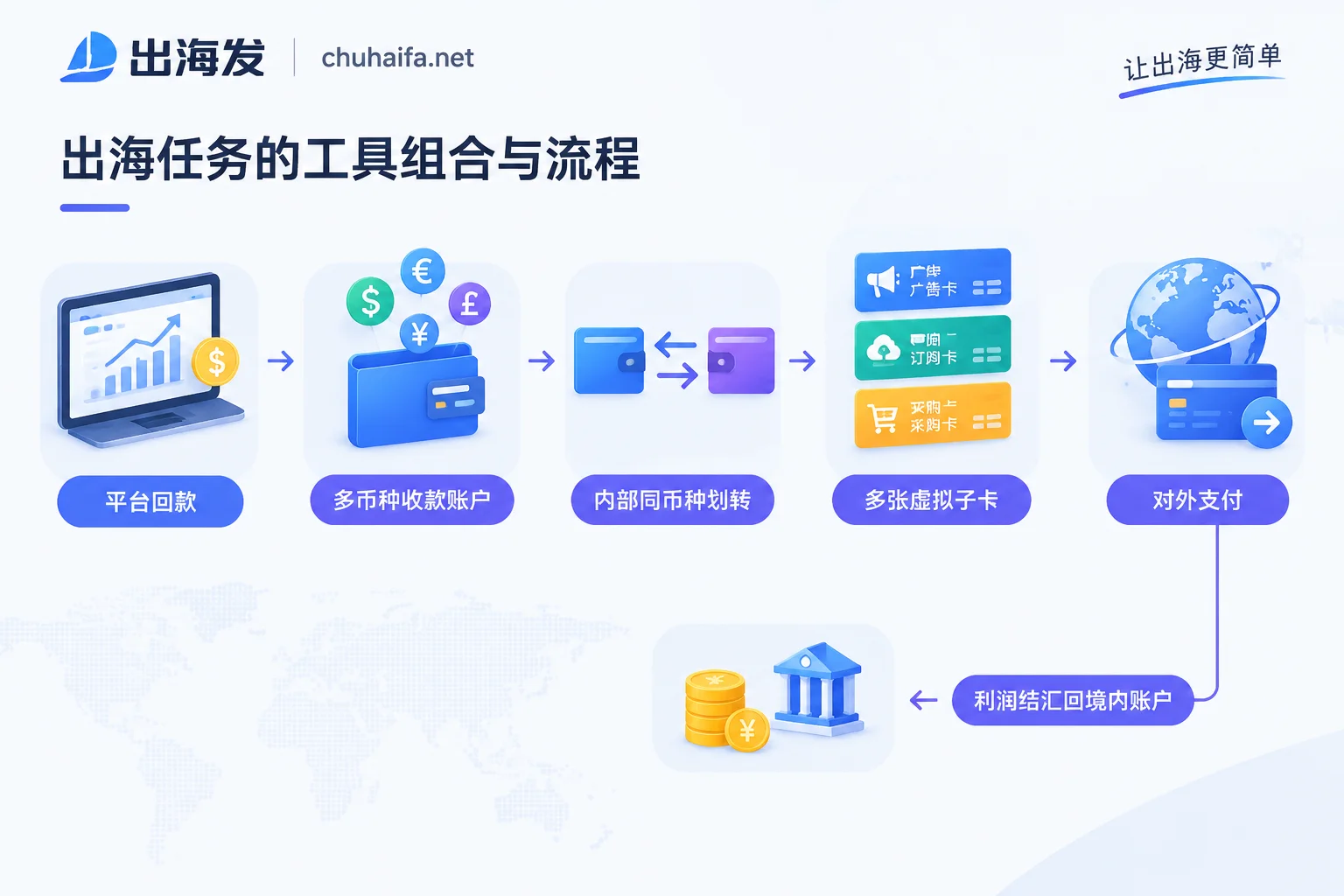
Standard flow: four steps for a full cycle
- Platform or client payments enter the receiving account, landing in a multi-currency wallet in the original currency such as USD, EUR, or GBP;
- Transfer the balance internally to the virtual card on the same platform, or use the balance to directly issue or top up cards;
- The virtual card pays externally for ad spend, subscriptions, store rent, and procurement;
- The remaining profit is then converted and settled back to a domestic account.
The key is step 2: if receiving and card issuance are on the same platform, USD comes in and USD goes out without currency conversion, saving the round-trip exchange loss and fees of “converting foreign currency to RMB → then purchasing foreign currency for payment”. For teams where ad spend is a major cost, this difference is not small over a year.
So when choosing a receiving platform, it’s worth checking whether it can issue virtual cards and which currencies it supports for card issuance; conversely, simply picking a “cheap virtual card” without considering where its funds come from often means paying the cost back at the top-up stage. How to choose a receiving account itself depends more on where your company entity is registered and which platform the money comes from. For this, you can refer to How to choose a cross-border receiving platform based on your company entity.
The second role of virtual cards: separating risk and budget
Many people only treat virtual cards as a payment channel, but their more important use is isolation. Most mainstream platforms support batch generation of sub-cards in the backend or via API, so you can divide them like this:
- One card per store / one card per account: Multiple stores or ad accounts sharing one card number is a typical source of association risk. Splitting into independent card numbers ensures that if one account has issues, others are not affected.
- One card per business line: Use separate cards for ads, subscriptions, and procurement, so month-end reconciliation doesn’t require digging through a pile of transactions for receipts.
- Issue cards per person: Give media buyers and procurement staff their own cards with individual limits; if exceeded, the card stops working, which is easier than asking later “who spent this?”
- Restrict merchant category codes (MCC) and limits: Allow only ad-related or subscription-related charges, which can block some fraudulent charges after card theft.
If a single card is compromised, the loss is limited to that card; you can cancel and reissue without affecting the main account balance or other ongoing charges.
Things to confirm before going live
These are the “if you don’t confirm, you’ll run into trouble” type, and rules vary by provider—don’t apply one provider’s experience to another.
Limits strictly depend on balance. Most virtual cards issued by mainstream cross-border platforms are prepaid or debit in nature, not true credit cards. How much you can spend depends entirely on the available balance in the receiving account. If the ad platform tries to charge and the balance is insufficient, the result is not debt but immediate suspension of ads, and the account may be flagged. The approach is to keep a balance on the main ad card that is several times the average daily spend, and prepare in advance during months with long payout cycles.
Funding sources may be restricted. Some platforms’ virtual cards require that the funds in the card come from compliant trade payouts, and do not support large top-ups from domestic personal cards. If your business does not yet have stable overseas payouts (e.g., just starting and only running ads to test products), you need to ask about the top-up path before opening an account, rather than discovering after opening the card that you can’t fund it.
Prepaid virtual cards generally cannot do chargebacks. In cases of fraudulent transactions or merchants not shipping, a physical credit card can still pursue a chargeback, but prepaid cards have much weaker remedies. So these cards are suitable for paying deterministic recipients like Meta, Google, Shopify, but for large prepayments to unfamiliar suppliers, you need another approach.
BIN acceptance changes. Ad platforms and subscription services have different risk control standards for different issuing banks and BINs from different countries and regions, and they adjust them. It’s not rare for the same card to work with Meta today but be rejected by OpenAI later. The safe approach is to have two backup cards from different institutions for critical business, rather than betting everything on one BIN.
Three pairings by business type
Platform sellers (Amazon, TikTok Shop, etc.): The main line is a receiving account to collect platform settlements, then transfer to a virtual card to pay for on-platform ads, store monthly rent, reviews, and tool fees. If you have multiple stores, split cards by store to avoid card numbers becoming an association point between accounts. For the preparation order when just opening a store, you can refer to Tool checklist for new TikTok Shop Southeast Asia stores.
Independent site teams: The receiving end is payment collection via Stripe, PayPal, etc., which lands in the receiving account. The payment end is mainly Meta/Google ads and a bunch of SaaS subscriptions. These teams usually have the most virtual cards—one for ad accounts, one unified for subscriptions, and another separate one for trial tools, with the trial card limit set to the minimum to avoid forgetting to cancel and being auto-renewed. For other parts of the entire chain, see What types of tools are needed from site building to payment collection for independent sites.
Foreign trade B2B / service teams: Payouts are mainly client wire transfers, few in number but large in amount. The multi-currency retention and settlement timing of the receiving account are more critical; virtual card usage is concentrated in exhibitions, SaaS, and a small amount of online procurement. Cards don’t need to be many, but for large payments to new suppliers, prioritize wire transfers or payment methods with chargeback protection, and don’t use prepaid cards for everything just for convenience.
A pre-launch checklist
- Are the receiving account and virtual card on the same platform? Can they transfer in the same currency without forced conversion?
- Does the balance on the main ad card cover the payout interval? Is there a balance alert?
- Is each store/ad account using an independent card number?
- Do critical charges (ads, store rent) have a second backup card from a different issuing institution?
- Is the card prepaid or credit? Do you know the recovery path in case of disputes?
- Card issuance fees, monthly management fees, and cross-currency exchange rate markups vary widely; refer to the official website’s current disclosure, and don’t estimate based on old guides.
Where to choose next
After determining that you need “a receiving account + several cards for specific purposes”, you can compare providers’ account opening thresholds, supported currencies, and card issuance policies—the receiving and virtual card services listed under Overseas Payment can be checked directly on their official websites for current rules. If your spending is mainly on advertising, the account management and store tools in Ad Tools and Cross-Border E-Commerce usually need to be decided together with card allocation, so you don’t end up with a half-baked solution where “cards are split but accounts are not”.