

Many people assume that a slow cross-border payment means the platform has issues, but how long it takes for cross-border payments to arrive depends on the route the money takes: local clearing networks typically arrive within 0-2 business days, while SWIFT international wire transfers typically take 2-5 business days.
Given the divergence in cross-border settlement routes, the time differences between channels are growing. This article helps you first determine the route, then compare against standard timeframes, and finally troubleshoot overdue payments across four stages, turning vague "platform slowness" into actionable criteria.
Key Takeaway: How Long Cross-Border Payments Take Depends on the Route
There is no single fixed number of days that applies to all cross-border payments. Currently, cross-border settlement falls into two main routes: local clearing networks (e.g., ACH in the US, SEPA in Europe, FPS in the UK), where funds move within the receiving country via local direct connections, with standard arrival of T+0 to T+2 business days; and traditional SWIFT international wire transfers, where messages pass through the sending bank, multiple intermediary banks, currency conversion, and the receiving bank, with standard arrival of 2-5 business days.
The time difference between these routes stems from the mechanisms themselves, not deliberate platform delays. The following two sections break down why each is fast or slow, and their respective normal ranges.
Route 1: Local Clearing Network – Standard Range and No Intermediary Fees
If the platform provides you with a local currency account in the destination country, and funds arrive as a local transfer, your payment is going through the local clearing network. The standard arrival time for this type of channel is usually 0-2 business days, with no intermediary bank fees deducted. For details on account and receiving scenarios, see How to Use a Southeast Asian Local Bank Account for Cross-Border Payments.
It is fast because funds move within the local direct network of the receiving country, bypassing multiple intermediary banks and reducing transfer points. However, note that "0-2 business days" is the network's own time, not including platform withdrawal review time. Review may involve compliance checks and batch processing windows, which need separate estimation.
Route 2: SWIFT International Wire Transfer – Standard Range, Intermediary Fees, and Delay Risks
When your withdrawal or payment needs to go from a bank in one country to a bank in another, and the currency or receiving account is in a different location, it typically goes via SWIFT. This route is slower because the message must pass through the sending bank, one or more intermediary banks, currency conversion, and the receiving bank. Standard arrival is typically 2-5 business days, accompanied by intermediary fees and currency conversion delays.
The longer the route and the more intermediary banks, the higher the variability. For major currency pairs, fewer intermediary layers are involved; for minor currencies or paths requiring multiple conversions, more intermediaries mean longer processing. The number of intermediaries depends on the sending bank's network, viewable via MT103 messages.

How to Determine Which Route Your Payment Takes: Three Clues
Without banking jargon, you can quickly identify the route with these clues:
| Clue | Local Clearing Network | SWIFT International Wire Transfer |
|---|---|---|
| Withdrawal page label | Shows "Local Transfer" or "Local Clearing," often with an estimated arrival range | Shows "International Wire" or "SWIFT," often requiring SWIFT/BIC code |
| Currency and account location | Same currency, same region (e.g., USD to US account) | Cross-currency or cross-region (e.g., EUR to Asian account) |
| Receiving account format | Only needs local account number, no intermediary info | Requires SWIFT/BIC codes, intermediary or routing bank info |
Once you've identified the route, refer back to the standard ranges in the previous sections. If you're using SWIFT, longer arrival times are normal. For information on receiving entity and account location, see Which Cross-Border Payment Platform to Use for a Hong Kong Company.
Troubleshooting Overdue Payments: Four-Stage Sequence
If your payment exceeds the normal range for its route, don't immediately contact customer service. Follow these steps in order:
- Platform withdrawal review stage: Check if the platform is still processing your withdrawal request. Compliance checks and batch processing windows may extend review time.
- Local clearing stage: Confirm whether you missed the bank's daily cutoff time (the last moment to enter the day's clearing batch). Each bank's cutoff differs; check with the receiving bank or platform. If missed, clearing moves to the next business day, or to Monday if Friday.
- Intermediary bank stage: Funds may be stuck in an intermediary's compliance review or currency conversion, especially during anti-money laundering spot checks; this can take variable time.
- Receiving bank stage: The receiving bank may trigger information matching or AML manual review, delaying crediting.
The standard tool for locating the intermediate node is to request the MT103 message and the 36-character UETR code from the sending bank (MT103 is the standard interbank transfer message showing which banks the money actually passed through; UETR is the unique global identifier for the transfer, usable in SWIFT GPI, the payment tracking system, to see where the funds currently are). With tracking, you can see which stage the funds are stuck at, which is more effective than simply pressing the platform.
Why Arrival Times Vary Every Time: Cutoff Times, Weekends, and Holidays
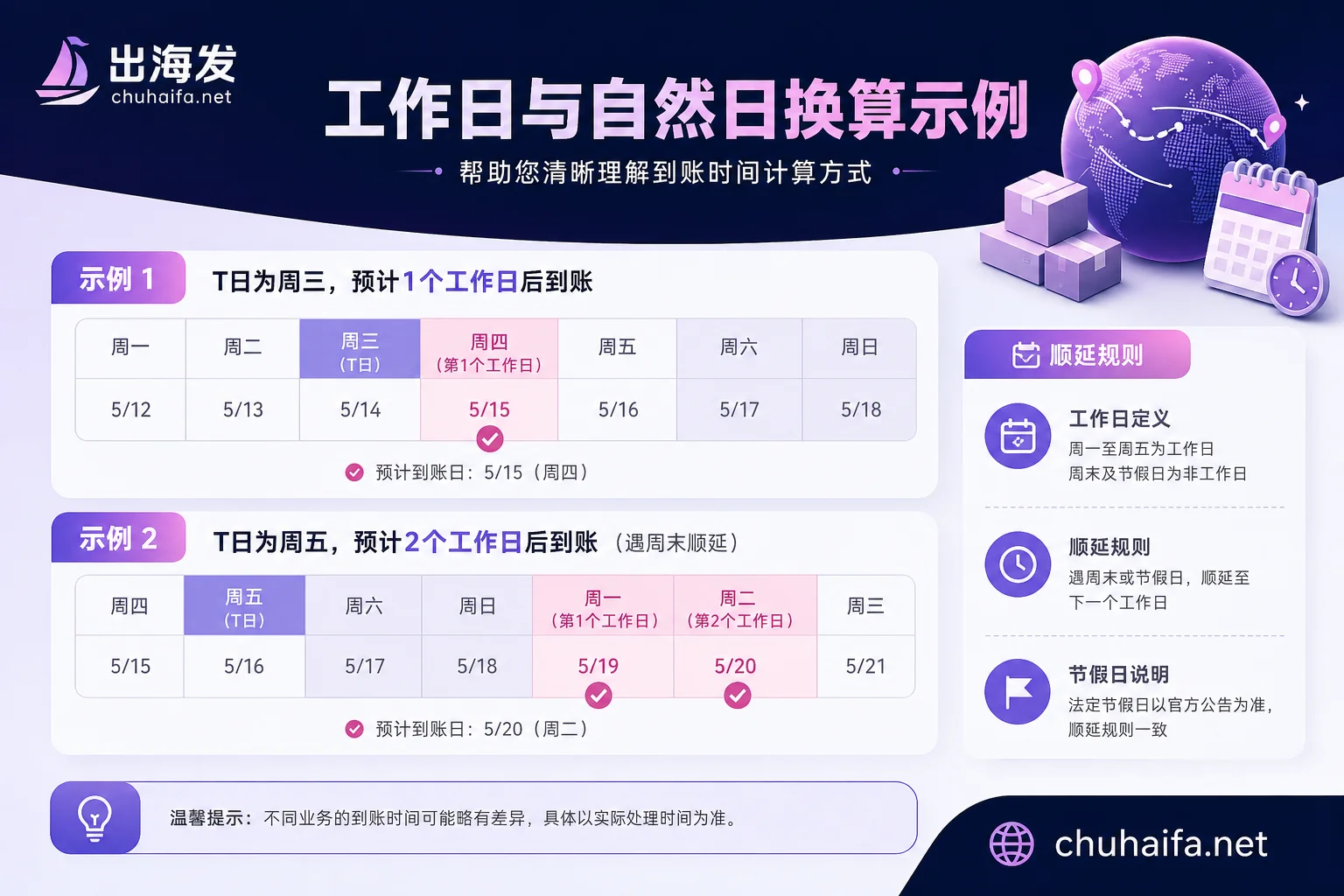
The same platform and account can yield different arrival times because the daily cutoff time determines whether the payment enters today's or tomorrow's clearing. Instructions submitted after the cutoff are processed on the next business day, and weekends and non-working days do not participate in clearing, causing delays.
More complex, holidays in the sending and receiving countries may not align. When the sending country is on a long holiday but the receiving country is a workday, the mismatch can stretch "2 business days" into five or six calendar days.
Answering "Will a weekend withdrawal delay cross-border payment?": Yes, because weekends are not working days for clearing, your funds will be processed starting the next business day. When calculating, convert calendar days into shared business days for both countries, then compare against the standard range.
Common Misconceptions: 3 Days Not Arrived ≠ Lost, Smaller Amount ≠ Not Arrived
Returning to the original question – how long cross-border payments take depends on the standard range for the route, not on the number of calendar days you wait. Two common misconceptions need clarification:
- "If not arrived in 3 days, the platform is stealing money or my account is frozen": This is not valid. If you're using SWIFT, and it spans a weekend or faces an AML compliance check, 3-5 business days or even 7 business days can still be normal in transit; funds are not lost or frozen.
- "If the arrival amount is less than expected, it hasn't arrived": The reduction is usually due to intermediary fees and currency conversion, which are deductions, not non-arrival. First check the deposit details before judging any anomaly.
Be wary of claims like "instant full arrival within 1 hour, 0 intermediary fees, regardless of holidays," which contradict international clearing and AML mechanisms and are false. For fee calculation, see How to Calculate Cross-Border Payment Fees.
Three Evaluation Dimensions for Overseas Payment Tools
Turn the timing judgment experience into a selection standard for comparing overseas payment tools:
- Clearing path visibility: Can the tool tell you before withdrawal whether it will use local clearing or SWIFT? Does it provide MT103 messages or UETR codes?
- Fee disclosure completeness: Does it clearly state intermediary fees and currency conversion policies upfront, rather than only after arrival?
- Reconciliation granularity: Can you see the status at each stage (withdrawal review, local clearing, intermediary, crediting), rather than just "Processing"?
These three dimensions are key comparable fields when evaluating cross-border payment platforms, especially for tools in the "overseas payments" category. For systematic comparison, see How to Choose a Cross-Border Payment Platform. Save this range and four-stage troubleshooting sequence as a team manual, and when selecting next time, compare against the continuously updated tool list in the overseas payments category.
Arrival Self-Checklist
| Stage | Action |
|---|---|
| Before withdrawal | Confirm route type (local clearing or SWIFT); verify receiving account details to avoid errors; avoid cutoff times and holiday windows. |
| While waiting | Calculate business days based on the route's standard range; don't let calendar days cause anxiety; note withdrawal time and platform reference numbers. |
| After timeout | Follow the four-stage sequence; request MT103 and UETR from the sending bank; keep withdrawal vouchers and timestamps. |
FAQ
Is it normal for cross-border payment not to arrive in 3 days?
First check the route. For local clearing, the standard range is 0-2 business days. If 3 business days have passed without arrival, it is overdue and you should start troubleshooting. For SWIFT, the standard range is 2-5 business days. If 3 calendar days include a weekend, converted to business days may be less than 2, which is still normal.
Which is faster: local clearing or SWIFT?
Local clearing is faster, typically 0-2 business days, with no intermediary fees; SWIFT takes 2-5 business days and may incur fees and currency conversion losses. If you need funds quickly, choose tools that support local clearing accounts.
How many business days does a SWIFT transfer usually take?
Typically 2-5 business days. If faced with intermediary compliance checks or currency conversion, it may extend to 7 business days. Always calculate shared business days and allow buffer time.
I've made a withdrawal but the bank account hasn't received it. How do I check?
First confirm the route, then troubleshoot in four stages: platform review status, bank cutoff time, intermediary progress (use MT103/UETR tracking), and receiving bank crediting. If the chain is clear, ask the receiving bank about manual verification.
Will a weekend withdrawal delay cross-border payment?
Yes. Banks don't process clearing on weekends, so your funds will start moving on the next business day. If you withdraw on Friday afternoon, actual arrival may be counted from Monday. Avoid withdrawals on weekends or the day before holidays.
For a few emerging markets with strict exchange controls (e.g., Nigeria, Argentina), there is central bank foreign exchange allocation, lacking a uniform public schedule. The ranges in this article do not apply to those scenarios; follow the specific receiving bank's declaration progress.