

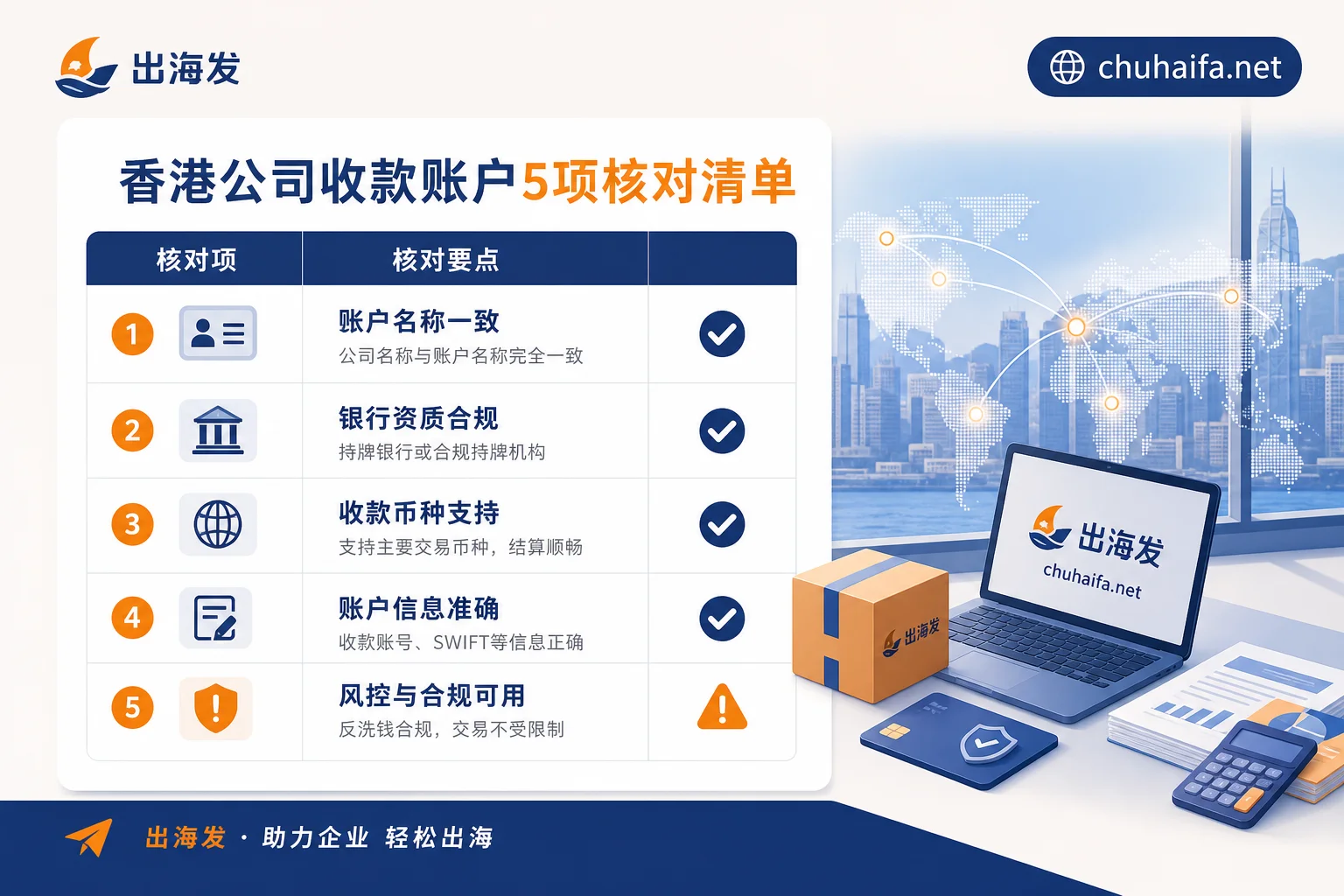
What cross-border payment platform should a Hong Kong company entity use? The answer is not to look at the brand first, but to see if the platform's receiving account can pass 5 entity adaptation checks: account name matches the company, sales revenue collection rights are not transferred, physical operation proof can be aligned, local clearing channels are complete, and multi-store sub-accounts can be isolated. After Amazon updated Section 18 of the Business Solutions Agreement (BSA) on August 24, 2026, the pledge of repayment rights for Hong Kong entity stores was locked down, and physical operation verification was simultaneously tightened. Now is the time to recheck account configurations according to these 5 items. Below is a quick reference table, followed by detailed explanations.
| Check Item | Core Judgment | New Changes in August 2026 |
|---|---|---|
| Account Name Matches Entity | Account name must strictly correspond to the company registration full name | Hong Kong company registration name case and punctuation are strictly compared |
| Sales Revenue Collection Rights Ownership | Must not be transferred or pledged to third parties without platform written permission | BSA Section 18 effective August 24 |
| Physical Operation Proof and Address Alignment | Utility/broadband bills, registered address, and account address must be explainable | Platform conducts large-scale verification of Hong Kong entity bills |
| Local Clearing and SWIFT Arrival Difference | Local clearing T0-1 business day, SWIFT T0-3 business days | Licensed institutions expand CHATS/ACH/FPS/MEPS networks |
| Multi-store Sub-account Isolation | One store, one account name, one account number, clear books, no risk penetration | Under new rules, repayment rights ownership needs to be confirmed per store |
For general selection logic not limited to Hong Kong entities, refer to How to Choose a Cross-Border Payment Platform.
Check 1: Is the Receiving Account Name Strictly Consistent with the Store Entity?
When a Hong Kong company opens an Amazon store, the receiving account name must strictly match the company's registered full name. Here, "match" means more than just the same letters; it includes case, spaces, punctuation, and the writing of "Limited" or "有限公司". For example, if the company is registered as "ABC TRADING (HK) LIMITED", writing the account name as "ABC TRADING (HK) LTD" may be identified as inconsistent.
Why is an inconsistent account name high risk? Because when the platform verifies the entity, it compares the store registration entity with the holder information of the receiving account. Once there is a mismatch, at best the repayment is intercepted, at worst it triggers store review. Can the receiving account name and store entity be inconsistent? Under compliance standards, the account name should be strictly consistent with the store entity; inconsistency is a high-risk configuration and must be corrected as soon as possible.
Suggested self-check action: Before opening an account, retrieve the company registration certificate and business registration certificate, and verify the account name word by word; if the account is already opened but the name has discrepancies, first contact the platform to confirm the supported name change process, then go through the rebinding or update process, keeping records of each step.
Check 2: Boundary of Sales Revenue Collection Rights—What Section 18 of BSA Locks Down
Amazon's Business Solutions Agreement (BSA) Section 18, effective August 24, 2026, directly changes the operational space for Hong Kong entity stores in terms of funds. The clause stipulates: without the platform's prior written permission, sellers must not transfer or pledge to third parties any operational rights and obligations, including the right to collect sales revenue. This means that the past practice of some sellers transferring store repayment rights to third parties through factoring companies or private agreements to get cash flow is now formally blocked.
This rule distinguishes two types of behavior: one is compliant withdrawal from a licensed receiving account—you receive store repayments to your own Hong Kong company account, then convert or withdraw, which is normal fund collection; the other is transferring the entire repayment right to a third party, such as signing a "repayment right pledge agreement" to a fund provider, which without platform endorsement is a violation.
Can store repayment rights be pledged to a third party? Strictly speaking, not without the platform's written consent. What you need to self-check now is: have you signed any factoring, advance payment, or repayment right transfer agreements in the past? If so, quickly verify whether these agreements involve actions prohibited by BSA Section 18, and evaluate whether you need to communicate with the platform to obtain written permission. This article does not expand on any circumvention paths; compliance boundaries must be maintained. Returning to the question "What cross-border payment platform should a Hong Kong company entity use?", any solution that requires you to transfer repayment rights in exchange for advance funding should be directly excluded.
Check 3: How to Align Physical Operation Proof and Account Registration Address
Does Amazon require Hong Kong entities to provide utility or broadband bills? Based on the current verification status, yes. Amazon is simultaneously conducting large-scale verification of physical operation utility/broadband bills for Hong Kong company registered stores. The key here is the consistency between "physical operation proof" and the address reserved for the receiving account.
Typically, materials needed include: utility or broadband bills for the office address from the last 6 months, where the address on the bill must be consistent with the company address in the store backend and the registered address of the receiving account, or have an explainable correspondence. If the company registration address is a secretary company address and the actual office is elsewhere, you need to prepare a lease contract, utility bills, and other evidence chain to explain.
It is important to clarify the factual boundary: Amazon has not yet published a whitelist of industries exempt from physical operation verification for Hong Kong entities; currently, affected sellers need to submit materials case by case. So don't wait until you are notified; clarify the bills and address alignment beforehand.
Check 4: How to Read the Arrival Difference Between Local Clearing (FPS/CHATS/ACH/MEPS) and SWIFT
For Hong Kong companies receiving trade payments, the speed depends on which clearing chain is used. According to the product documentation of WorldFirst updated in August 2026, after Hong Kong and Singapore local accounts access local clearing networks such as CHATS, ACH, FPS, and MEPS, the receiving arrival time is usually T0-1 business day (fastest same-day); while cross-border SWIFT wire transfers usually take T0-3 business days.
This time difference means, is local clearing faster or SWIFT faster for Hong Kong companies receiving trade payments? The answer is direct: local clearing is faster, SWIFT is slower. But which chain to use depends on three dimensions:
- Currency: Local currencies (such as HKD, USD within local clearing networks) are prioritized for local clearing;
- Account Location: Only accounts opened in Hong Kong or Singapore can access corresponding local clearing networks;
- Clearing Network Type: Whether the account supports CHATS/FPS/ACH/MEPS channels, not just SWIFT.
Additionally, regarding the rumor circulating online that "cross-border remittances over $1,000 will be fully frozen," here is a clarification: large remittances trigger KYC/due diligence verification processes of financial institutions, not freezing. Normal compliant trade payments can still be cleared within T0-1 or T0-3 timeframes. For cost differences beyond arrival time, see How Cross-Border Payment Fees Are Calculated.
Check 5: Why It Is Recommended to Isolate Receiving Sub-accounts for Multiple Stores/Sites
If you operate multiple Amazon stores or sites under a Hong Kong company entity, it is not recommended to share the same sub-account for receiving payments. Sharing the same receiving sub-account across multiple stores brings three hidden dangers:
- Ambiguous entity confirmation: Multiple store repayments mixed in one account, making it difficult to quickly correspond each fund to a store during platform verification;
- Difficulty in bookkeeping: When reconciling, it's impossible to match a specific repayment to a specific store one-to-one, increasing financial processing costs;
- Risk contagion: If one store has issues, the entire account may be suspended, affecting funds of other stores.
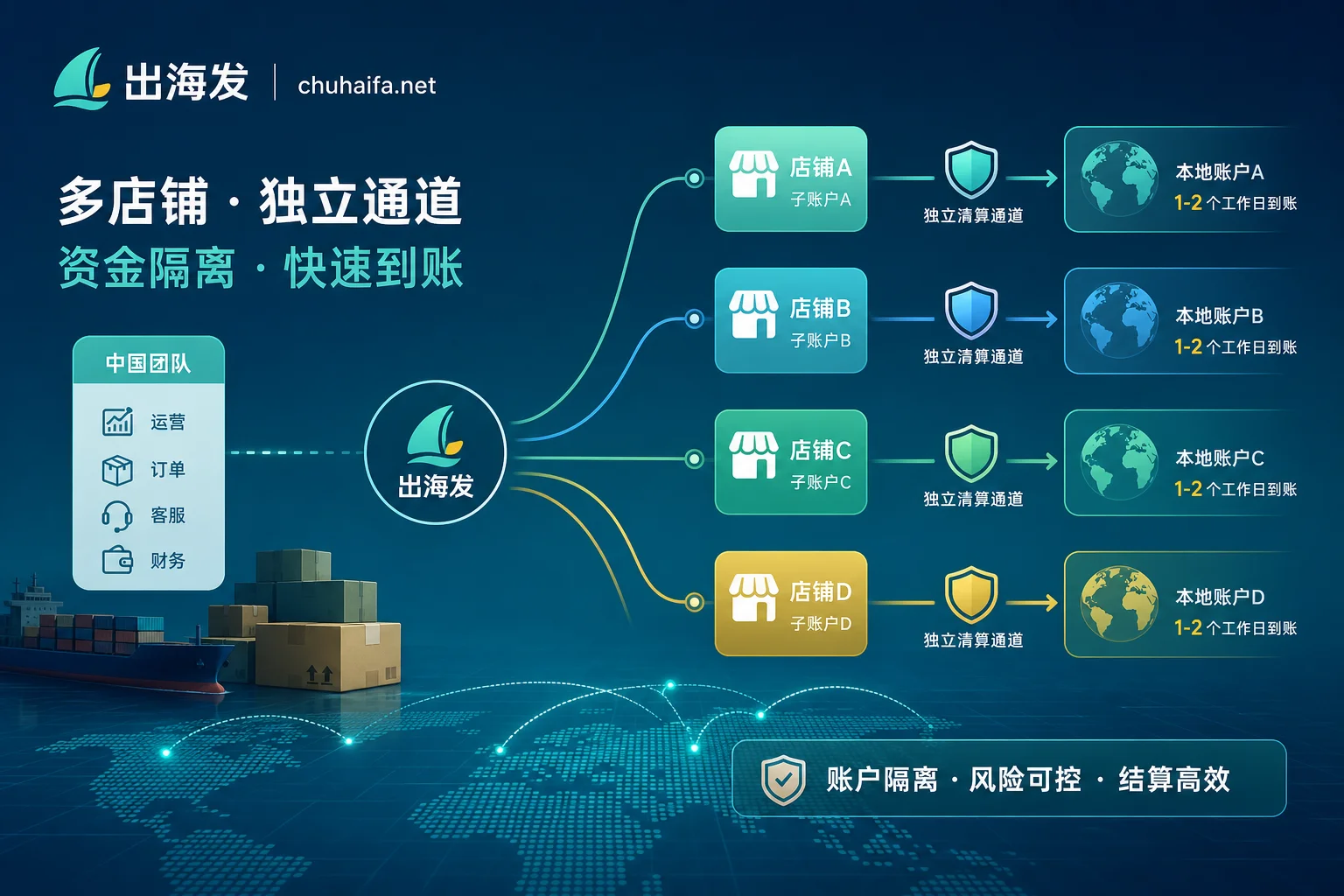
Recommended practice: Open independent receiving sub-accounts per store/site, maintaining a "one store, one account name, one account number" correspondence. This not only allows clear reconciliation but also facilitates confirming repayment rights per store under the new BSA rules.
Account Configuration Paths for Three Types of Hong Kong Entity Sellers: Single Store, Multi-store, B2B Foreign Trade
What cross-border payment platform should a Hong Kong company entity use ultimately depends on the specific business model: single store, multi-store, or B2B foreign trade have different answers.
Single-store sellers: First confirm whether the platform supports opening an account under the Hong Kong company entity and provides an account name matching the registered full name; prioritize licensed payment platforms with simple account opening processes and support for local clearing (such as FPS/CHATS), ensuring the account name is consistent, and prepare utility bills in advance.
Multi-store sellers: First confirm whether sub-accounts are independent accounts rather than virtual labels under the same account; the core is sub-account isolation. Confirm whether the platform supports opening multiple sub-accounts, each with independent account numbers and names, to bind different stores separately.
B2B foreign trade sellers: First confirm whether the in-transit period for non-local clearing currencies falling back to SWIFT is still within T0-3 business days; such sellers often receive payments in multiple currencies like USD and EUR, so it is recommended to choose platforms supporting multi-currency local accounts (such as USD ACH, EUR SEPA), while keeping SWIFT as a backup chain for non-local clearing currencies. If buyers are concentrated in Southeast Asia, refer to How to Receive Cross-Border Payments via Southeast Asian Local Bank Accounts.
For each type of seller, one thing must be confirmed before opening an account: whether the platform supports opening an account under a "Hong Kong company entity" and can provide an account name consistent with the company name.
Account Opening and Binding Self-Check Checklist
Condensing the above five items into a table gives an executable answer to what cross-border payment platform a Hong Kong company entity should use.
| No. | Check Item | Pass Criteria |
|---|---|---|
| 1 | Company registered full name exactly matches account name | Letters, case, punctuation, Limited/有限公司 writing all match |
| 2 | Store entity bound to receiving account matches account name entity | Backend entity info corresponds to account holder info |
| 3 | Sales revenue collection rights not transferred or pledged to third parties | No factoring/pledge agreements without platform written permission |
| 4 | Physical operation utility/broadband bills available for last 6 months | Bill address explainably consistent with store registered address |
| 5 | Account supports Hong Kong local clearing (FPS/CHATS etc.) | Arrival time T0-1 business day |
| 6 | Cross-border SWIFT chain available as backup | Arrival time T0-3 business days |
| 7 | Sub-accounts independent for multiple stores | One store, one account name, one account number |
| 8 | Account opening materials archived completely | Registration certificate, business registration, bills, lease contract, etc. stored |
| 9 | Quarterly review of account and agreement status | No new pledge or transfer behaviors |
This checklist can be directly reused; candidate account forms can be compared item by item by currency and clearing channel under the "Overseas Payment" category on the going-global platform.
Frequently Asked Questions
What account should a Hong Kong company use to receive payments for an Amazon store?
For a Hong Kong company entity opening a store on Amazon, it is recommended to choose a licensed cross-border payment platform that supports Hong Kong local clearing (such as CHATS/FPS), ensure the account name is consistent with the company registration full name, and open a multi-currency or HKD local account for faster arrival.
Does Amazon require Hong Kong entities to provide utility or broadband bills?
Yes. Since August 24, 2026, Amazon has been conducting large-scale verification of physical operation addresses for Hong Kong entities, typically requiring utility or broadband bills from the last 6 months. The official whitelist of exempted industries has not been published; currently, materials need to be submitted case by case.
Can the receiving account name be inconsistent with the store entity?
No, it is not allowed and is a high-risk configuration. The platform will compare the account holder with the store entity information; inconsistency may lead to delayed repayments or account anomalies. It should be corrected to be consistent as soon as possible.
How long does a Hong Kong FPS transfer take to arrive?
FPS (Faster Payment System) is one of Hong Kong's local clearing networks. When a cross-border payment platform uses local clearing for deposit, the arrival time is usually T0-1 business day (fastest same-day), depending on the processing times of the receiving institution.
Which is faster for a Hong Kong company receiving trade payments: local clearing or SWIFT wire?
Local clearing is faster. Using local networks like CHATS/FPS/ACH/MEPS for receiving usually arrives within T0-1 business day, while SWIFT wire transfers take T0-3 business days. For large B2B payments, local clearing can be prioritized.
Can store repayment rights be pledged to a third party?
Amazon BSA Section 18 stipulates that without the platform's written permission, sales revenue collection rights must not be transferred or pledged to third parties. Therefore, factoring or pledge operations without official endorsement are prohibited; the compliant path is to obtain the platform's written consent.