

First, break down the cost of your AI export tool into two independent accounts: the platform-side per-message channel fee and the model-side token consumption fee. These two layers are billed separately and do not overlap; combined, they represent your true monthly bill. Taking the WhatsApp ecosystem as an example, according to third-party pricing interpretation (intelli.chat, August 6, 2026), as of August 1, 2026, the built-in Meta Business Agent generative AI conversations are billed per token, with a unified global benchmark rate of $2 per 1 million tokens (this fee already includes AI processing and message delivery). Meanwhile, starting October 1, 2026, non-template messages within the 24-hour customer service window will resume per-message billing, ending the free period that has been in place since November 2024. Understanding these two layers is the first step in budgeting for AI export tools. This article's billing basis is compiled based on public interpretations as of August 2026. Meta has not yet released a country-specific per-message rate table. Please refer to official developer documentation and your BSP's billing terms for formal rates and effective details.
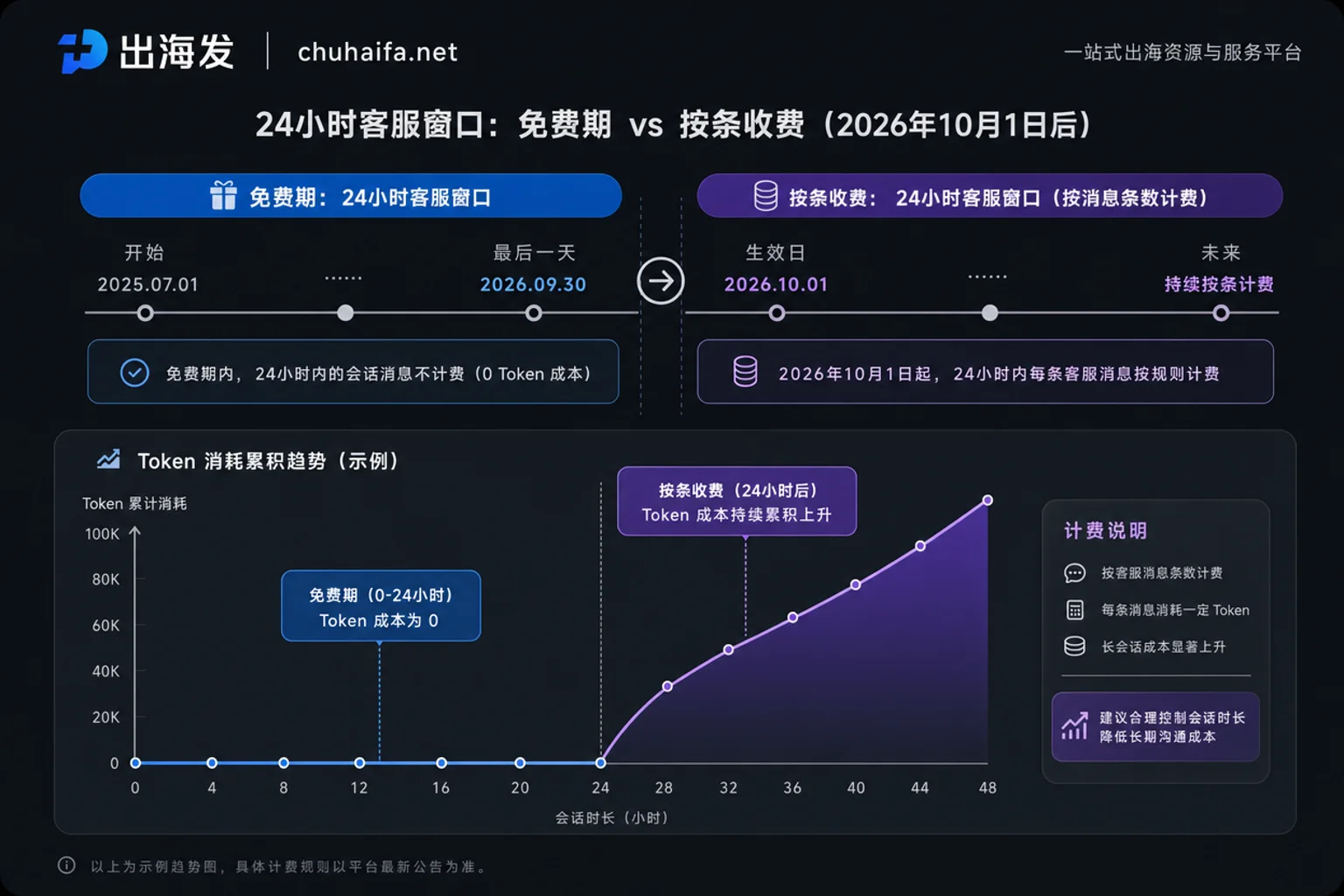
How to Read the Platform-Side Billing: Differences Between Free Window, Per-Session Billing, and Per-Message Billing
WhatsApp's platform message billing actually has three different categories, and the most confusing boundary for overseas teams is between the “free window” and “per-message billing.”
- 24-hour customer service window: Within 24 hours after the user's last message, any reply you send (including AI auto-replies) falls within the customer service session window. Messages in this window are currently free, but this free period will end on October 1, 2026.
- Template messages: After the 24-hour window, you can only send pre-approved template messages (e.g., order notifications, marketing campaigns). These have always been billed per message, with prices varying by country.
- Per-message billing (service messages): Starting October 1, 2026, non-template messages within the 24-hour window (i.e., customer service session messages) will resume per-message billing. Meta officially plans to release the country-specific base price table on September 1, 2026.
Many cross-border communities claim that “customer service messages are permanently free,” which is a misunderstanding of the free period. The free period ends on October 1, 2026, after which every customer service message will incur a fee. So, those “free” customer service sessions you see now will become a linear cost on your bill come October.
How to Read the Tool-Side Billing: Where Token Consumption Occurs and What Hidden Usage Looks Like
If the platform side charges per message, the AI tool side charges per token. A token is the smallest unit of text processed by a model, roughly equivalent to a word or a character fragment. Every time a third-party AI customer service tool generates a reply, it consumes tokens.
The key lies in hidden consumption. Many teams assume tokens are only spent on “user input + AI output,” but there are at least four hidden sources:
| Hidden Token Source | Description | Impact on Cost |
|---|---|---|
| System Prompt | Instruction text carried with each request, e.g., “You are a customer service assistant for a brand” | Fixed overhead, accumulates linearly with request count |
| RAG Retrieval Context | Relevant snippets retrieved from the knowledge base, concatenated into the prompt | Single consumption can be large, depends on retrieval length |
| Multi-turn Historical Dialogue | To maintain context, the model needs to include previous turns | The longer the conversation, the higher the token consumption per reply |
| Tokenization of Lesser-Used Languages | Non-English characters (Thai, Vietnamese, Arabic) have higher tokenization density | For the same content, token count may be several times higher |
Take a long conversation: a customer chats 20 turns. When replying to the 20th turn, the model must re-process the entire text of the previous 19 turns. You see a simple “OK” for the 20th turn, but the backend may burn tokens equivalent to the sum of the previous 19 turns. That's why the cost per reply in long conversations rises cumulatively.
Estimating Per-Customer Cost After Stacking the Two Layers: A Formula You Can Apply
Combining the two layers, the monthly cost per customer can be estimated as:
Monthly cost per customer = Number of conversations × Messages per conversation × Platform per-message unit price + Number of conversations × Tokens per conversation × Model unit price
Here, the platform per-message unit price can only be filled in after Meta releases the country-specific price table on September 1, 2026. For the model side, the only public benchmark currently available is Meta Business Agent's $2.00/1M tokens (third-party tools may differ; refer to your actual contract).
In practice, we recommend exporting last month's actual conversation data and counting three numbers: total conversations, average messages per conversation, and average tokens per conversation (most AI tools provide token usage reports in their backend). Plug these into the formula to get a rough monthly cost baseline. Don't use an estimated “average customer value” to work backwards—it hides the cost amplification from long conversations and rich text.
Reverse-Engineering Selection Criteria for AI Export Tools: Billing Transparency, Usage Visibility, Limits and Downgrades
With an understanding of the cost structure, you can now check tools against it. Don't just look at whether they say “per-token billing”; see if they can actually account for costs clearly.
| Selection Check | What to Ask | Why Ask |
|---|---|---|
| Billing transparency | Does the invoice distinguish platform channel fees from model fees? | To avoid mixing the two and making attribution impossible |
| Token usage visibility | Do you provide per-conversation token breakdowns? | Long-conversation costs can be traced to specific customers |
| Budget cap and downgrade | Do you support monthly budget caps? On overrun, auto-downgrade or hard stop? | To keep bills from spiraling |
| Whether AI replies incur an extra message fee | Does an AI auto-reply within the 24-hour window count as a platform message? | This fee will become real after October |
Special attention to “whether an AI reply counts as a message fee”: based on the currently public window billing policy, messages replied within the window are typically billed as customer service messages, but whether AI auto-replies are classified separately or charged additionally by the tool provider—there is no unified detail from Meta or BSPs yet. You must confirm in writing with each provider during selection. After October 1, AI replies within the window will likely incur platform per-message fees, so be sure to ask: do AI auto-replies go through the platform channel? Are they counted in the message count? Are they billed separately?
Configuration Paths for Three Types of Teams: Small Teams, Single Market; Multi-Market, Multi-Language; Customer-Support-Heavy
Different team structures require different configuration strategies and cost control priorities.
- Small teams, single market: Shorten the context length, e.g., keep only the last 5 turns of dialogue, significantly reducing token consumption. Also, make knowledge base chunks smaller to retrieve only the most relevant paragraphs.
- Multi-market, multi-language: Lesser-used languages have higher tokenization density, so the token count for the same content will rise noticeably. The exact multiplier varies by language and model tokenizer—run a real test with your own lesser-used language conversation samples before setting a buffer ratio, rather than directly applying a general percentage. Also, use a more streamlined system prompt to avoid stuffing useless information.
- Customer-support-heavy (high-frequency, long conversations): Set a higher “manual fallback” ratio. Conversations the AI can't handle should be transferred to humans quickly, preventing the AI from burning tokens meaninglessly in long sessions. Set a maximum number of AI reply turns, forcing human handover beyond that.
These three configurations are not fixed formulas; they help you anchor your cost priorities according to business type. According to billing models (per-message channel fee type / per-token type / hybrid type), AI customer service and messaging automation tool resources are categorized. You can check billing descriptions for WhatsApp marketing tools and AI marketing tools. You can also visit Meta's WhatsApp Business Platform pricing documentation page and your BSP's pricing change announcements to cross-check rates. This article could not obtain a second independent accessible source for cross-verification; readers should defer to official documents.
Pre-Launch Cost Self-Checklist and Common Misconceptions Clarified
Before going live, run through this checklist to avoid most billing surprises:
- [ ] Confirm the platform's base per-message price (wait for September's country price table)
- [ ] Confirm whether the AI tool provides token usage reports
- [ ] Set monthly budget caps and overrun downgrade policies
- [ ] Confirm whether AI replies incur an additional platform message fee
- [ ] Test actual token consumption with lesser-used language samples
- [ ] Run the cost formula with last month's actual conversation data
Also, clarify two widespread claims:
- “WhatsApp customer service messages will be permanently free”: This is a misreading. The free period ends on October 1, 2026, after which per-message charges resume.
- “Meta Business Agent double charging”: Based on current public interpretation, the $2.00/1M tokens rate already integrates AI processing and message delivery; no additional message delivery fee has been seen. We recommend requesting written billing terms from your BSP to confirm.
Additionally, you can refer to the WhatsApp marketing tools and AI marketing tools categories to check billing descriptions.
FAQ
Will WhatsApp customer service messages be charged starting October 1?
Yes. Starting October 1, 2026, non-template messages within the 24-hour customer service window will resume per-message billing. Meta will release country-specific price tables on September 1, 2026; we recommend checking official announcements then.
How is AI customer service tool per-token billing calculated?
It mainly depends on two factors: the number of tokens consumed per request (including system prompt, historical conversation, RAG context) and the model's token unit price. For example, Meta Business Agent's benchmark price is $2/1M tokens, but third-party tools may add a margin or charge based on plans.
Does an AI reply count as a message fee?
Based on the currently public window billing policy, messages replied within the window are typically billed as customer service messages, but whether AI auto-replies are classified separately or charged additionally by the tool provider—there is no unified detail from Meta or BSPs yet. You must confirm in writing with each provider during selection.
How much does an AI export tool cost per month?
There is no fixed amount. Use the formula: Number of conversations × Messages per conversation × Platform per-message unit price + Number of conversations × Tokens per conversation × Model unit price. The platform per-message unit price can only be filled in after Meta's September 1, 2026, country price table is released. The model-side public benchmark is only Meta Business Agent's $2.00/1M tokens; third-party prices depend on actual contracts. Therefore, no single price range is provided.
How does Meta Business Agent billing work?
It is billed per token, with a global benchmark of $2/1M tokens, covering AI processing and message delivery (based on current public interpretation). If you use AI via a BSP or third-party tool, their service fees are added on top.