
In late October 2026, Google Ads released several important updates that directly affect the daily operations of overseas advertisers: First, AI Mode ads officially expanded to 10 new countries including Australia, Canada, India, and Singapore, and launched "Multiturn Ads" in the US that support follow-up scenarios; Second, the Google Developer Blog confirmed that starting December 4, newly created Performance Max (PMax) campaigns will default to forced automatic image extraction from landing pages, even if dynamic image extensions are turned off at the account level, the individual campaign will still take effect by default.
Combined with the previously fully rolled out AI Max search ads (including the AI Brief natural language control layer) and Asset Studio's built-in 33-language AI video dubbing, the underlying logic of Google Ads has completely changed:
In the past, media buyers could achieve stable ROAS with "fine keyword segmentation + manual bid control"; now the average search query length has become 3 times that of traditional search, and a large number of impressions occur in AI Overviews and AI Mode generative answers—if you only run traditional exact match or phrase match standard search ads, your ads may not even be eligible to enter the display pool of AI Overviews and AI Mode. But conversely, if you hand your budget directly to PMax or AI Max without safeguards, lacking high-quality conversion signals, compliant landing page assets, and strict negative keyword guardrails, the budget will quickly be consumed by low-quality placements and irrelevant long-tail terms.
Facing increasingly powerful platform automation, you need a Google Ads tool combination that integrates external and official tools to "feed the right materials and set rules" for AI. If you are still looking for tools here and there, you might as well follow this "four-layer collaborative architecture" to straighten out your team's advertising toolbox once and for all.
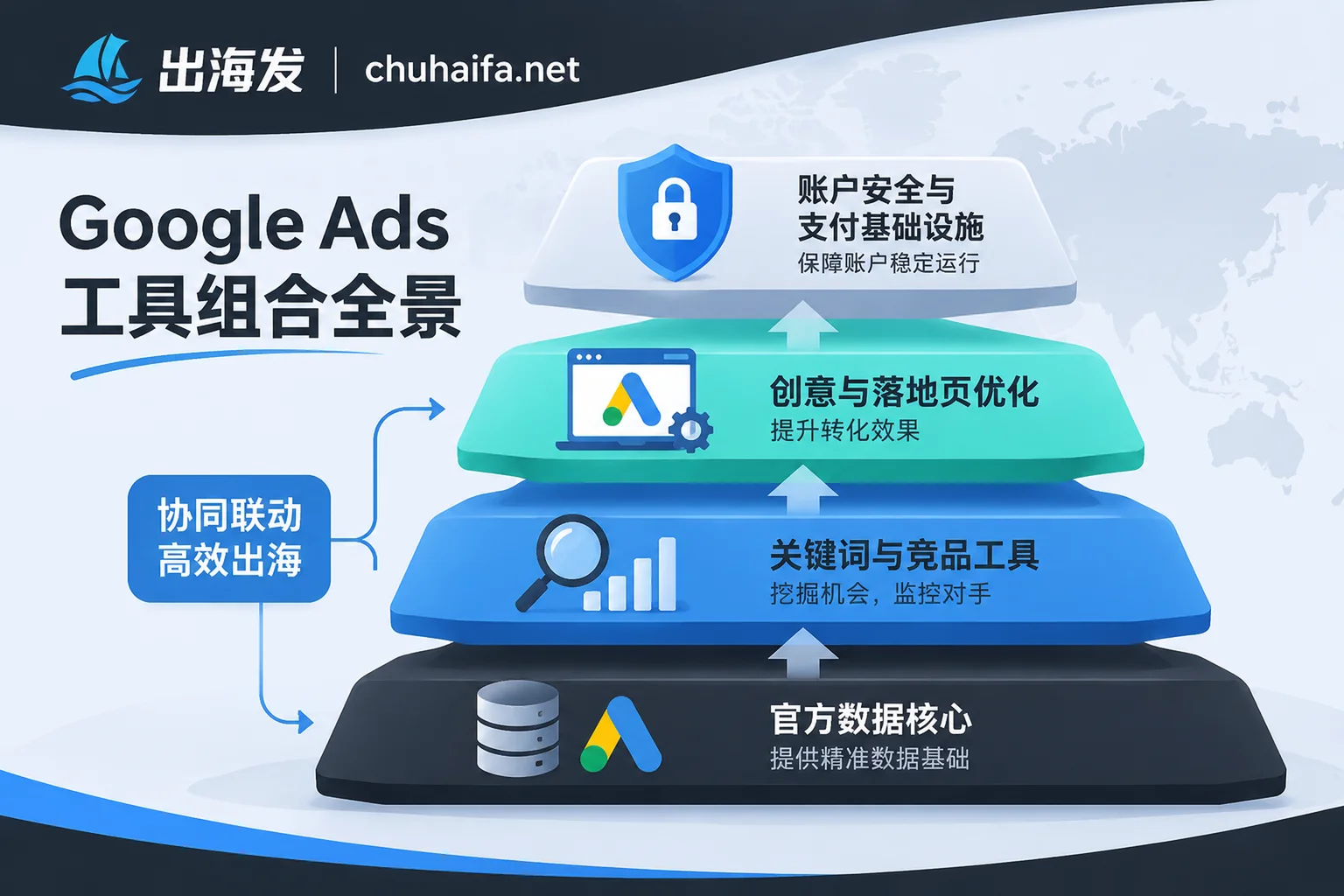
1. Official Core Foundation: Don't Just Stare at the Ads Dashboard, First Connect the "Data Iron Triangle"
Many small teams that have just entered the independent site or B2B overseas market still understand Google Ads tools as merely the Google Ads dashboard. But under the 2026 algorithm mechanism, Google Ads, Google Analytics (GA4), Google Tag Manager (GTM), and Google Merchant Center (GMC) are already deeply integrated through the underlying Data Manager and the built-in intelligent agent Ask Advisor.
- Use GTM+GA4 to feed accurate first-order conversion signals
In its September update, Google integrated Data Manager directly into GA4 and launched the "Data Strength Uplift Metric". For e-commerce and B2B lead generation sites, relying solely on browser-side cookies already misses a large number of conversions. Media buyers must use Tag Manager to configure Enhanced Conversions and send cleaned first-party purchase data or real valid leads back to the system. This is also the core infrastructure we emphasized earlier in "How to Match Overseas Promotion Tools Without Pitfalls: First Distinguish B2B Lead Generation vs. B2C Conversion, Then Equip the Tool Stack According to the Customer Acquisition Path". - Use GMC and Search Console to capture AI Mode traffic
In the latest AI Mode conversational search, the system not only looks at keywords but also directly extracts structured attributes from GMC product feeds to answer users' multi-turn follow-up questions (for example, a user first asks "how to choose a certain type of equipment," then follows up with "which one has the best value for money"). At the same time, use Search Console to identify query terms with high organic impressions but low clicks, and use Google Trends to capture seasonal rising terms in regional markets in advance, which can help you write the "AI Brief" in AI Max and the search themes for PMax more quickly.
Tool Direct Access Suggestion: For official entrances such as Ads, Analytics, Search Console, Tag Manager, Merchant Center, and Trends that are used frequently daily, as well as accompanying Google plugins, you can directly access them one-stop in the Google Zone of ChuhaiFa, saving the time of flipping back and forth among multiple account bookmarks.
2. Search Intent and Competitor Intelligence: Use Third-Party Tools to Draw "Guardrails" for AI Max
After enabling AI Max and broad match, Google's "keywordless" technology will automatically expand traffic based on your landing pages and existing creatives. Many media buyers complain that after enabling it, a large number of junk terms appear. The core reason is the lack of a precise negative keyword library and intent boundaries in the early stage.
In this环节, the official keyword planner often lacks granularity. You need two types of third-party tools to cooperate:
1. Keyword and SEO Tools: Dig Out "High-Intent Long-Tail" and "Industry Negative Word Lists" in Advance
Before enabling AI Max's URL expansion or PMax, use third-party keyword tools and SEO tools to pull out competitors' core traffic word lists. On the one hand, extract high commercial value comparison and review terms into PMax's "audience signals" and "search themes"; on the other hand, organize terms with free, tutorial, second-hand, repair, or competitor brand into account-level Negative Keyword Lists. To learn how to choose such tools at different stages, you can refer to "How to Choose Google SEO Tools: Don't Buy a Full SaaS Suite Right Away, Build a Four-Layer Tool Stack According to the Website Building Stage". These word libraries and Google plugins are also collected under the Google Category.
2. Ad Monitoring Tools: See What Competitors Are Running in Demand Gen and YouTube
As Google accelerates the migration of traditional display ads to Demand Gen, and PMax increases the weight of video and high-quality images, the premium space for pure text search ads is narrowing. Before creating creatives, use the ad monitoring (creative intelligence) tools in Ad Tools to check top competitors in the target market. For how to filter out filler creatives and identify opponent creatives that truly achieve ROI, you can combine with the method in "How to Judge Whether a Creative Is a Real Hit with Ad Monitoring Tools: Look at the 3 Signals of Placement Duration, Number of Variants, and Landing Page" for practical operation.
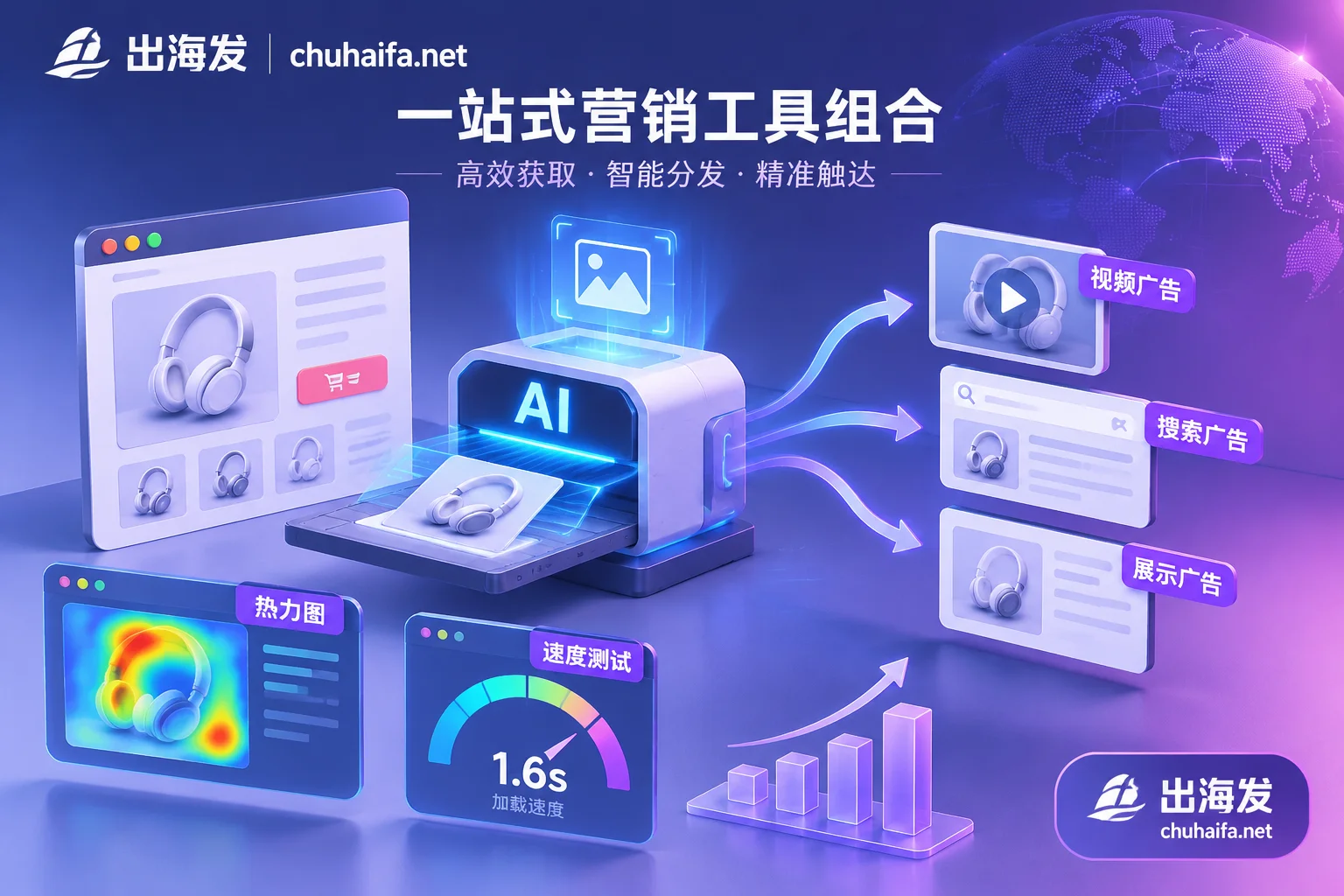
3. Creative Production and Landing Page Detection: Catch PMax's "Automatic Image Extraction" and Traffic Reception
As mentioned earlier, starting December 2026, newly created PMax campaigns will default to enabling GENERATE_IMAGE_EXTRACTION (automatic landing page image extraction). This means Google AI will automatically scan the final URL you provide and extract high-resolution images from the page to serve on YouTube, Discover, Gmail, and the Display Network.
This poses two extremely practical tool requirements for advertisers:
- Lander Production and Visual Creative Compliance
If your landing page still has rough white-background images without background removal, banners with exaggerated non-compliant copy, or poorly laid out collages, after being automatically extracted by AI and synthesized into ads, not only will the click-through rate be dismal, but it is also very likely to trigger ad policy disapprovals. Before using Google's official Asset Studio for localized derivatives, it is recommended to first use Lander production, copywriting tools, creative editing, and stock image websites under the Content Production category to polish the first screen visuals and product detail images of the landing page; when you need to batch-generate multilingual scripts or visual drafts, you can also combine with AI writing and AI design tools in AI Tools for efficiency. - Detection Optimization and Independent Tracking System
When AI Max enables Final URL Expansion, the system will send users to any internal page it deems most relevant. If some internal pages load too slowly or mobile buttons are blocked, the expensive AI search clicks will bounce directly.
Therefore, before scaling, be sure to use the detection optimization tools (speed test, heatmap, landing page A/B testing) in Ad Tools to check the loading speed and user scroll heat zones of each core landing page; for teams running affiliate programs or needing cross-channel attribution comparison, they also need to set up an independent tracking system under this category to avoid data inflation caused by single-platform self-attribution.
| Advertising Stage | 2026 Google Ads Core Pain Points | Essential Tool Types | ChuhaiFa Corresponding Navigation Entry |
|---|---|---|---|
| Underlying Infrastructure and Signals | AI Overviews and AI Mode eat traditional clicks, algorithm heavily relies on first-party conversion data | Google Official Suite (Ads / GA4 / GTM / GMC / Trends) | Google Zone |
| Scaling and Risk Control Guardrails | AI Max and PMax automatic keyword expansion easily go off track, lack competitor visual references | Keyword tools, Google plugins, ad monitoring (creative intelligence) | Google Zone / Ad Tools |
| Creative and Landing Page Conversion | PMax defaults to extracting landing page images, URL expansion tests site-wide loading and reception | Lander production, creative editing, speed test and heatmap, A/B testing, tracking system | Content Production / Ad Tools |
| Account Environment and Payment | Cross-region advertising preview, multi-account anti-association, high-frequency ad spend deduction risk control | Virtual credit cards, fingerprint browsers, overseas IP proxies, IP environment detection | Overseas Payment / Overseas Recommendations |
4. Account Security and Payment Infrastructure: Don't Let Underlying Risk Control Block Q4 Peak Season Scaling
No matter how well the tool stack is built, if the account is suspended due to abnormal environment or payment failure (Suspicious Payments / Circumventing Systems), all previous tests will be reset to zero. Especially when expanding to the 10 newly opened AI Mode country markets, or when opening multiple accounts to test different categories during peak season, the underlying infrastructure must be solid:
- Cross-region Preview and Multi-Account Anti-Association Environment: When checking search result page previews for specific countries (such as Canada, Singapore, Australia), or managing multiple sites and MCC sub-accounts, never frequently switch under the same local browser and changing IP. You can configure stable overseas IP proxies through Overseas Network, and use Fingerprint Browsers for environment isolation; if you want to equip proxy IPs, fingerprint browsers, and SMS verification services within one ecosystem, you can directly check NexIP, NexBrowser, and NexSMS in Overseas Recommendations (specific functions and operations are handled by their respective official websites). Before logging into core ad accounts each time, use the IP environment detection tool in Common Recommendations to verify purity.
- High-Frequency Deduction and Multi-Currency Payment Guarantee: Google Ads deducts funds extremely frequently during budget scaling periods, and ordinary cards are easily declined due to risk control, causing ads to be interrupted. In the Overseas Payment category, prepare cross-border payment accounts supporting multi-currency settlement and high-approval-rate virtual credit cards in advance, achieving "one account, one card, dedicated card for dedicated use." For the overall compliant construction of the funding chain, you can also read "How to Choose a Cross-Border Collection Platform: Under Tax Reporting and Data Penetration, Build a Complete Funding Chain According to 'Front-End Acquiring—Platform Repayment—Multi-Currency Allocation'".
Conclusion: Leave Energy for Strategy, Let the Navigation Site Handle Tool Discovery
In 2026, Google Ads advertising is no longer a game you can win just by "knowing how to read dashboard reports." After AI Max, AI Mode, and PMax take over bidding and matching, the competitiveness of media buyers depends on whether they can use the right tools to feed the algorithm more accurate first-party conversion data, clearer negative keyword guardrails, more compliant visual creatives, and smoother landing pages.
If you are organizing or upgrading your team's Google Ads tool stack, you don't need to try and error one by one in search engines. Open the ChuhaiFa Homepage, whether it's the official dashboards and keyword tools in the Google Zone, or the creative intelligence and landing page detection in Ad Tools, each listing provides a direct link to the official website without intermediate redirect pages. Only by equipping a handy toolbox first can you stabilize your position in the upcoming peak season traffic competition.