
Many teams that are new to or preparing to scale up often have several cloud drive lists of 50-60 software tools when searching for "TikTok operations tools." After buying a round of SaaS memberships according to the list, they find that some functions are already provided for free in TikTok's official backend, while the real bottlenecks—network environment, batch secondary creation, and private domain engagement—are still being handled manually.
Especially after TikTok's official series of integrations of commercialization tools, the first step in tool selection is no longer "finding more third-party plugins," but rather first understanding the capability boundaries of official free tools, and then spending budget on hard needs that the official tools cannot meet.
1. First, Understand the Foundation of TikTok's Official Tools: Where Should You Not Spend Money?
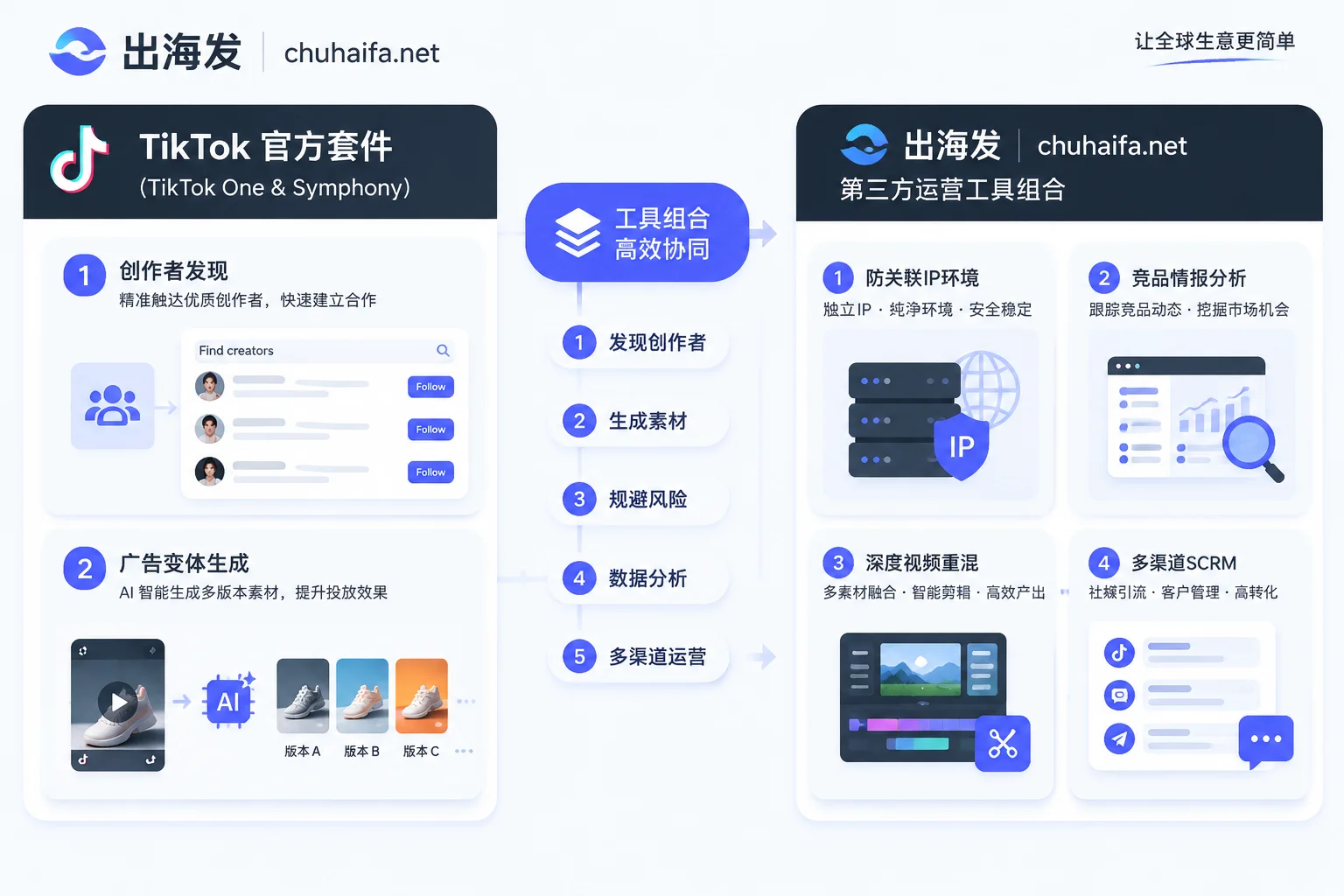
Over the past two years, TikTok has merged several previously scattered backends into two core hubs. Before paying for third-party tools, make full use of these two official free foundations:
1. TikTok One: Where Did the Original TCM and Creative Center Go?
Many veteran operators are used to looking for TikTok Creator Marketplace (TCM) or Creative Center. These entry points have now been integrated into the one-stop creative platform TikTok One.
- What the official platform can do: In the Chinese backend's "Creator Plaza," you can filter creators by individual country/region, view basic performance metrics, initiate brand collaboration invitations, and view Top Ads trending ad rankings and popular music trends.
- What the official platform cannot do: It mainly serves brand campaigns and Spark Ads, and is not equivalent to TikTok Shop Seller Center's affiliate collaborations (Open/Target Collaboration); it also does not support cross-platform influencer vetting (e.g., comparing YouTube and Instagram simultaneously), nor can it replace internal batch sample follow-up and off-site outreach workflows.
2. TikTok Symphony: Can Official AI Replace Editing Tools?
TikTok's generative AI suite Symphony (including Creative Studio, Automation, and digital human Product Avatars, etc.) is now deeply embedded in advertising processes such as Smart+.
- What the official platform can do: Automatically capture information from product links to generate mixed-cut videos, use authorized digital humans for multilingual voiceovers, and automatically generate variant assets in ad delivery.
- What the official platform cannot do: Symphony's core logic is to quickly supplement test variants for "paid advertising." If you are running organic matrix accounts, need to finely process local influencer live-action footage, or need to download reference videos from other platforms without watermarks and perform deep visual reconstruction, you still need professional external content production and AI tools.
2. Where Official Tools Fall Short: Fill the Gaps with Third-Party Tools in These 4 Modules
After treating the official backend as a "standard exam," the TikTok operations tools that teams truly need to purchase or combine externally are concentrated in the following four modules:
Module 1: Foundational Network and Multi-Account Anti-Association Infrastructure (Determines Account Survival)
TikTok strictly verifies account environment consistency. Whether running a TikTok Shop multi-site store matrix or organic matrix accounts, once there is IP jumping between countries, DNS leaks, or identical device hardware parameters, new accounts may easily get 0 views or even face associated bans. If you are stuck with view count issues, you can first refer to this article "Where to Start Checking When Product Videos Have No Views: First Distinguish Between 0 Views or Stuck at Hundreds, Then Troubleshoot in Five Steps" for a comprehensive diagnosis.
When setting up the environment daily, you need to equip the following four types of tools:
- Clean Network and Environment Self-Check: Bind a fixed, clean residential proxy IP to each core account. Before each live stream or video post, use the IP environment detection tool in Common Recommendations to check whether the disguise degree, time zone, and DNS are consistent. Proxy nodes can be compared and selected in the Overseas Network category, or you can directly check NexIP in Going Global Recommendations.
- End-to-End Isolation Containers: If managing multiple store backends, ad accounts, or web versions on a computer, you must use an anti-detect browser (or NexBrowser in Going Global Recommendations) with independent IPs to isolate cookies and software/hardware fingerprints; if your team heavily relies on the app for browsing videos to nurture accounts and live streaming with shopping carts, you can find suitable cloud phones or Android emulators in the Traffic Tools section to replace a desk full of second-hand real devices.
- Batch Registration and Verification: When lacking overseas phone numbers or email addresses during the matrix account setup phase, you can solve this through SMS verification and virtual email tools under the Overseas SMS Verification category, or directly use NexSMS.
Module 2: Product Selection Analysis and Ad Intelligence Spy (Determines Entry Direction)
The official Creative Center only shows general industry popular ads, but for TikTok Shop product sales or ad投放, you need to know "which product suddenly surged in the last three days" and "how competitors' independent site landing pages are set up":
- Store Product Selection and Sales Data: To see competitors' daily order volume, GPM of sales videos, and which mid-tail creators are actually generating sales, you need product selection analysis tools under the Cross-border E-commerce category.
- Viral Creative Breakdown: To uncover competitors' running dark posts and landing page structures, go to Ad Tools and use professional ad monitoring (creative intelligence) and tracking systems. For how to filter out self-indulgent creatives and pick truly profitable benchmark videos, we have a detailed breakdown in "How to Judge Whether Ad Monitoring Tools Identify True Viral Hits: Look at These 3 Signals: Delivery Duration, Number of Variants, and Landing Page".
Module 3: Localized Creative Production and AI Efficiency (Determines Content Capacity)
Although US TikTok product videos have a high daily posting limit, maintaining a stable daily posting rhythm is more conducive to algorithm distribution (see "How Many TikTok Product Videos Can Be Posted Per Day: US Limit is 30, Daily 3-5 is More Stable"). To feed the algorithm without significantly increasing editing manpower, the toolchain should be configured around "breakdown—reconstruction—landing":
- Raw Material Acquisition and Editing: In the Content Creation category, first use video download tools to save benchmark materials for studying storyboards, then use copywriting tools, material editing, and stock image websites to complete deduplication editing and subtitle packaging; teams doing independent site traffic can also find handy Lander creation tools in this category to quickly build high-converting landing pages.
- AI Batch Creation and Computing Power Support: To write authentic American slang scripts and generate product background images, you can directly use AI writing and AI design tools in AI Tools; if the team has deployed open-source video generation models or voice cloning models for high-intensity mixed editing, local GPUs often cannot handle it. In this case, you can rent GPU computing power on demand through NexGPU in Going Global Recommendations.
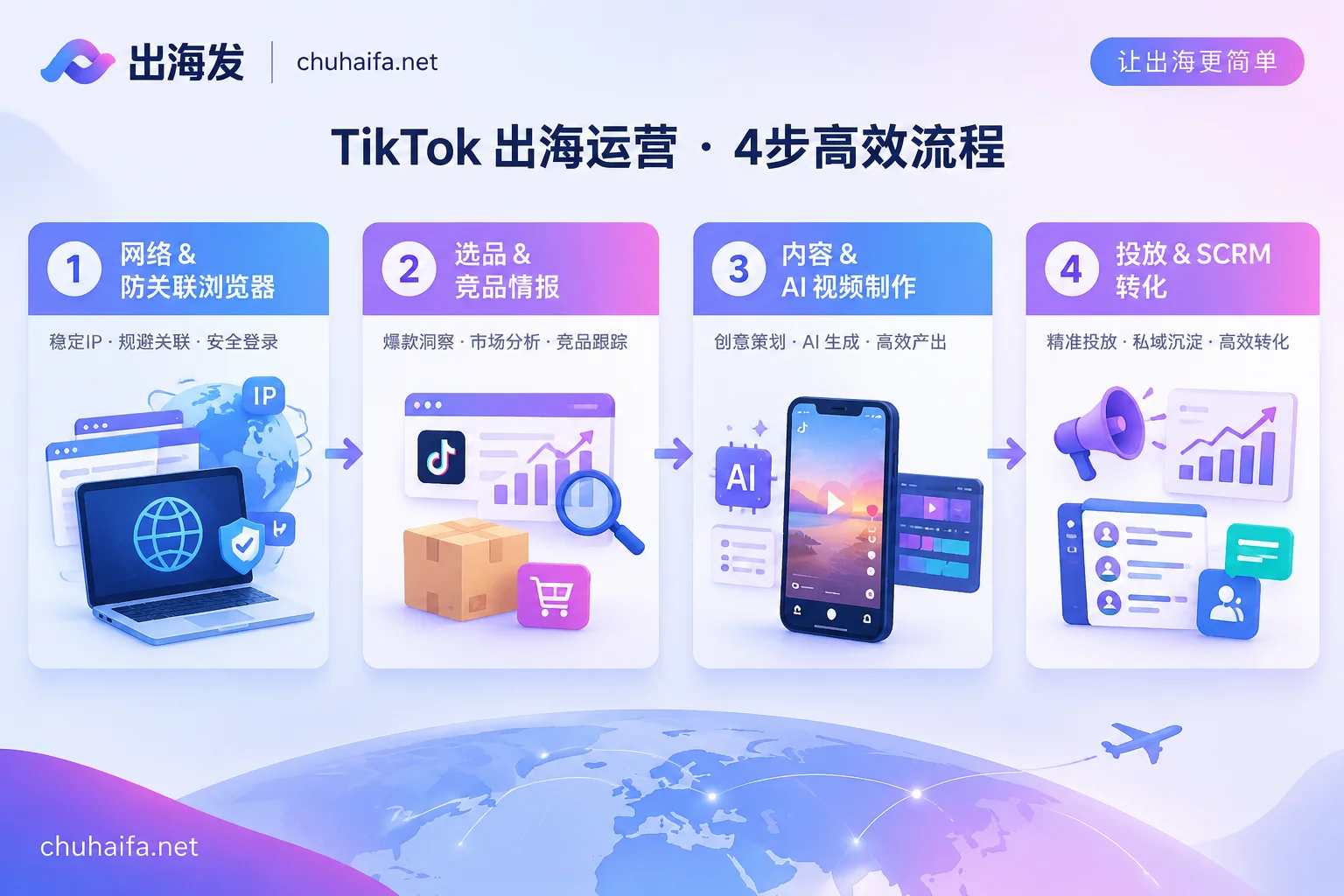
Module 4: Influencer Outreach, Scheduling and Publishing, and Private Domain Engagement (Determines Conversion Loop)
After content is published and influencers are contacted, the biggest fear is disconnection between stages—missing the golden posting time due to time differences, influencers going silent after receiving samples, or customers from bio links not being responded to in time:
- Cross-Timezone Scheduling and Influencer Marketing: In the Overseas Promotion category, you can use social marketing (scheduled publishing, social media management, account data) tools to schedule finished videos at active times in target markets; combine with influencer marketing and EDM marketing tools to send bulk outreach emails to a large number of sales influencers. For how to precisely align with each country's schedule, refer to "How to Schedule Overseas Short Video Marketing: First Set Time Zones, Then Phased Frequency, Finally Use Scheduling Tools".
- Private Domain Number Filtering and Multilingual Engagement: Teams doing B2B foreign trade inquiries or high-ticket independent sites usually direct TikTok traffic to WhatsApp or Telegram for conversion. In Going Global Recommendations, you can first use NexCheck to batch filter and clean collected numbers, then use NexSCRM (multilingual social SCRM) to aggregate multiple social media customer service accounts and handle global inquiries with real-time two-way translation.
- Store Fulfillment and Fund Recovery: After videos go viral, use common ERP and logistics freight forwarders in Cross-border Services to handle multi-store shipping; for influencer commission payments, ad account top-ups, and platform fund recovery and settlement, compare and select compliant cross-border payment and virtual credit card solutions in the Overseas Payment category.
3. How Can Teams of Different Sizes Build a Tool Stack Without Wasting Money?
Tools are not better when more expensive; never take on a heavy SaaS subscription burden at the start (if you have previously fallen into the trap of buying software randomly, we recommend reading "How to Choose Cross-border E-commerce Tools Without Wasting Money: Say Goodbye to SaaS Redundant Subscriptions, Slim Down Your Toolbox with a Four-Layer Architecture").
For three typical team types, it is recommended to configure in the following order:
Individual Testing and Beginner Phase (1-2 people)
- Core Goal: Validate the minimal loop, ensure accounts survive and videos get normal baseline views.
- Configuration Plan: Official backend (TikTok One / Seller Center) + clean proxy IP (e.g., NexIP) + basic IP environment detection and free video download/editing tools. Don't rush to buy product selection big data software costing tens of thousands per year; official rankings plus manually browsing local benchmark accounts are enough.
TikTok Shop Sales Growth Team (3-10 people)
- Core Goal: Increase the probability of hit products, improve influencer outreach efficiency, and ensure multi-store anti-association security.
- Configuration Plan: On top of the beginner setup, add an anti-detect browser (e.g., NexBrowser, to protect multi-site stores and ad accounts) + 1 handy TikTok product selection and ad monitoring tool + influencer marketing and EDM outreach tools + cross-border ERP and virtual card payment.
Multi-Platform Matrix and Brand Private Domain Team (10+ people)
- Core Goal: Omnichannel content distribution, high-concurrency AI material production, and private domain customer accumulation.
- Configuration Plan: Introduce cloud phone/emulator clusters + social media scheduling and data aggregation tools + NexGPU computing power to support self-built AI workflows + NexCheck and NexSCRM to handle 24/7 multilingual private domain traffic.
4. Where to Find All These TikTok Operations Tools in One Place?
Tool URLs saved in various WeChat groups and forums often either fail to open or redirect to counterfeit phishing pages when you actually need them.
To save individuals, small teams, and operations managers going global the time of verifying URLs everywhere, Chuhaifa (chuhaifa.net) has categorized all the TikTok-related tools mentioned above according to actual business tracks:
- If you are looking for anti-association, network nodes, SMS verification, or SCRM, directly check Going Global Recommendations (which includes the full suite of Nex products such as NexIP, NexBrowser, NexSMS, NexSCRM, NexCheck, NexGPU, and virtual resource store Nexshop) as well as Overseas Network and anti-detect browser;
- If you are looking for product selection spy, material editing, social media scheduling, or payment ERP, directly click into Cross-border E-commerce, Ad Tools, Content Creation, and Overseas Promotion.
Chuhaifa only provides pure tool and resource navigation; it does not sell products, nor does it use annoying intermediate redirect pages—each entry provides the official website, and clicking "Enter Website" takes you directly to the corresponding tool's official site (the homepage also has built-in site search and English version toggle). As for the latest feature updates, package prices, and after-sales support of each tool, you can go directly to the official website and compare and purchase according to your actual business stage.