

When choosing a cross-border payment tool, the easiest way to go astray is to start by comparing fees. Fees are the last step. What really determines which accounts you can open are two preconditions: which channel the money comes in through, and which jurisdiction your company entity is registered in. If these two don't match, comparing anything else is useless—for example, using a mainland business license to apply for Stripe simply won't get through the process.
Let's lay out the decision order first:
- Clarify the payment collection type: platform store payouts, credit card acquiring for independent sites/digital products, and B2B foreign trade wire transfers—these three go through completely different channels.
- Check whether the entity's jurisdiction can support this type of channel. If not, either change the business form or add an entity.
- Only then compare fees, settlement paths, arrival speed, and customer service responsiveness among the available options.
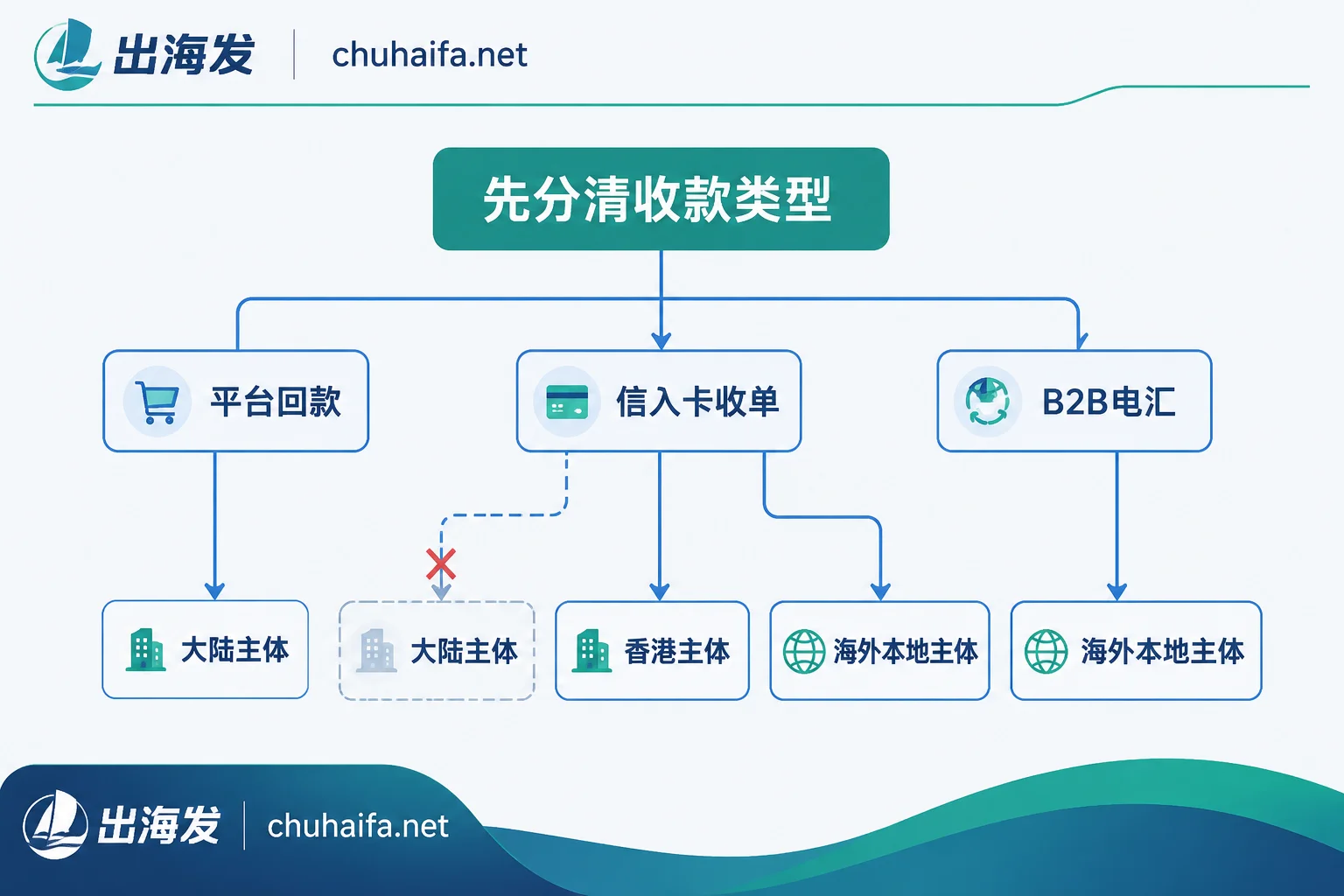
Step 1: What kind of money are you collecting?
Platform payouts. For stores on Amazon, TikTok Shop, eBay, Walmart, etc., the platform pays you according to its settlement cycle. What you need is a receiving account that can accept platform payments and then convert the money into RMB or keep it in a foreign currency account. This category is the most tolerant of entity types.
Credit card acquiring (PSP). For self-built independent sites, digital products, in-app purchases, and SaaS subscriptions, consumers pay by card on the spot. What you need is a payment service provider to open a merchant account for you and handle risk control. This category is the most picky about entity types.
B2B foreign trade wire transfers. Overseas customers send large payments according to contracts via SWIFT or local clearing networks in various countries. The focus is on multi-currency aggregation, whether the receiving account is easily frozen, and whether you can compliantly settle the money using customs declarations.
Many people get stuck because they treat the second category like the first: assuming "if I can receive Amazon payments, I can accept credit cards for my independent site." These are two completely different sets of admission requirements.
Mainland companies or sole proprietorships: smooth settlement, difficult acquiring
When you only have a mainland business entity (company or sole proprietorship), what you can do is clear: accept platform payouts, handle B2B wire transfer collections, and use compliant settlement paths.
Suitable options are third-party cross-border payment platforms with relevant qualifications, commonly including WorldFirst, PingPong, LianLian Global, Payoneer, and the mainland collection version of Airwallex; for B2B foreign trade scenarios, XTransfer or WorldFirst's B2B services are often used. Their common feature is that they can perform compliant settlement using cross-border e-commerce order data or customs declarations, remit foreign currency to a domestic corporate account or the legal representative's personal account, and do not occupy the individual's annual $50,000 settlement quota—this point is most valuable for sole proprietors and small teams. Withdrawing from PayPal to a personal card yourself is a completely different matter.
The sticking points are also clear: mainland entities are not supported for directly registering and opening Stripe; most international acquiring gateways have strict thresholds when opening credit card acquiring for mainland entities, usually examining industry category, website compliance, historical transaction volume, and both the review period and rejection rate are not low.
So if you currently only have a mainland license and your business is purely platform stores or traditional foreign trade, there's no need to rush to register an overseas company. Getting platform payouts and settlement paths running smoothly is enough. Only when you want to build your own site to directly accept credit cards does the entity issue become a hard constraint.
Hong Kong company: a common springboard for independent site acquiring
The usefulness of a Hong Kong entity is concentrated in two things: opening credit card acquiring for independent sites, and multi-currency fund aggregation.
A Hong Kong company can directly apply for Hong Kong version Stripe, Airwallex's Hong Kong business account, PayPal HK, covering mainstream credit card acquiring and multi-currency settlement, with fund inflows and outflows not subject to foreign exchange controls. Connecting with Shopify and WooCommerce are routine paths. This is also why many independent site teams open a Hong Kong company in addition to their mainland entity.
Two points to factor in ahead of time:
- Foreign exchange wear and tear. When a Stripe Hong Kong account settles USD payments to a local Hong Kong bank, the currency choice affects whether forced currency conversion occurs. Matching the settlement currency with the bank account currency when opening the account can save a long-term cost.
- Maintenance obligations. Hong Kong companies must undergo annual review and bookkeeping on schedule each year, and obtain an audit report from a licensed auditor. This is a fixed expense and fixed time cost, and may not be worthwhile when the business volume is too small.
US and other overseas local entities: exchanging for local payment capabilities
Local entities such as US LLCs (commonly registered in Delaware and Wyoming), UK LTDs, and Singapore companies are suitable for DTC brands, overseas apps, and SaaS subscriptions focused on European and American markets.
What they can open are full-featured local channels: Stripe US accounts, Shopify Payments, PayPal US, Wise Business, and local commercial bank accounts like Mercury and Relay. The actual difference this brings is more comprehensive local payment methods—ACH debits, Apple Pay, Google Pay, and buy-now-pay-later services like Klarna can all be added, and the payment authorization rate for local cards is usually higher. For subscription businesses, an increase in authorization rate directly reflects in renewal success rates, and this benefit is often greater than the fees saved.
The cost is compliance expenses: registered agent service fees, federal and state tax filings, EIN or ITIN applications, and potentially pass-through taxation and audit requirements. These are not one-time; someone needs to be responsible for them every year.
By the way, a commonly asked situation: for pure offshore island entities (BVI, Cayman), the KYC admission thresholds at mainstream third-party payment platforms vary, and each company's policies and strictness change relatively quickly. Public information is insufficient to give a definitive conclusion. It is recommended to directly confirm current requirements with the onboarding advisor of your target platform, and not to infer based on experience with Hong Kong or US entities.
Common combinations, mapped by business form
- Only doing platform stores like Amazon/TikTok Shop: Mainland company or sole proprietorship + a payment platform like WorldFirst / PingPong / Payoneer, with the focus on withdrawal fees and whether settlement is smooth. No additional entity needed.
- Platform stores + self-built independent sites in parallel: The mainland entity continues to receive platform payouts, and a separate Hong Kong entity is set up to accept Stripe HK or Airwallex for independent site acquiring, with the two fund flows accounted for separately. This is currently the most common dual-entity structure.
- European and American DTC brands, apps, or SaaS subscriptions: Directly use a US/UK local entity to open local Stripe accounts and Shopify Payments, roll out local payment methods comprehensively; at the same time budget for overseas bookkeeping and tax filing.
- Traditional export B2B: The entity generally doesn't need to change. The focus is on choosing virtual bank accounts that support local clearing in multiple countries and SWIFT, solving the three issues of large payment aggregation, anti-freezing, and foreign exchange settlement.
Two more things to verify before deciding
One is the channel qualification itself. The same brand may have different licensing situations in different regions, industries it can serve, and fund settlement paths. Before opening an account, understanding these clearly is more important than comparing prices. For verification methods, see How to Verify Compliance of Overseas Payment Tools? 4 Steps to Check Qualifications and Channels.
Two is that payment collection is only one part of the independent site chain. Site building, domains, risk control environments, and account isolation for multiple stores will in turn affect acquiring review results. For the division of tools across the entire chain, see What Types of Tools Are Needed from Site Building to Payment Collection for Independent Sites.
After clearly determining which category you belong to, then choose specific platforms: for payment collection and acquiring channels, you can compare and filter from Overseas Payment Categories; if you need to register an entity, do bookkeeping and auditing, or file taxes, see Cross-border Services; supporting tools for the platform store side are in Cross-border E-commerce. Functions and fees are subject to the current descriptions on each company's official website. Before opening an account, be sure to ask about admission conditions using your own entity type and business category.