

How to receive cross-border payments with a Southeast Asian local bank account? The answer lies in only five links: settlement entity qualification, local account type, platform binding and verification, local clearing and withdrawal, and settlement into RMB. Starting August 17, 2026, Lazada will impose a technical support fee on all cross-border orders in Malaysia, Singapore, Thailand, and Vietnam, as well as 3PF fulfilled orders in the Philippines, deducting a fixed percentage of the completed sales amount plus local taxes. In Malaysia, the base rate is 4%, rising to 4.32% after taxes (Ebang Power, August 2026). This change significantly increases the per-store deduction burden for cross-border sellers, making it an opportune time to reassess the total cost of a payment collection chain.
Conclusion First: Five Links, Each with a Checkpoint
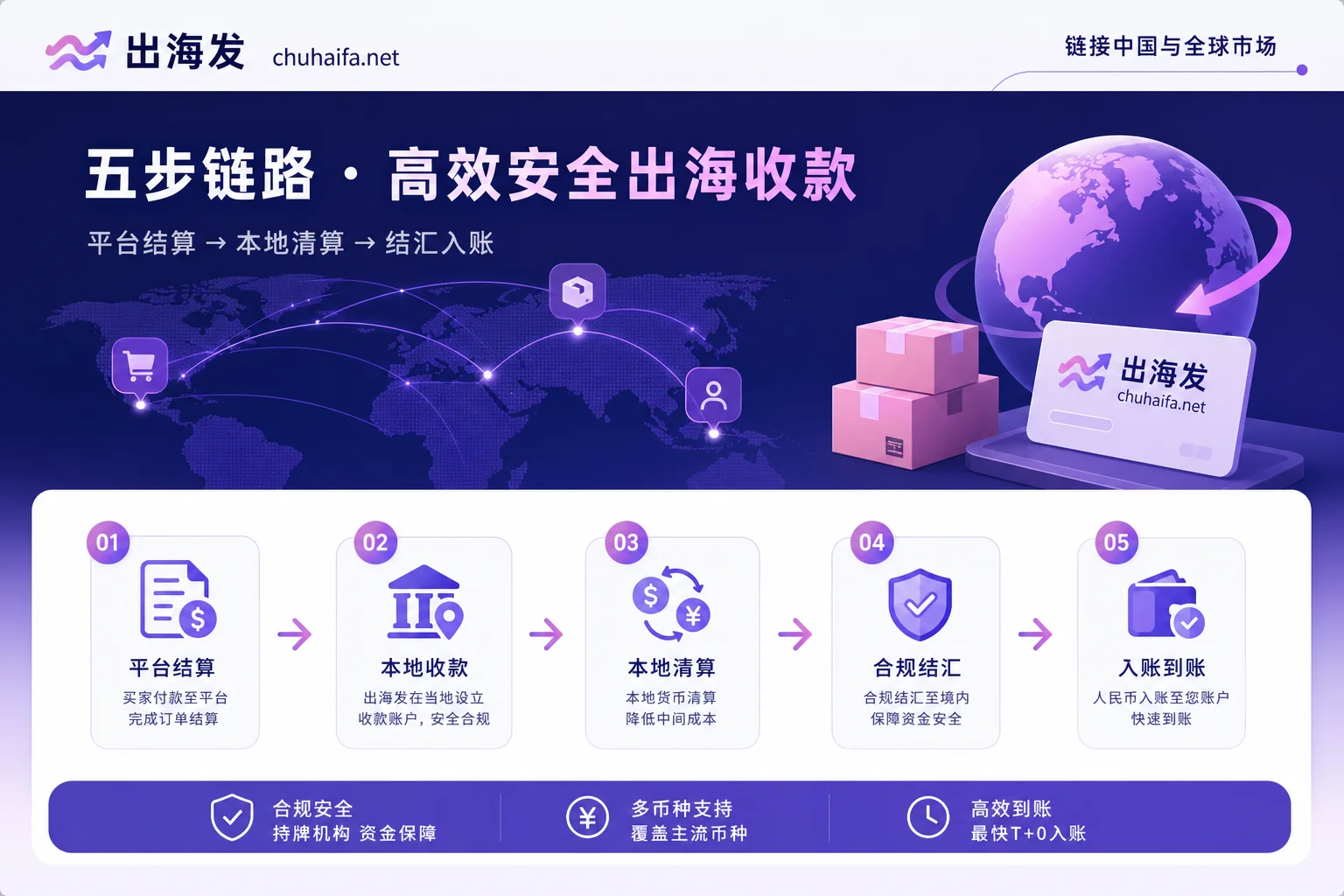
How to receive cross-border payments with a Southeast Asian local bank account generally involves five segments: First, confirm the settlement entity's qualifications, which determine the type of account you can open; Second, choose a local virtual or physical account; Third, complete platform binding and KYC verification; Fourth, withdraw funds through the local clearing network; Fifth, retain funds in original currency or settle into RMB. Each segment has clear checkpoints, and if any segment is blocked, funds are stuck there.
Segment One: Settlement Entity Determines Whether You Can Open an Account
Cross-border stores and local stores have entirely different requirements for payment accounts. Cross-border stores can bind multi-currency virtual local accounts provided by licensed third-party institutions using mainland China or Hong Kong entities, supporting currencies such as USD and SGD; local stores, however, require binding a local bank physical account or local virtual clearing card number in the name of a local company or individual in the site's country, going through the local bank clearing network (WorldFirst Official Guide, April 2026).
Many sellers ask, "Can I open a Southeast Asian local payment account without a local company?" The answer is: what type you can open depends on your entity's qualifications. Without a local entity, you can usually only open a multi-currency virtual local account corresponding to a cross-border store, not a physical bank account in the site's country. To open a physical account, you need to either register a local company or apply with a local individual's real-name qualification. Whether it can be approved depends on the service provider's actual review; it is recommended to confirm the required qualification list with them before opening an account.
Segment Two: Local Bank Accounts and Third-Party Virtual Accounts Are Different
Local bank physical accounts are payment accounts within the local clearing system, able to directly receive funds through the local bank clearing network; whereas multi-currency virtual local accounts provided by licensed third parties such as WorldFirst, LianLian, and Payoneer, while appearing as a local account number during collection, are essentially sub-accounts of the institution within the local clearing system, used to receive platform settlement funds.
The key differences between the two lie in currency coverage and account attributes. Virtual accounts typically cover major currencies like USD and SGD, suitable for cross-border stores settling in original currency; physical accounts are mostly in local currency, used for local clearing in local stores.
Taking the question "Can a Singapore local bank account receive Lazada payments?" as an example, if your store entity and account attributes match (cross-border store bound to virtual account, local store bound to physical account), and the currency matches, then the Singapore account can naturally receive payments. The key lies in the platform's requirement for consistency of account attributes, not the account's location.
Segment Three: Verification Points When Binding to a Platform
During binding, the platform strictly reviews three things: the account holder name, Bank Information Document, and store entity. These three must match, otherwise you will be blocked during binding or withdrawal.
Common inconsistency scenarios include: individual account name bound to a company store, currency mismatched with the site's settlement currency, and account attribute not a local clearing account. Before binding, it is recommended to prepare the following materials:
- Store entity business license (company or individual)
- Legal representative's ID card or passport
- Bank Information Document (need to obtain from service provider or bank)
- Other KYC documents required by the platform
When checking, first ensure the account name and ID number match the store backend information, then confirm the account currency matches the site's settlement currency, and finally confirm the account attribute is local clearing type. If the store entity has a local company or individual real-name qualification in Vietnam or other countries, you may need to provide corresponding entity proof or real-name documents as required by the site, the specific list subject to site and service provider requirements.
Segment Four: Difference Between Local Clearing and Traditional Telegraphic Transfer
Withdrawing through the local clearing network can avoid the fees charged by multiple intermediary banks in the traditional international SWIFT wire transfer path. This difference occurs in the "withdrawal clearing" segment, not in the platform settlement segment. That is, during platform settlement, the platform deducts commissions and technical support fees; during withdrawal, if you use local clearing, you can save intermediary bank fees.
The specific arrival time and fee amount vary by institution and site, with no uniform standard, so you need to check with each one. It is recommended to request the settlement chain description and fee details from the service provider, and ask clearly: "From submitting the withdrawal to the funds entering the account, how many nodes are involved, and is each node charged?"
Segment Five: Reconciliation and Settlement After Funds Arrive
After the withdrawal arrives, you can retain funds in original currency or settle into RMB through licensed foreign exchange channels. Here we address a common question: Will settling the Southeast Asian multi-currency account incur an additional fee? Settlement is an independent segment in the fifth link, and its fee basis is separate from the previous four segments (settlement, withdrawal). You need to check the institution's published basis; do not speculate.
For reconciliation, it is recommended to align on three granularities: order number, settlement batch, and currency. Every withdrawal should be traceable to the corresponding order; the settlement batch number should match the batch in the platform backend; and currency conversion records should be clear, so any issues can be quickly located.
Incorporating Lazada's Technical Support Fee into Per-Store Cost Table
Before incorporating the technical support fee into the per-store cost model, let's return to the main line of how to receive cross-border payments with a Southeast Asian local bank account: which fees scale with sales? Taking Malaysia as an example, the base rate is 4%, after taxes 4.32%, meaning the higher the sales, the more this fee increases. In contrast, withdrawal and settlement fees in the payment chain are typically charged per transaction or per amount tier, not necessarily scaling with sales.
| Fee Item | Billing Model | Scales with Sales? | Occurrence Segment |
|---|---|---|---|
| Platform Commission | Percentage of sales | Yes | Platform Settlement |
| Technical Support Fee (e.g., Malaysia) | Fixed percentage of completed order sales (base 4%, after taxes 4.32%) | Yes | Platform Settlement |
| Withdrawal Fee | Per transaction or per amount tier | Not necessarily | Local Clearing Withdrawal |
| Settlement Fee | Per transaction or per amount tier | Not necessarily | Settlement into RMB |
This table helps you distinguish which costs scale with sales and which are relatively fixed. As for "which has lower fees, local or cross-border stores," the conclusion is that it depends on the total of entity costs, store type, and payment chain, not just one fee rate. Local stores may have lower platform fees, but the costs of local company registration, bank account opening, and tax compliance are higher; cross-border stores face rising platform fees but simpler accounting.
Path Selection for Three Types of Sellers
Based on entity status, paths can be divided into three types:
- Pure cross-border dropshipping sellers: Prioritize getting a multi-currency virtual local account working, complete binding and verification, then check settlement terms.
- Sellers preparing to open local stores: First calculate the compliance and time costs of local entity registration and bank account opening, then evaluate overall profit.
- Sellers with existing overseas entities: Focus on verifying whether the account attribute is truly a local clearing account and whether settlement terms are clear.
The criterion is: which path has the fewest checkpoints and is currently most feasible. Don't just look at rates; also consider compliance thresholds and capital turnover efficiency. If you're still debating whether to choose a platform first or a payment method, refer to the judgment dimensions in Which Cross-Border E-commerce Platform Is Easy to Use.
Account Opening and Fund Reconciliation Checklist
How to receive cross-border payments with a Southeast Asian local bank account ultimately comes down to three self-checks:
Before opening: Verify entity qualifications against site requirements, confirm whether you can open a virtual or physical account.
When binding: Verify name, currency, account attribute, and Bank Information Document consistency, ensuring full match with the store entity.
After first payment: Check whether the settlement batch and order number align, and identify where fees were deducted (platform settlement, withdrawal, or settlement into RMB).
Behind this checklist are four capability dimensions for evaluating overseas payment and cross-border collection services: local clearing currency coverage, whether the account attribute is truly a local clearing account, whether reconciliation granularity can align order numbers with settlement batches, and whether settlement terms are publicly disclosed. These four dimensions also serve as comparison criteria when horizontally organizing service providers under the "overseas payment and cross-border services" category, allowing for initial screening using the same standard. You can find a more systematic comparison method in How to Choose a Cross-Border Payment Platform, and cost calculation approaches in How to Calculate Cross-Border Payment Fees.
Frequently Asked Questions
How is Lazada's technical support fee deducted?
Starting August 17, 2026, Lazada will deduct a technical support fee as a fixed percentage of the completed sales amount for all cross-border orders in Malaysia, Singapore, Thailand, and Vietnam, and 3PF orders in the Philippines, plus local taxes. For example, Malaysia's base rate is 4%, after taxes 4.32%. The fee is automatically deducted during platform settlement, and sellers can view details in the backend.
Which has lower fees, local or cross-border stores?
There is no absolute answer. Local stores may have lower platform fees, but they incur costs such as local company registration and taxes; cross-border stores face rising platform fees but simpler accounting. It is recommended to calculate based on a per-store model, including all platform fees, payment processing fees, and compliance costs, to compare overall profit margins.
Can I open a Southeast Asian local payment account without a local company?
Yes, but you can only open a multi-currency virtual local account for cross-border stores, provided by licensed third parties, supporting USD, SGD, etc.; to open a local bank physical account required for local stores, you must have a local company or individual real-name qualification. The final decision rests with the service provider's review.
Will settling a Southeast Asian multi-currency account incur an additional fee?
Settlement is an independent segment in the fifth link. Whether it is charged separately and under what terms varies by provider. Handling fees and exchange rate spreads are separate from withdrawal fees; the specific fee terms should be based on the service provider's published explanations, so it is recommended to obtain details before opening an account.
Can a Singapore local bank account receive Lazada payments?
Yes. As long as the account attributes match the store entity (e.g., cross-border store bound to a multi-currency virtual account or local store bound to a physical account), and the currency matches, the Singapore account can receive payments normally. The key is meeting the platform's consistency requirements.
How long does it take for funds from Thailand to arrive after withdrawal?
The arrival time varies by payment institution and site, with no universal value. It is recommended to ask the payment service provider for a settlement chain explanation and inquire about the duration at each node: withdrawal processing, local clearing, and crediting.