

To put it directly: first determine the time zone of your target market, then set frequency in two phases. During the first 2 to 4 weeks of account launch, post 1 to 2 videos per day to give the platform recommendation system enough data. After entering the stable period, reduce to 3 to 5 videos per week, or 1 video per workday. If you post multiple videos in one day on the same account, leave several hours between each. When distributing the same asset set to TikTok, Instagram Reels, and YouTube Shorts, stagger the posting order. Finally, prepare 1 to 2 weeks of finished videos in advance and use scheduled publishing to release them on time according to local time. Save manpower for post-publishing comment replies and review.
Below, we expand in the order of “set frequency → set time → set distribution order → equip tools.”
Frequency: being able to maintain it long term matters more than posting a lot in a single week
TikTok officially once suggested that creators post 1 to 4 videos per day, but this number is more of an upper-bound reference. Third-party statistics on tens of millions of short videos show that the range with the most obvious improvement in views per video is going from “1 video per week” to “2 to 5 videos per week (or 1 per workday),” with an average increase of about 17%. Beyond that, marginal returns begin to diminish.
Another conclusion is even more noteworthy: accounts that post consistently for more than 20 consecutive weeks have significantly higher engagement rates than accounts that post intensively for a short period and then stop.
So when setting frequency, look not at how many videos can be edited in a certain week, but at the production capacity the team can maintain for several consecutive months. If the maximum stable output is 4 good pieces of content per week, then schedule 4, not 15 in the first week and then nothing in the third week.
These data mainly come from single-account operations. E-commerce accounts or matrix volume-broadcasting accounts are different; platforms have their own limits and risk controls on daily posting volume for a single account. You can refer to two articles on the site: How many TikTok e-commerce videos can be posted per day at most, and Are there limits on the number of short videos posted on Southeast Asian sites.
Phase-based scheduling: post more during cold start to test data, reduce volume during the stable period to maintain quality
| Phase | Approximate duration | Suggested frequency | Purpose of this phase |
|---|---|---|---|
| Cold start / testing period | First 2–4 weeks | 1–2 per day | Give the recommendation system enough content tags and audience feedback, and test which topics and audience groups respond |
| Stable growth period | Long term afterward | 3–5 per week, or 1 per workday | Focus on quality, alternating trending content and evergreen content |
When should you switch from the testing period to the stable period? Two signals can be observed: the audience profile in the backend begins to stabilize, and you have already found two or three types of topics that perform clearly above average. If the data is still scattered after 4 weeks, you can extend the testing period; there is no need to force the switch.
When posting multiple videos in a single day, be sure to space them out. For example, post one in the local morning, one at noon, and one in the evening; do not post several within one hour. Dense posting is easily identified as spam marketing and may instead be throttled.
Time: work backward from the audience’s local time to domestic operating time
The first 1 to 2 hours after a short video is published are critical; the interaction speed during this period affects subsequent recommendation volume. Therefore, the publishing time should fall at the beginning of the audience’s active period, not be posted casually according to domestic routines.
Starting reference: Based on overall platform statistics, local time Tuesday to Thursday from 2 p.m. to 6 p.m. tends to have relatively active engagement. This is only a platform-wide average, not necessarily your audience. You can use it as a starting point first, and after the account accumulates data, base it on the follower active times in backend Analytics. For the specific entry point, see Where to view TikTok engagement data.
Conversion example (US Eastern Time):
- During daylight saving time (UTC-4), local 2 p.m. corresponds to 2 a.m. Beijing time the next day.
- During standard time (UTC-5), local 2 p.m. corresponds to 3 a.m. Beijing time the next day.
- Under current rules, the United States ends daylight saving time on November 1, 2026, while Europe ends it on October 25, with a one-week difference between the two. If you operate in both European and American markets, the schedule must be adjusted separately: overall corresponding domestic times shift one hour later.
Things to note in other markets:
- Most Southeast Asian regions differ from Beijing time by about one hour, so conversion is simple. But work schedules and holidays differ by country, so it is best to look at data by country.
- Middle Eastern markets experience obvious schedule changes during Ramadan, with increased nighttime activity. This period needs separate scheduling and cannot simply follow the usual timetable.
Cross-platform distribution: publish on the main platform first, stagger other platforms
When posting the same asset to TikTok, Reels, and Shorts, it is recommended to publish first on the main platform, then sync to other platforms several hours later or the next day. Mechanically syncing all three platforms in the same minute makes it easy to be identified as reposting or a bulk marketing account.
Staggering also has another benefit: you can first look at the first few hours of data on the launch platform, then decide whether the title and cover need to be changed.
Execution: use an inventory pool and scheduled publishing to solve time zone differences
The golden hours for European and American markets mostly fall late at night in China. Relying on people staying up late to post manually is hard to sustain for 20 weeks. A more stable approach is:
- Prepare 1 to 2 weeks of finished video inventory. If there is a temporary shortage of drafts or you need to insert trending content, the rhythm will not break.
- Use scheduled publishing instead of manual publishing. When doing only one or two platforms and not many accounts, the platform’s built-in scheduling feature is usually enough; for specific entry points and limits, refer to the platform’s current interface. For unified scheduling across multiple platforms and accounts, third-party social media scheduling tools are more convenient.
- Arrange post-publishing manpower separately. Scheduled publishing only solves “publishing on time”; the first 1 to 2 hours of comment replies still require someone online. You can use shifts, or concentrate comment replies in a fixed period after publishing.
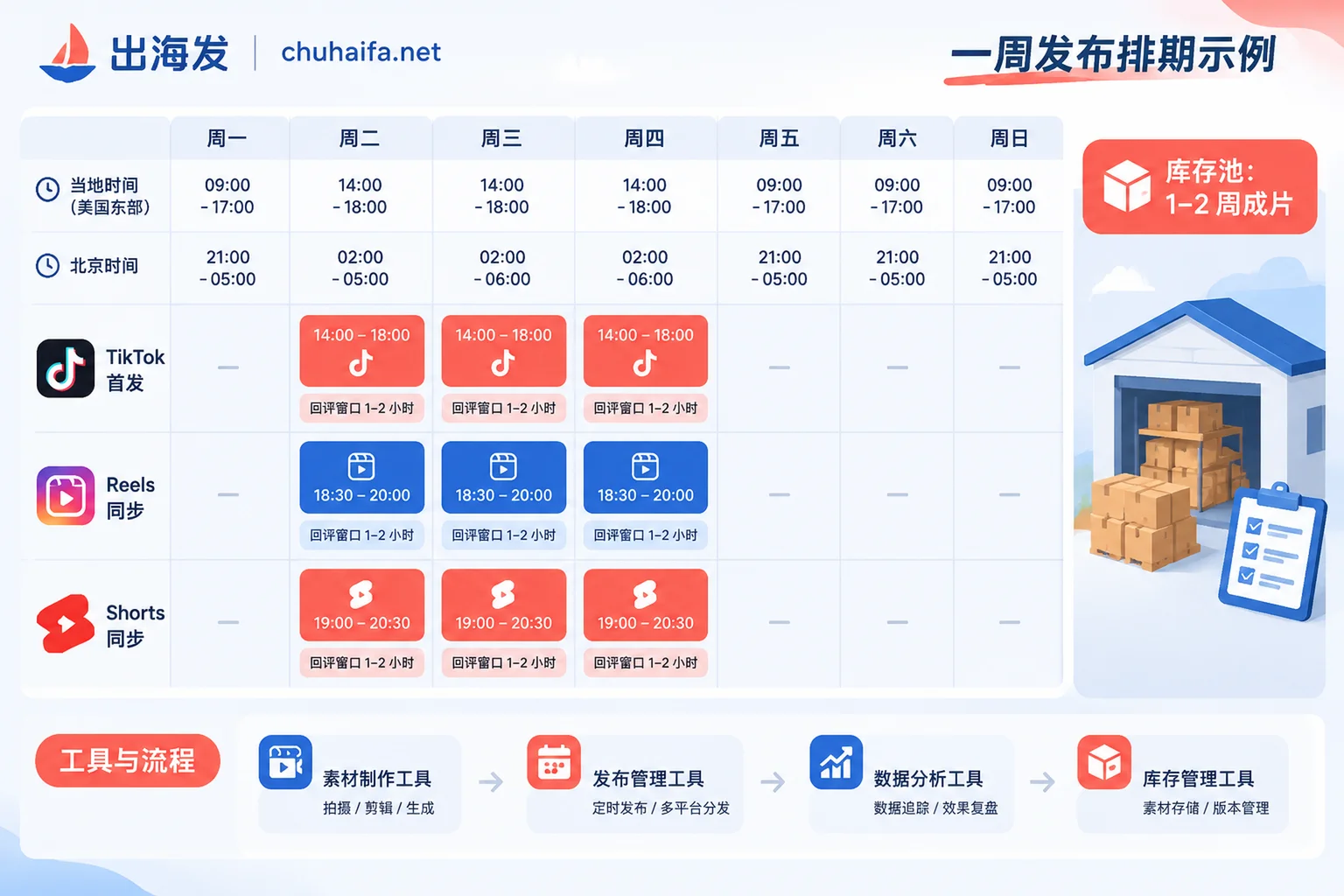
Review data once a week on a fixed basis and adjust next week’s topics and timing. For which metrics to review in a weekly report, see Which metrics should be reviewed in a social media weekly report.
How to equip tools: fill them in in this order
To execute the publishing rhythm stably, several types of tools need to work together behind the scenes. In order of priority:
- Network environment. When logging in and publishing from an account, the network exit should preferably match the target market and remain fixed. A mismatch between positioning and target market is one of the common suspicious factors for traffic bias and abnormal views (but not the only reason). Multiple accounts should also not share the same exit.
- Account environment isolation. If you only operate a single account alone, you may not need this at first. If you have a multi-account matrix, or multiple people collaboratively manage the same batch of accounts, you need to use an anti-detect browser to separate an independent environment for each account and reduce association risk.
- Scheduling and data tools. Social media scheduling tools handle on-time publishing by time zone, and data analysis tools handle weekly review. In the early stage, the platform’s built-in backend is enough as a foundation; after accounts and platforms increase, add third-party tools.
- Content production acceleration (optional). When production capacity cannot keep up with frequency, AI tools can be used for scripts, voiceovers, and long-video slicing to shorten the production cycle.
After determining which types of tools you need, you can compare options in the corresponding categories; features and prices are subject to each provider’s official website:
- Network environments such as proxies and VPS: Overseas Network
- Multi-account environment isolation: Anti-detect Browser
- Social media scheduling, promotion, and data tools: Overseas Promotion