

Let's get straight to the conclusion: Yes. If you only change the cover and leave the video itself untouched, mainstream short-video platforms will most likely still identify it as duplicate content. Platforms primarily compare the video's visuals and audio when detecting duplicates. The cover, title, and description are presentation-layer information; changing them doesn't affect the comparison of the audio-visual core.
Whether you want to re-upload an old video with a new cover or distribute the same finished video across a matrix of accounts, the following three questions will explain it step by step: why changing the cover doesn't work, what happens after each platform detects a duplicate, and where to make changes if you want to reuse the material.
Why Changing the Cover Can't Bypass Duplicate Detection
Take Bilibili, which has publicly disclosed technical details, as an example. Its large-scale video duplicate detection method involves extracting keyframes from the video, extracting visual feature vectors, and then performing similarity searches in a massive video database. Common industry methods also include perceptual hashing (visual fingerprints), audio fingerprints, and text comparison after speech-to-text conversion.
The inputs for these methods are the video itself. The cover is just an image displayed on the list page, and the title and description are text fields. They affect click-through rates but do not participate in judging whether "this audio-visual segment is highly similar to existing content." So from the system's perspective, a video with a changed cover is almost indistinguishable from the original.
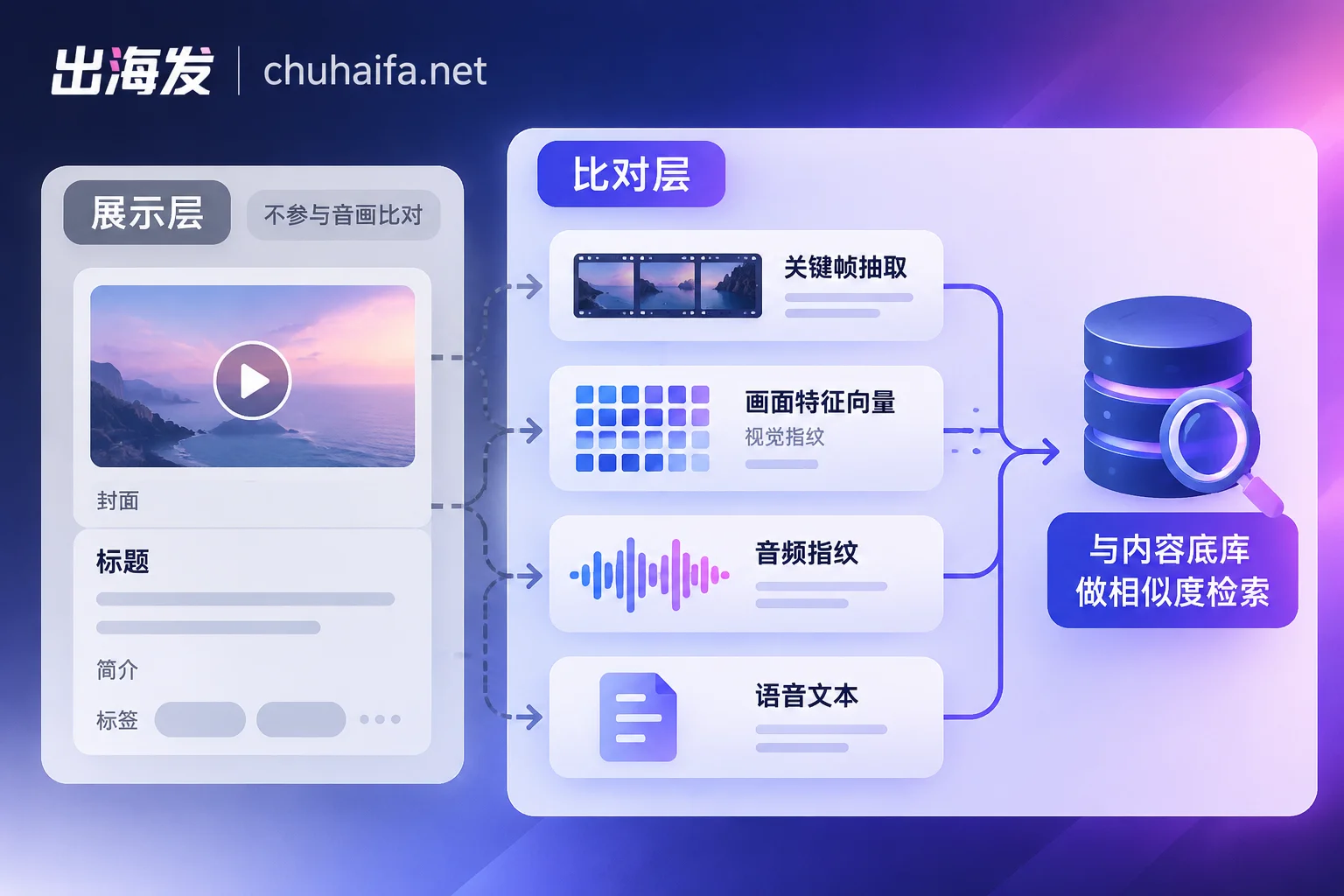
It should be noted that no platform discloses its specific algorithms or similarity thresholds. The above describes general principles and does not mean every platform uses exactly the same methods.
Consequences After Duplicate Detection: TikTok and YouTube Differ
Don't apply one platform's rules to all platforms. The two commonly used platforms for going global have different focuses.
TikTok: Mainly affects distribution. TikTok has rules for "Unoriginal Content" and "Reproduced Content." Re-uploading the same video, or搬运 material without adding substantial new perspective, may be flagged as unoriginal, resulting in "Not eligible for the For You Feed"—meaning it won't enter the recommendation feed. At that point, the video basically only gets views from followers and the profile page, showing as consistently low play counts. TikTok Shop Seller Center also has specific "avoid duplicate content" guidelines, and product videos are subject to this rule as well. If an account is enrolled in the Creator Rewards Program, repeatedly posting duplicate content may also lead to disqualification.
YouTube: Mainly affects monetization. YouTube's channel monetization policies include two relevant provisions: "Reused Content" and "Inauthentic Content" (formerly Repetitious Content). Videos with substantially the same content, even with different thumbnails and titles, may still be deemed duplicate or mass-produced content, causing the channel to be denied or lose eligibility for the YouTube Partner Program (YPP). Frequent re-uploads may also trigger the Spam policy. In other words, such videos may not immediately lose views on YouTube, but monetization will be affected.
For other platforms, refer to their respective official policies.
Minor Tweaks Like Adding Black Bars or Blurred Backgrounds Are Also Insufficient
Many people make small changes along with the cover: adding black bars, blurred backgrounds, changing aspect ratios, or swapping titles and hashtags. These low-edit tricks are already widely recognized by platforms as superficial deduplication attempts. Their common flaw is that neither the main visual content nor the audio track has changed—and those are exactly what duplicate detection compares.
What About Image Carousels with Only the First Image Changed?
No platform has disclosed duplicate detection thresholds for image-text or carousel content. There is currently no reliable answer on how many original images kept is safe or how many changed is enough. Based on the principles of video duplicate detection, changing only the first image while keeping the rest the same is likely to be flagged.
The safe approach is to treat image-text as new content: rearrange the content logic, rewrite the copy, replace most images—not just the first one.
Want to Reuse the Same Batch of Material? Where to Make Effective Changes
The idea is to change the content itself, not the shell. The following three methods are listed from lowest to highest effort and can be combined:
- Change the audio layer. Rewrite the script, use new voiceover or on-camera re-narration, and replace the BGM. This makes the audio track a new piece of content.
- Restructure the visual sequence. Rearrange the shot order, change the opening hook, replace keyframes, or add new footage.
- Change the content angle. The same product can be split into different versions: review, use case, comparison, buyer Q&A, etc., each with its own information points. When judging originality, TikTok specifically looks for "substantial new perspective."
AI video, voiceover, and copywriting tools can significantly reduce the cost of steps 1 and 2. For example, use the same set of raw footage to generate different scripts and multilingual voiceovers, then edit them into different structural cuts. For how to choose tool combinations based on available material, see How to Combine AI Tools for Multilingual Product Videos.
How to Arrange Matrix Account Distribution
- Manage your asset library as "raw material → multiple versions." Don't let multiple accounts post the same finished video; instead, each account gets a version adapted to its own positioning. For how to divide roles and handoffs, see How to Divide Work for Overseas Short-Video Account Matrix.
- Distinguish two types of risk. Fingerprint browsers and proxies solve the problem of environmental association between multiple accounts, but they don't handle content duplication. No matter how cleanly you isolate account environments, if you post the same video, it will still be identified through content comparison. These two issues must be handled separately.
- Control the pace. Even with many adapted versions, don't release them all in the same time period. For platform-specific posting frequency and intervals, see How Many Videos per Day Is Appropriate for Overseas Short Videos.
If you've already posted duplicate content and views are abnormally low, stop posting the same version and switch to substantially adapted versions. For specific troubleshooting, follow Where to Start Checking When Product Videos Get No Views step by step. For YouTube monetization review issues, follow the official appeal and review process.
Quick Self-Check Before Publishing
- Cover the cover and title: does this look and sound basically the same as the one you posted before?
- Is at least one of the narration, voiceover, or BGM new?
- Have the first few seconds and main visuals been re-edited or replaced?
- Does this version have information or angles not covered in the previous one?
If the answers to the first two questions are "the same" and "no," changing the cover any number of times won't make much difference.
For tools, you can browse the AI Tools category for creating derivative and multilingual assets; for distribution, scheduling, and growth tools, see Overseas Promotion; for multi-account environment isolation tools, see Fingerprint Browsers. Tool features and prices are subject to their official websites.