

First, the conclusion: For a single account, TikTok at around 1 post per day is a relatively safe starting point. During the cold-start testing phase, you can go up to 2–3 posts per day. Instagram Reels: 3–5 posts per week, no more than 1 per day; YouTube Shorts: 1–3 posts per week, at most 1 per day. If your business requires a higher volume, the better approach is to distribute the output across multiple accounts rather than posting repeatedly from one account.
Below, we break down how these numbers are derived and when to adjust them based on three scenarios: platform, operational stage, and multi-account setup.
Reference Frequency for Three Platforms
| Platform | Reference Frequency per Account | Notes |
|---|---|---|
| TikTok | 1–3 posts per day during testing; 1 per day or 3–5 per week once stable | After exceeding 11 posts per week, the incremental gain from each additional post drops significantly |
| Instagram Reels | 3–5 posts per week, max 1 per day | Can pair with 1–2 Stories per day to maintain account activity |
| YouTube Shorts | 1–3 posts per week, max 1 per day | More reliant on completion rate and long-tail recommendations; posting multiple times on the same day can fatigue subscribers |
These numbers come from statistics and industry benchmarks from organizations like Buffer and Hootsuite, not hard limits published by the platforms. Platforms won’t tell you “from which post rate limiting starts,” so treat them as starting points and calibrate with your own account data.
TikTok: Where the Returns from Posting More Start to Diminish
Buffer analyzed over 11 million TikTok posts, and the results roughly fall into three segments:
- Going from 1 post per week to 2–5 posts per week yields the most noticeable increase in views per post, about 17%.
- At 6–10 posts per week (roughly 1 per day), total impressions can still continue to grow.
- Beyond 11 posts per week, marginal returns drop significantly.
In other words, the biggest gain comes from moving from “occasional posting” to “consistent posting.” Going from 1 to 3 posts per day may not yield a proportional increase in views for the extra editing and topic selection work. When material capacity is limited, investing effort into the quality of that one daily post is often more worthwhile.
Set Frequency by Operational Stage
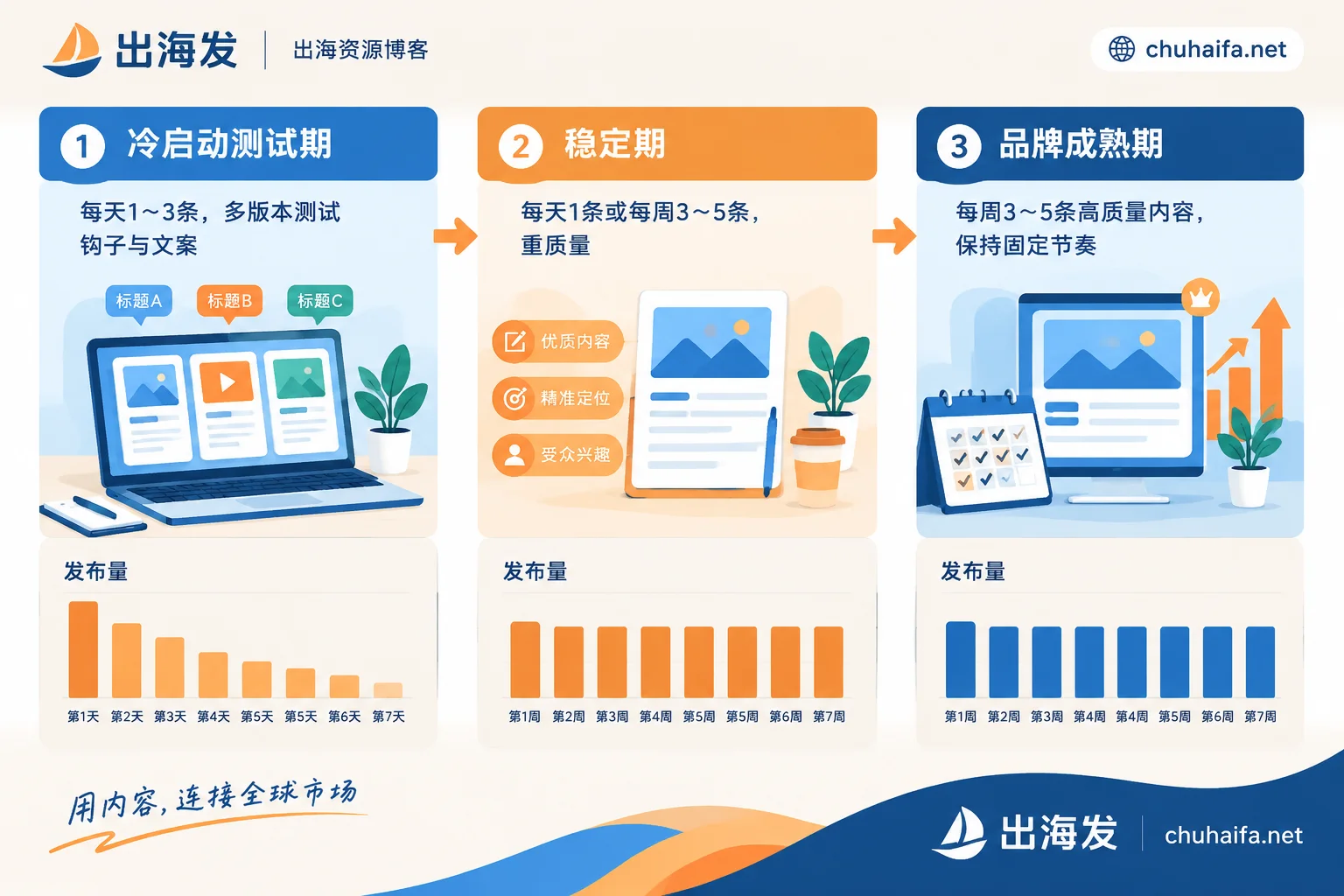
Cold start and testing phase: 1–3 posts per day. New accounts need to quickly figure out what type of content gets views. At this stage, posting more is about testing: use the same product with different opening hooks, different copy, and different visuals to compare which version has better completion and engagement. Each post should have actual differences; reposting the same material with a different tag doesn’t serve as a test and may be treated as duplicate content.
Stable phase: Converge to 1 post per day or 3–5 per week. Once you find a content direction that works, focus shifts to maintaining quality. Some analyses suggest that platforms evaluate the overall engagement performance of an account, and a large number of low-completion, low-engagement videos can drag down account performance. Therefore, during the stable phase, it’s not advisable to continue relying on volume.
Brand maturity phase: Focus on 3–5 high-quality pieces per week. Once the account has a fixed audience, a stable rhythm matters more than daily quantity. Sudden spikes or long gaps are worse than consistent updates.
For how long to wait between posts and how to schedule across time zones, refer to the spacing arrangements in How Many Short Videos to Post Per Day for Overseas Audiences.
E-commerce accounts need special attention: whether TikTok Shop shoppable videos have a separate daily post limit—there is currently no clear official statement. For closed-loop e-commerce, follow the latest rules in the Seller Center for your region, and don’t directly apply the frequency for content accounts.
Posting Methods That Easily Look Like Bot Activity
Posting a lot itself isn’t necessarily a problem; the problem is usually posting in a way that “looks like a machine.” Common risk signals compiled by third-party risk control and social media tool providers include:
- Posting 6–10+ times in a row from a single account in one day;
- Posting multiple times within a few minutes;
- Posting at fixed intervals, such as exactly on the hour;
- Using the exact same hashtag combination for every post, or highly similar material.
When triggered, common symptoms include new videos stuck in review, prolonged 0 views, or views suddenly dropping to a fraction of normal—what’s often called a shadowban. These thresholds are empirical summaries, not official numbers, but the direction is consistent: natural spacing, differentiated content, and don’t pile too many posts on a single account in one day.
If you’re already seeing a sudden drop in views, don’t rush to post more to compensate. Follow the steps in Where to Start Checking When E-commerce Videos Get No Views to first distinguish between 0 views and being stuck at a few hundred, then handle accordingly.
Want to Post More: Distribute Across Multiple Accounts with Proper Isolation
If you genuinely need higher volume, a common approach is to build an account matrix, with each account posting 1–2 times per day. The prerequisite is that accounts must not be linked: if multiple accounts log in and post in bulk from the same device and public IP, one account’s problem can implicate others.
Matrix publishing generally requires three types of tools working together:
- Network: Use a relatively fixed, independent IP for each account, commonly native static residential IPs. For which proxy types suit which tasks, see What Tasks Are Residential Proxies and Datacenter Proxies Suited For.
- Environment isolation: Use anti-detect browsers to create independent browser environments for each account to avoid overlapping device fingerprints. Teams that mainly operate on mobile devices sometimes use cloud phones; for how to choose between the two, see Cloud Phones vs. Emulators for Multi-Accounting.
- Scheduled publishing: Use scheduling tools to stagger posting times for each account, which both prevents manual operations from unconsciously clustering in the same time slot and avoids mechanical patterns like fixed hourly intervals. Before choosing a tool, first clarify whether it’s an official matrix or a multi-account matrix; see What Tools to Use for Multi-Platform Social Media Scheduling.
As the number of accounts grows, you also need to clarify who is responsible for topic selection, editing, publishing, and review. For how to consolidate roles when short-staffed, see How to Divide Labor for Overseas Short Video Account Matrices.
Next Steps
First, set a frequency for each account based on its stage, run it for two to three weeks, then adjust based on views and engagement data. Single-account operations basically don’t need extra tools; if you’re building a matrix, choose in the order of “network → environment → publishing”:
- IP and proxies: Overseas Network
- Account environment isolation: Anti-detect Browser
- Social media operations and promotion tools: Overseas Promotion
For specific features and pricing of each tool, refer to their official websites.