

How to choose a cross-border payment platform? Check five key stages: the payee entity, local payment methods at checkout, payout coverage regions, clearing network, and fund repatriation and reconciliation. Don't just compare fees. Stripe expanded local payout coverage to 27 new countries and regions in 2026, and the Federal Reserve's Regulation J amendment is also advancing cross-border instant clearing. These changes suggest that the old experience of "withdrawals arriving in 3-5 days" needs re-validation. This article expands on these five steps: first confirm the payee entity, then check local payment coverage, verify payout regions, break down the clearing network, and finally run through reconciliation.
Node 1: Payee Entity and Target Market - Can Your Company's Registration Open an Account?
The first step in choosing a cross-border payment platform is not comparing prices, but confirming whether your company entity can open an account. Most selection failures happen at this first step: whether you apply with a domestic entity, a Hong Kong entity, or a local entity directly determines the list of platforms available to you and the settlement currencies you can use.
Verification Action: Check the platform's publicly available list of supported entities to see if it matches your store's registration location; prepare entity proof materials (business license, address proof, etc.) in advance to avoid delays after opening due to missing documents, which slows down your launch. For example, if you registered your independent site with a Hong Kong company, but the platform only supports US or Singapore entities, you need to re-evaluate. This step determines the feasibility of all subsequent steps.
Node 2: Is the Local Payment Method Coverage at Checkout Sufficient? Why Do Pix, BLIK, etc. Affect Conversion?
Revenue leakage on the receiving end is often overlooked: if the checkout page only offers international cards and lacks local payment methods for the target market, you lose orders directly at checkout. Research shows that the cart abandonment rate due to the lack of local payment methods (such as Pix in Brazil, BLIK in Poland) reaches 10%-19%. This means for every 100 customers ready to pay, 10 to 19 may abandon because they can't find a familiar payment method.
In Stripe's 2026 product updates, Checkout Studio natively integrates over 125 localized payment methods including Pix, BLIK, Bizum, etc. There is a fundamental difference between "native support" and "patching together with third-party plugins": native solutions display popular local options on the checkout page by default, load faster, and provide a smoother experience, while plugin solutions often require redirects and have fragmented styling, which naturally hurts conversion rates.
Verification Method: Use an IP from the target market to go through a real checkout flow and see which payment methods are displayed by default. If your target market is Brazil and Pix appears on the first screen of the checkout page, coverage is adequate; if only credit cards are shown, you should be wary of the risk of losing customers.
Node 3: Payout Coverage Regions - What Does the 27 New Regions Mean and How to Verify If Your Receiving Country Is Included?
"Can receive" is not the same as "can pay to the account you want." Receiving coverage and payout coverage are two different lists. Many sellers only confirm the receiving currencies when opening an account but overlook the ability to pay out to local bank accounts, only to find it unsupported during withdrawal.
Stripe's Global Payouts API update in 2026 added local bank cross-border payout support to 27 new countries and regions, including Taiwan, China, UAE, Vietnam, and Malaysia. This reminds us that coverage lists are continuously changing - last year's experience may be outdated this year.
Verification Method: Check the platform's latest payouts support documentation, not marketing pages, for the countries and currencies you want to receive. Confirm whether it's a local bank account or only specific wallets or wire transfers. For example, if you need to receive UAE Dirham and pay out to a local bank, check whether the Global Payouts documentation includes the UAE, rather than looking at the receiving currency list.
Node 4: Local Clearing vs. Traditional Wire Transfer - Where Does the Difference in Arrival Time Lie?
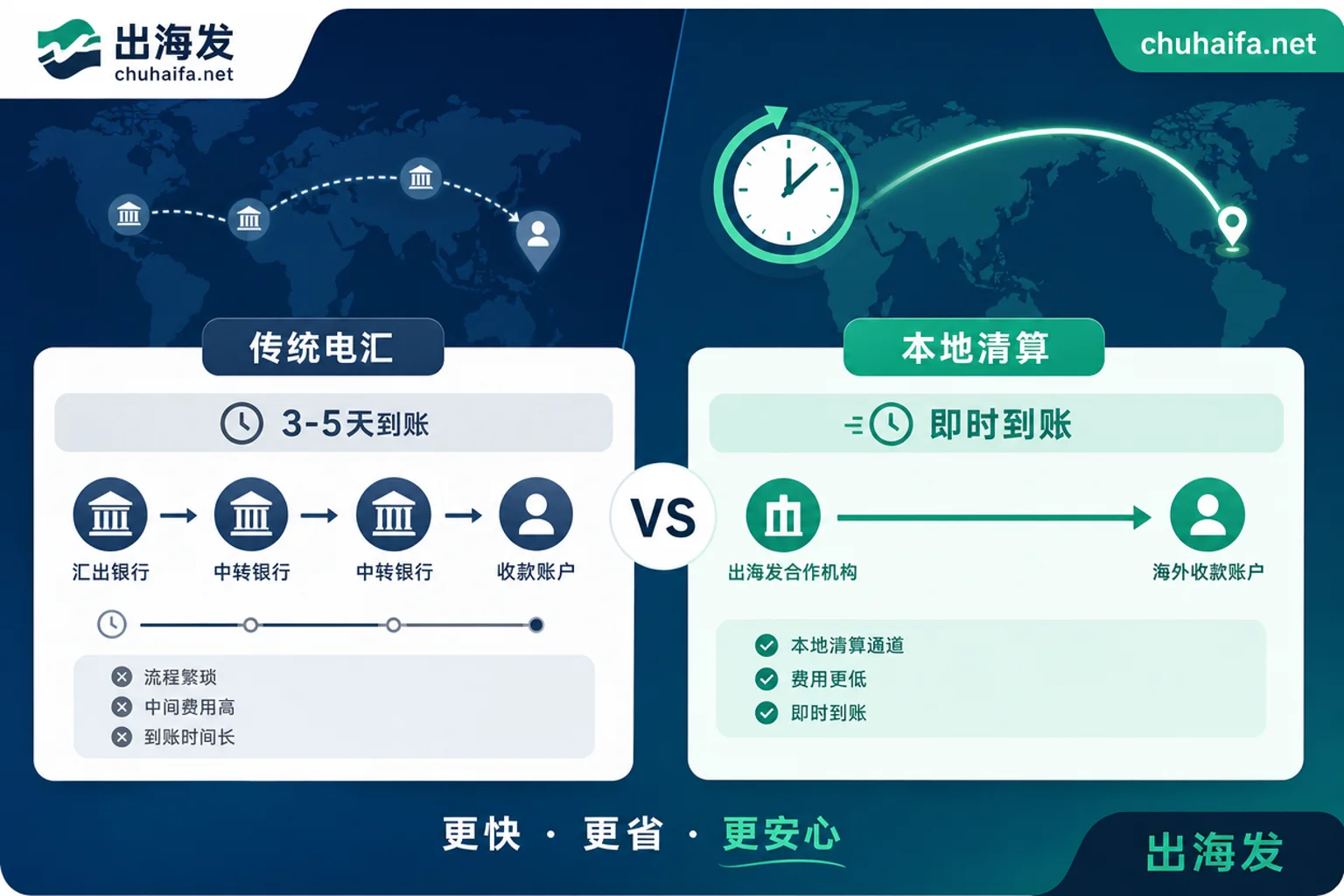
"How many days does cross-border payment withdrawal take?" Breaking this down, it actually consists of three parts: the platform settlement cycle, the clearing network, and the receiving bank's crediting time. Whether it uses the target market's local clearing network is the main source of time differences, but even with local clearing, settlement cycles vary among different service providers. Traditional wire transfers usually go through intermediary banks, taking 3-5 days (a common industry experience range, not a commitment by any platform), and may incur intermediary fees; local clearing networks directly connect to the local clearing system, usually significantly faster. In April 2026, the Federal Reserve proposed amending Regulation J to allow FedNow participants to send cross-border payment clearing instructions through agent intermediary banks; in August 2026, this amendment received public support from industry giants like Stripe, Visa, and Wise. This indicates that cross-border instant clearing is accelerating, but note that this amendment is still in the proposal and comment period and has not been officially implemented, so it cannot be treated as an available feature.
Question Checklist: Ask the service provider three questions: What is your settlement cycle? Does the money go through local clearing or traditional wire transfer? Are there intermediary bank fees? Get the answers in writing to avoid disputes later. For example, if you mainly receive Vietnamese Dong, local clearing might arrive the same day, while wire transfer could take 3 days.
Node 5: Fund Repatriation and Reconciliation - How to Account for Multi-Currency Settlements?
The last stretch is often overlooked: Are multi-currency accounts held by currency or automatically converted? Can the settlement reports match order numbers? How are refunds and chargebacks offset? Can you export reconciliation files usable by finance? These questions directly affect financial efficiency and capital costs.
Verification Action: First run a small real transaction to test the complete loop - receiving, settlement, payout, crediting, and reconciliation - then scale up. Specifically test refund scenarios: does the refund return via the original route, or does it incur additional fees? Does the settlement report include the original currency and settlement amount for each order? Only when the reconciliation criteria are clear can you avoid the hassle of mismatched accounts at month-end.
Selection Path for Three Types of Teams: Single-Market Independent Sites, Multi-Market Dropshipping, and Needs to Pay Overseas Partners
Different business types have different priorities.
- Single-Market Independent Sites (e.g., only selling in Brazil): Prioritize local payment method coverage and conversion, focusing on Node 2 and Node 4, ensuring native support for local methods like Pix and that payouts can reach local banks.
- Multi-Market Dropshipping (selling in Europe/US and Southeast Asia): Prioritize multi-currency settlement and reconciliation, focusing on Node 3 and Node 5, confirming that payout coverage is broad enough and that reconciliation reports can match multi-currency orders.
- Needs to Pay Overseas Partners (e.g., paying overseas influencer commissions): Prioritize payouts coverage and clearing network, focusing on Node 3 and Node 4, confirming you can pay to their local bank accounts with controllable timing.
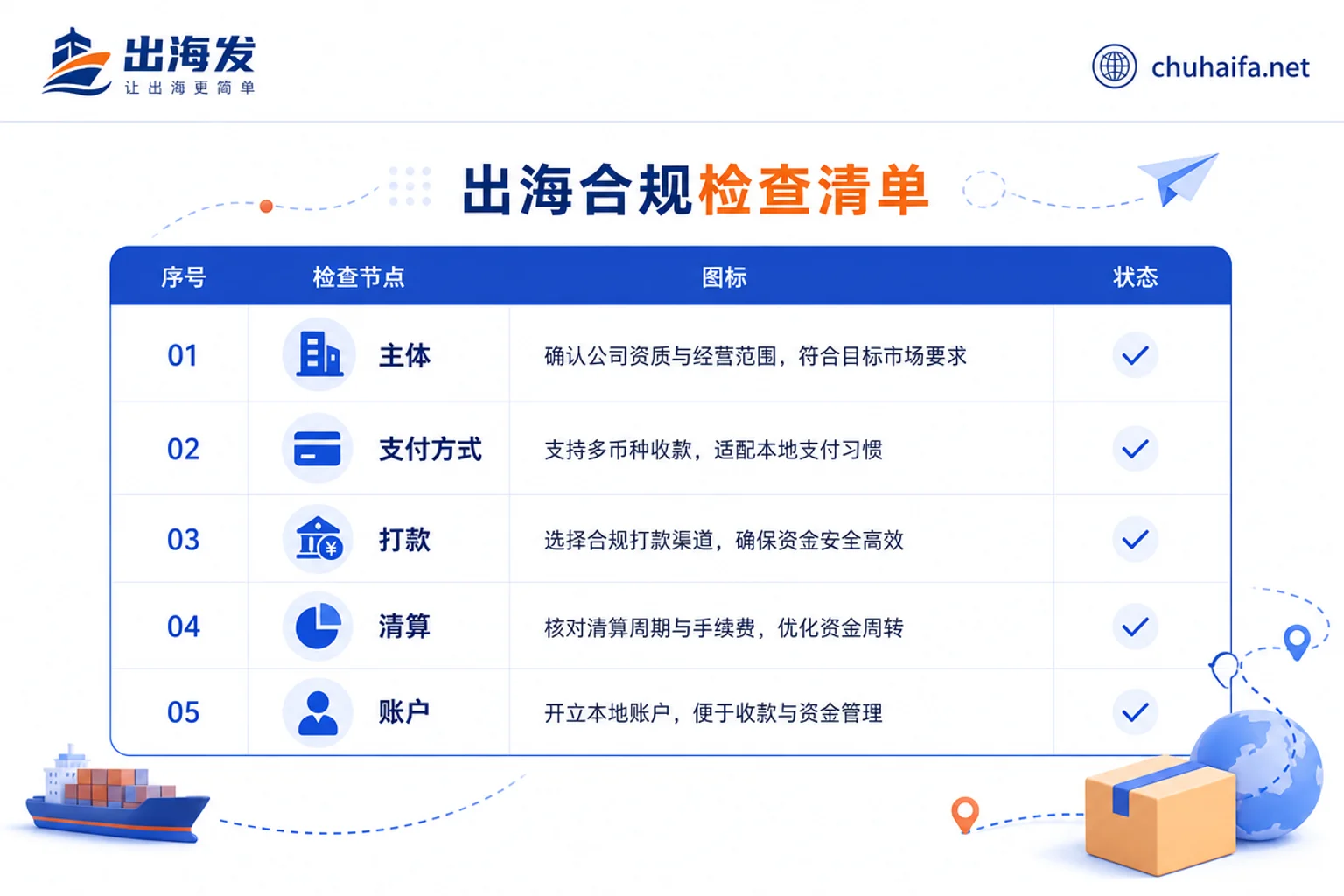
Cross-Border Payment Platform Self-Checklist: Check Off Each Step in Five Nodes
Here is a reproducible decision table, each row with a verifiable question and verification method. Check off each item against your candidate platforms.
| Node | Verifiable Question | Verification Method |
|---|---|---|
| Payee Entity | Is my company's registration location supported for account opening? | Check the platform's public list of supported entities |
| Local Payments | Does the checkout page natively support the target market's mainstream local payment methods? | Walk through the checkout flow with a target market IP |
| Payout Coverage | Are the countries and currencies I need to receive covered in the payouts list? | Check the platform's latest payouts documentation |
| Clearing Network | Does the money go through local clearing or traditional wire? Are there intermediary fees? | Ask customer service for written confirmation of the clearing path |
| Fund Repatriation | Is multi-currency settlement and reconciliation clear? | Run a small real transaction to test the full loop |
Based on the target market and payee entity in the table, you can filter candidate service providers from the "Overseas Payment and Cross-Border Settlement" resource category on Chuhai Fa, then test the loop with a small real transaction. For further platform comparison, you can also refer to the cross-border SaaS tools and cross-border e-commerce platforms categories to quickly narrow down your options.
FAQ
Which cross-border payment platform has the fastest arrival time?
The speed depends on the clearing network: local clearing is generally significantly faster than traditional wire transfers. The exact number of days should be confirmed in writing by the service provider. Stripe's Global Payouts API added local bank payout support to 27 new countries and regions in 2026, indicating that local payout coverage lists are continuously changing, so refer to the latest official payouts documentation. When choosing a platform, ask about settlement cycles and clearing paths, and prioritize platforms that support local clearing in your target market.
Should an independent site use Stripe or PayPal for payments?
The decision should return to Node 2 and Node 3 - first run through the checkout page with a target market IP to see which local payment methods are displayed by default; then check each platform's payouts documentation to confirm coverage for your receiving countries and currencies. On the Stripe side, only verifiable information is retained: "Checkout Studio natively integrates over 125 local payment methods (Stripe 2026 product update)." For PayPal's specific capabilities, please refer to official documentation.
Which countries does Stripe support for local bank payouts?
With Stripe's 2026 update, it added local bank payout support to 27 new countries and regions, including Taiwan, China, UAE, Vietnam, and Malaysia. Please refer to Stripe's official Global Payouts documentation for the latest list.
How many days does cross-border payment withdrawal take?
The arrival time is determined by the combination of the platform settlement cycle + clearing path + receiving bank crediting time. Local clearing networks are usually significantly faster than traditional wire transfers through intermediary banks. The exact number of days should be confirmed in writing by the service provider. It is recommended to confirm the specific timeline with the service provider before opening and verify with a small test.
Does the checkout page need to support local payment methods?
Yes. Lack of local payment methods can cause a 10%-19% cart abandonment rate, directly affecting conversion. Especially when the target market has mainstream methods like Pix and BLIK, native support for these options can significantly increase order completion. It is recommended to prioritize platforms that can natively integrate local payment methods when selecting a platform.