

In the context of increasingly fierce competition in cross-border e-commerce and foreign trade, the era of relying on a single channel to hit a home run is over. How to leverage efficient overseas marketing tools for low-cost customer acquisition and precise traffic diversion has become a survival issue for all international expansion teams. Industry data shows that by 2026, the AI penetration rate in precision advertising will exceed 85%, and in influencer marketing it will reach 73%. From AI-generated copywriting and videos to multi-account automated operations, the tool matrix is reshaping the efficiency of overseas customer acquisition.
However, facing the plethora of marketing software, automation scripts, and underlying network infrastructure on the market, cross-border teams often encounter confusion in tool selection and high trial-and-error costs. This article will break down the construction methods of overseas marketing tools from three dimensions: traffic acquisition trends, tool classification comparison, and implementation steps.
New Trends in Overseas Marketing Tools 2026: AI Agents and Automation Collaboration
Traditional overseas marketing relies heavily on manual post writing, manual ad placement, or one-by-one influencer outreach. Today, AI agents and automated workflows are fully taking over repetitive tasks. The development of overseas marketing tools exhibits three major characteristics:
- Full-chain Intelligence: AI is not only used for generating copy in small languages but also plays a role in market insights, competitor monitoring, and potential customer profiling.
- Multi-channel Matrix: From mainstream paid advertising on Google and Meta, expanding to multi-platform social media matrix strategies on TikTok, Instagram, WhatsApp, and LinkedIn for combined traffic generation.
- Infrastructure Compliance: With tightening platform risk control policies, account environment isolation, proxy IP matching, and SMS verification have become prerequisites for smooth overseas marketing.
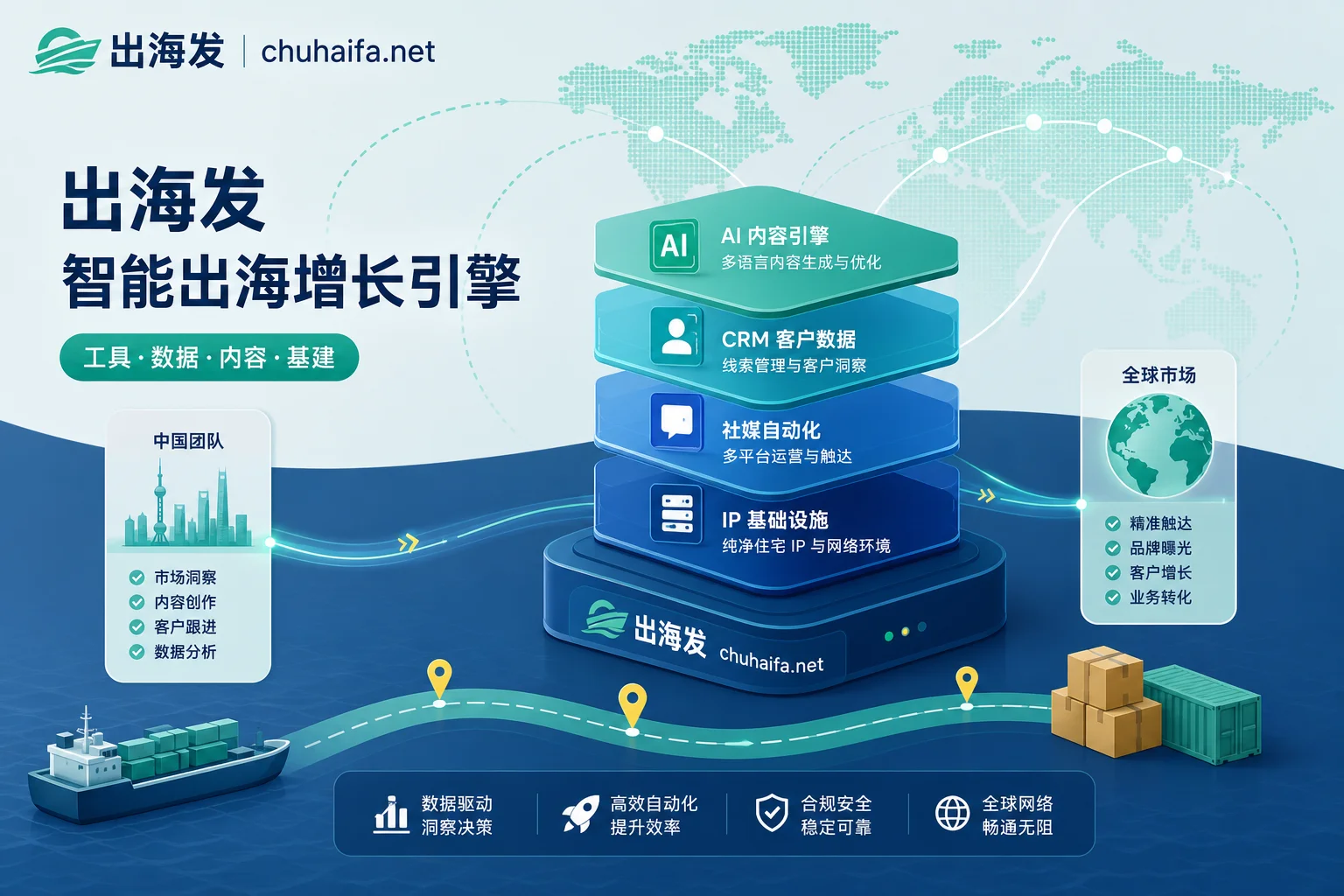
Four Categories and Comparison of Efficient Overseas Marketing Tools
Teams at different stages of international expansion have varying tool priorities. The following organizes the classification characteristics and applicable scenarios of current mainstream overseas marketing tools:
| Tool Category | Representative Functions and Uses | Suitable Scenarios and Teams | Evaluation Focus Points |
|---|---|---|---|
| AI Content Generation and Creation | Batch generation of ad copy, multilingual materials, and short video scripts | Independent site sellers, content marketing teams | Language authenticity, brand tone alignment |
| Customer Development and Intent Recognition | Automated search for buyer information, monitoring high-intent visiting behavior | B2B foreign trade enterprises, outbound sales teams | Data accuracy, compliance, and contact quality |
| Social Media Management and Automation | Multi-account scheduling, social listening, and automated DM interactions | Social media operators, brand promotion teams | API stability, multi-platform support coverage |
| Operational Infrastructure | Anti-association fingerprint browsers, overseas proxy IPs, SMS verification | Matrix account operators, multi-account ad placement | Node cleanliness, environment isolation, and compliance security |
Building a Stable and Compliant Overseas Promotion Traffic System
Many operation teams encounter account bans and promotion obstacles after introducing quality social media tools. The root cause lies in neglecting the coordination of infrastructure. When building an overseas marketing toolchain, it is recommended to follow the "three-layer construction" principle:
- Upper Layer: Intelligent Content and Deployment Layer: Use AI tools to quickly create localized materials, generating copy tailored to the cultural context and promotional campaigns of different countries.
- Middle Layer: Scheduling and Automation Layer: Utilize multi-account management tools or automated workflow software to achieve cross-platform scheduled publishing and interaction responses, saving labor costs.
- Bottom Layer: Environment and Network Isolation Layer: Combine fingerprint browsers and clean overseas proxy IPs to configure an independent physical and network environment for each marketing account, preventing association-related risk control.
Facing the dizzying array of software services, many international expansion teams are prone to pitfalls during tool selection. This is precisely the industry pain point that the Chuhaifa resource navigation platform aims to solve.
As a global social traffic and cross-border resource navigation, Chuhaifa (chuhaifa.net) continuously collects and organizes core resource categories such as overseas promotion, cross-border e-commerce, advertising tools, AI tools, overseas payments, proxy IPs, overseas SMS verification, and fingerprint browsers. Whether teams are looking for a cost-effective multi-account management system or need to configure stable overseas proxies and payment channels, international expansion teams can quickly locate quality service providers that meet their business needs through Chuhaifa's navigation categories, reducing losses from blind testing.
Overseas Team Marketing Tool Selection Checklist
Before purchasing or using any overseas marketing software, it is recommended to follow the steps below for evaluation:
- Clarify the customer acquisition scenario: Distinguish between B2B precision development and B2C high-traffic acquisition to avoid blindly stacking redundant paid software.
- Test small-scale usability: Start with monthly billing or free trial versions for small-scale testing, verifying data conversion rates and workflow compatibility.
- Verify infrastructure compliance: Ensure proxy IPs and multi-account environments are stable to avoid account restrictions due to network fluctuations.
- Regularly review ROI: Establish clear customer acquisition cost (CAC) and conversion rate metrics, and promptly cut or optimize underperforming tools.
In the current era of rapid digital marketing iteration, reasonably assembling a promotion toolkit of "AI + Automation + Solid Infrastructure" will be the key for overseas companies to break through traffic bottlenecks.