

For running an overseas short-video matrix on platforms like TikTok, YouTube Shorts, and Instagram Reels, it's safer to divide the workflow into five stages: account & environment infrastructure, content planning & localization, batch production, distribution & engagement, and data review. When short-staffed, one person can take on several roles, but two things should be clearly assigned to specific individuals: who manages the login environment for each account, and who judges viral signals and passes them back to planning.
The division of labor is based on accounts, so first classify the accounts into tiers.
Define Account Tiers Before Assigning People
A common matrix structure has three tiers:
- Core main account (usually 1): Brand account or core IP, responsible for building trust and accumulating high-value followers. Highest demands on tone and quality.
- Vertical sales accounts (several): Each account corresponds to a specific SKU or a niche pain point, responsible for conversion.
- Test traffic accounts (batch): Use low-cost tests to see which creatives gain traction, and also intercept traffic in comments, directing people to the main account or independent site.
The three tiers have different requirements for the team. Test accounts need volume and speed; the main account needs consistent style; sales accounts need a smooth conversion funnel. It's advisable to first document in an account ledger which tier each account belongs to and what goals it serves, then decide who is responsible.
What Each of the Five Positions Manages and Delivers
1. Infrastructure & Environment Operations
Responsible for pre-launch preparation and isolation of accounts, including: configuring overseas network egress, registering with overseas numbers for SMS verification and binding emails, and assigning independent device fingerprints and dedicated proxies to each account in an anti-detect browser.
The goal of this position is to ensure that each account is always operated in its own environment when multiple people collaborate. Logging into multiple accounts from the same IP, overlapping fingerprint parameters, or frequently switching the same account between different environments can trigger rate limits or even bans.
Deliverable is an account ledger containing at least: account, tier, corresponding browser environment, proxy, registered phone number and email, and responsible person. Permissions are also managed by this position. Most anti-detect browsers offer team member and environment assignment features (check each vendor's official site for details), which is much safer than sharing account passwords in a group chat; when someone leaves, simply revoke their environment.
For details on choosing proxies and numbers, refer to What Tasks Are Residential Proxies and Datacenter Proxies Each Suited For and How to Choose Numbers by Country and Platform on Overseas SMS Verification Platforms. If some accounts need to be operated on mobile, see Cloud Phones vs. Emulators for Multi-Accounting: Which to Choose.
2. Content Planning & Localization
Responsible for building a hot topic library for the target market, studying local cultural habits, native expressions, and the rules for retaining viewers in the first 3 seconds on the platform, and distilling content into scalable frameworks, such as pain point demonstration, before-and-after comparison, unboxing demo.
Deliverable is scripts plus variation rules: which parts can be changed (opening, BGM, pacing) and which cannot (selling points, compliance statements, brand elements). Without variation rules, the production side either dares not change anything or changes it beyond recognition.
3. Batch Production & Editing
Responsible for turning one core script into multiple differentiated versions for scheduling across sub-accounts. AI tools save the most labor here, such as multilingual dubbing, subtitle translation, template-based mashups, digital humans, etc. The premise is that the visuals and materials themselves are compliant.
Deliverable is material packages sorted by account, with each video labeled with script number and version number. Version numbers may seem trivial, but they are the only clue for later review to trace "which version's opening drove the traffic." For ideas on combining multilingual materials, see How to Combine AI Tools to Create Multilingual Sales Materials.
4. Distribution & Engagement
Responsible for uploading according to the active hours of the target region in each account's isolated environment, configuring localized tags and keywords. After publishing, monitor comments, engage and moderate, pin traffic-driving links, and guide DM users to the independent site or private domain tools.
Deliverable is a publishing record including account, video version number, publish time, and tags. For how many posts and at what intervals, refer to How Many Short Videos to Post Per Day Overseas. For scheduling tools, first distinguish whether you are running an official multi-platform matrix or a multi-account matrix on the same platform; the applicable tools differ. See What Tools to Use for Multi-Platform Social Media Scheduling.
5. Data Analysis & Review
Responsible for tracking completion rate, engagement rate, follower conversion, and product click conversion for each account, and organizing regular reviews. When a piece of content significantly outperforms average, quickly identify common elements (opening, topic, pacing, selling points) and hand them to planning for additional remakes, while also selecting high-converting videos as candidates for paid ads.
Deliverable is a viral breakdown sheet, remake requests, and a candidate list for paid promotion.
Handoff Points Are More Prone to Problems Than the Positions Themselves
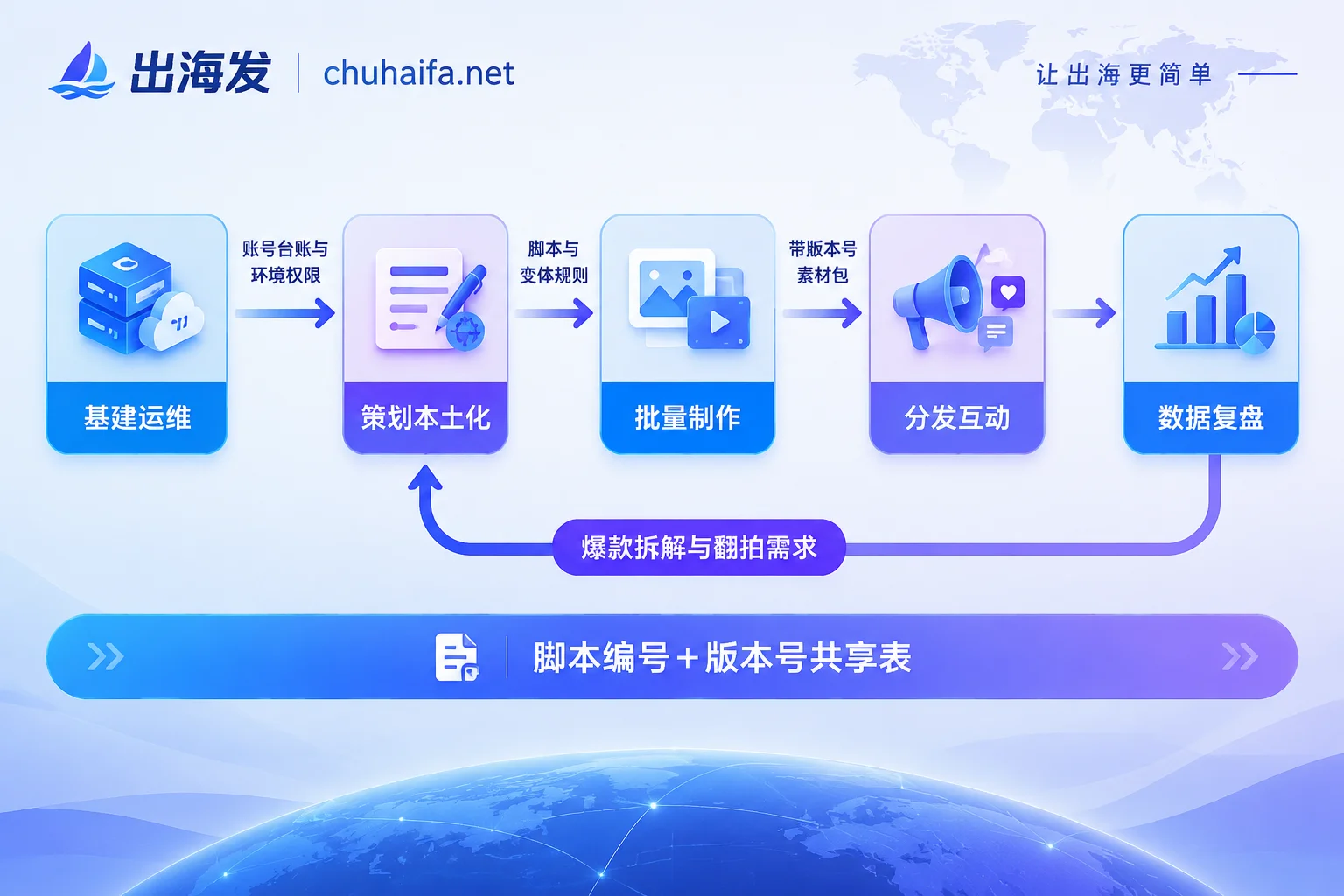
There are four handoffs between the five positions:
- Infrastructure → Distribution: Account ledger and environment permissions. Distribution staff only operate in their assigned environments.
- Planning → Production: Scripts and variation rules.
- Production → Distribution: Material packages with version numbers.
- Data → Planning: Viral breakdowns and remake requests.
The most commonly broken handoff is step 4. The team keeps producing, but no one passes data conclusions back to planning, so the matrix just piles up volume, and test accounts don't serve their testing purpose. Another common problem is that version numbers get lost during production or publishing, so during review you only know which account grew, not which version caused it.
A simple approach is to use a shared table with "script number + version number" running through the entire process, and each position fills in only their own columns.
How to Merge Positions When Short-Staffed
There is currently no unified reference standard for staffing ratios at different team sizes. Below are merging ideas based on role relevance; specifics depend on budget and number of accounts.
One person: Set up infrastructure thoroughly first, because with few accounts it's tempting to log in directly on your own computer. Planning and production are compressed using AI tools, publishing and comment replies are fixed at certain times each day, and review at least once a week. Limit the number of accounts to what you can maintain individually in isolated environments.
Two to three people:
- A: Planning + Review. The same person judges content quality, so data conclusions can be applied to the next round of scripts without handoff.
- B: Production.
- C: Infrastructure + Distribution & Engagement. All operations touching account environments are concentrated in one person, minimizing multiple people logging into the same account.
More people: Usually, environment operations are split off first, as managing the ledger and troubleshooting anomalies take up a lot of time as accounts scale. Then split distribution by account tier: the main account is handled by a dedicated person, test accounts are processed in batches. Production can be further split by language or market. When ad spend grows, consider a separate paid media role.
If the team hasn't yet set up basic accounts and tools, see What Accounts and Tools to Set Up in the First Week for an Overseas Team and fill them in dependency order.
Choose Tools Based on Roles
Once roles are divided, tool requirements become clear:
- Infrastructure role needs network egress like proxies or VPS, and an anti-detect browser. The former can be compared in the Overseas Network category, the latter in the Anti-Detect Browser category; focus on team member management, environment assignment, and proxy binding methods.
- Production role needs tools for dubbing, subtitle translation, mashup editing, digital humans, etc. Look in the AI Tools category for the missing piece.
Check official sites for features and pricing. It's recommended to first run the five-stage process end-to-end with two or three accounts before scaling up.